
A specialized data analytics recruitment agency is more than just a resume-slinger. Think of them as a strategic partner, deeply embedded in the world of data science, analytics, and engineering. They connect you with the kind of talent that doesn't just understand data but can turn it into real, measurable business growth.
Why Your Usual Hiring Methods Fall Short in Data Analytics

Let's be honest—finding truly exceptional data talent is tough. The market is white-hot, and the skills needed for today's AI, machine learning, and data science roles are incredibly specific and always changing.
Your internal HR team might be fantastic, but they probably aren't equipped to spot the subtle differences between a great data engineer and a merely good one. This is exactly where the usual hiring playbook starts to fall apart.
The Nuances Generalists Miss
General job boards will flood you with resumes, sure, but you'll spend countless hours sifting through candidates who don't have the right stuff. Generalist recruiters often fall into the same trap, getting tripped up by the technical jargon and missing the bigger picture.
A dedicated data analytics recruitment agency lives and breathes this stuff. They get the critical, make-or-break differences between roles. They know a Data Analyst building marketing attribution models has a completely different toolkit than a Data Scientist developing predictive maintenance algorithms for industrial IoT.
This kind of deep-domain knowledge is a game-changer. It means they can:
- Reach the "Unfindable" Talent: The best people are rarely looking for a job. They’re busy solving hard problems. Specialist recruiters have built genuine relationships over years and can tap into this hidden network of passive candidates.
- Screen for Business Impact, Not Just Keywords: They move past the buzzwords on a resume. Instead, they dig into a candidate's real-world problem-solving skills and their track record of driving actual business outcomes with data.
- Give You the Real Market Scoop: They know what top performers are actually earning and what it takes to get them to even consider a new role. This insight into salary benchmarks and competitive offers is priceless.
A specialized agency doesn't just fill a vacancy. They find the person who can unlock the value hidden in your data, turning it into a genuine competitive advantage. They close the gap between a technical job description and a hire who truly moves the needle.
Partnering with an expert isn't just about filling a role faster. It's about making a strategic hire that will shape your company's future. You can dive deeper into the benefits of outsourcing recruitment in our detailed guide.
Defining What You Actually Need in a Data Hire
Before you even think about picking up the phone to call a recruiter, you need an airtight, crystal-clear picture of the person you’re looking for. A vague job description is a surefire recipe for a pipeline full of mismatched candidates, and that just wastes everyone’s time. Honestly, getting this definition right is the single most important thing you can do.
Think of it like building a house. You wouldn't hire a contractor and just say, "build me something nice." You'd hand them a detailed blueprint. Your hiring plan is that blueprint, and any top-tier data analytics recruitment agency worth their salt needs it to find the perfect person for your team.
This goes way beyond just a laundry list of technical skills. It's about nailing down the role's real purpose, its day-to-day impact, and how it plugs into your company's bigger goals.
Differentiating Between Roles and Responsibilities
First things first, you need to be brutally honest about the type of data professional you need. These titles get thrown around and used interchangeably all the time, but the jobs themselves are fundamentally different. Are you looking for someone to make sense of what just happened, or someone to tell you what's going to happen next?
- Data Analyst: These are your storytellers of the past. They answer the "what happened?" question by cleaning, analyzing, and visualizing historical data. They’re the ones building out dashboards in Looker or Tableau that track the health of the business.
- Data Scientist: They live in the future. Their job is to answer "what will happen?" and "what should we do about it?" This means they're building machine learning models, running complex statistical analyses, and often wrangling messy, unstructured data.
- Data Engineer: These are the architects and plumbers. They build and maintain the data pipelines and infrastructure that everyone else relies on. Their work ensures data is clean, reliable, and accessible when the analysts and scientists need it.
A classic mistake we see all the time is a job description that reads like a wish list for all three roles. This "unicorn" candidate you're dreaming of probably doesn't exist, and if they do, you likely can't afford them. Be specific. Is the primary job analysis, prediction, or infrastructure? That clarity is what attracts real specialists.
Outlining Your Non-Negotiable Requirements
Once you’ve settled on the role, it’s time to build a scorecard of what truly matters. This isn't just a wish list; it's a hierarchy of needs. You have to separate your must-haves from your nice-to-haves and your absolute deal-breakers.
Technical Skillset
Get specific here. "Experience with Python" is useless. What you really mean is you need someone proficient with Pandas for data manipulation or Scikit-learn for machine learning. Don't just say "SQL skills"; clarify if they need to write complex window functions or know how to optimize queries on massive datasets. The details make all the difference.
Seniority and Impact
Define what "seniority" actually means at your company. A "Senior Data Analyst" at a scrappy startup might be expected to have way more strategic input than one at a massive corporation. It’s better to frame it around the outcomes you expect:
- Junior (0-2 years): Will mainly execute well-defined tasks and support the senior members of the team.
- Mid-Level (2-5 years): Should be able to own small-to-medium-sized projects independently from start to finish.
- Senior (5+ years): Is expected to lead large, ambiguous projects, mentor others, and actively contribute to the overall data strategy.
Finally, think about the person, not just the skills. Do you need a heads-down, independent problem-solver, or a super-collaborative type who thrives in team settings? Answering these questions creates that precise blueprint your recruitment partner needs to find the right people. If you need a hand structuring this, you can learn more about creating a skill gap analysis template to get all your requirements down on paper.
How to Vet and Shortlist the Right Agency Partners
Once you’ve got your hiring blueprint locked down, the real challenge begins: finding a specialist partner who gets it. The market is flooded with recruiters, and telling a true data expert from a generalist can feel impossible. You're not just looking for a resume-forwarding service; you need a data analytics recruitment agency that will operate as a genuine extension of your team.
Start by doing some online sleuthing. A great agency’s website is more than just a glossy brochure. Look for detailed case studies from companies like yours—similar in size, industry, or the specific technical problems they were solving. Written testimonials are nice, but video interviews with past clients are gold. They often give you a much better feel for how the agency actually works and what the partnership is like.
Evaluating an Agency's True Expertise
Don't get swept away by a polished sales pitch. That first call is your chance to dig deep and test their real knowledge of the data world. A generalist will ask about keywords on a job description. A specialist will want to know about your data stack, the business problems you’re wrestling with, and what you expect this new hire to achieve.
Here are a few sharp questions to help you separate the experts from the pretenders:
- On Screening: "Can you walk me through your technical screening process? How do you tell if a candidate can just write code versus actually thinking critically about our business challenges?"
- On Network Depth: "Tell me about a tough search you handled recently for a role like this. Where did you end up finding the perfect person, and what made them the one?"
- On Market Knowledge: "What are you seeing in terms of compensation trends right now for this exact skill set and seniority in our area?"
You're looking for specific, confident answers. If you hear vague talk about "our proprietary database" or "our extensive network," consider it a red flag. The right agency has recruiters who could hold their own in a conversation with your senior data scientists. Our guide on choosing the right data science staffing agency has even more tips on how to handle this evaluation.
The Power of Niche Specialization
The U.S. recruitment industry is a massive $32.1 billion market, and it’s dominated by a handful of giant firms. This is exactly why finding a niche agency is so important. With the U.S. Bureau of Labor Statistics projecting a 23% jump in data analyst jobs by 2032, you need a partner who can go beyond the generic talent pools. If you're interested in the numbers, you can explore the full industry report on ibisworld.com.
This visual flow shows the three core pillars you need to define before you even think about talking to a recruiter.
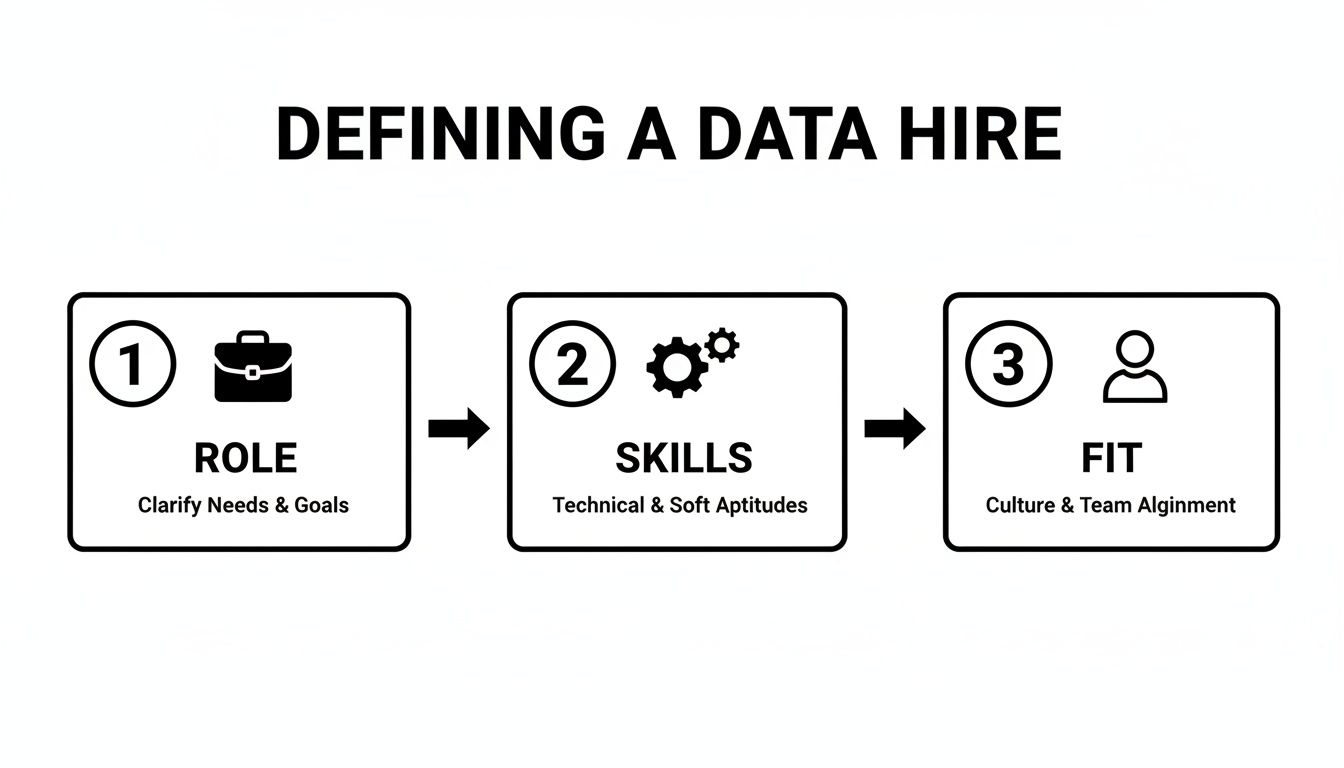
Nailing down the role's function, the essential technical skills, and the right cultural fit gives you a rock-solid foundation for the entire search.
Agency Evaluation Checklist
To keep your evaluation process consistent, use a scorecard or checklist. This helps you compare agencies apples-to-apples instead of relying on gut feelings alone. Here’s a simple framework to get you started.
| Evaluation Criteria | What to Look For | Red Flags to Watch Out For |
|---|---|---|
| Industry Specialization | Deep focus on data, AI, or analytics. Case studies with companies in your sector. | Generalist IT or tech recruiters who handle all types of roles. |
| Technical Acumen | Recruiters can discuss your tech stack (e.g., Python, SQL, Tableau) with confidence. | They only rely on keyword matching from your job description. |
| Sourcing Strategy | Clear, proactive methods beyond LinkedIn (e.g., community engagement, referrals). | Vague answers like "we have a large database." |
| Screening Process | Multi-stage process involving technical and behavioral assessments. | A simple resume review and a quick phone screen. |
| Client Communication | A dedicated point of contact. Regular, scheduled updates with clear metrics. | Sporadic communication; you're always the one chasing them for an update. |
| Market Insights | Provides real-time data on salaries, talent availability, and hiring trends. | Offers generic advice that could apply to any industry. |
| Transparency | Open about their fees, process, and candidate pipeline from the start. | Hazy on pricing, guarantees, or how they found their candidates. |
This checklist isn't exhaustive, but it provides a strong starting point for a structured and objective comparison, ensuring you find a partner who truly understands your needs.
Pro Tip: Your secret weapon is finding an agency with recruiters who have a technical background. Former data analysts or engineers who’ve moved into recruiting have an uncanny ability to size up both the hard skills and the cultural fit on a much deeper level.
In the end, your goal is to narrow the field to two or three agencies that have proven their expertise, operate with transparency, and genuinely understand what makes your business tick. This upfront diligence is what separates a frustrating hiring process from a successful long-term partnership.
Decoding Agency Pricing Models and Contracts
Let's talk about money. Navigating the financial side of working with a data analytics recruitment agency can feel a bit like reading the fine print on a new software license, but it doesn't have to be. Once you get past the jargon, it really just comes down to a few common models. Getting this right from the beginning is crucial—it prevents headaches down the road and makes sure the agency is just as invested in your success as you are.
Most of the time, you'll run into one of two main pricing structures: contingency or retainer. They each have their place, and the best choice really hinges on what kind of role you're trying to fill and how quickly you need to fill it.
Contingency Search: The "Pay-for-Performance" Model
The contingency model is the bread and butter of the recruitment world. It's straightforward: you only pay the agency's fee if you actually hire a candidate they bring to you. No hire, no fee. It’s that simple.
That fee is almost always a percentage of the candidate's first-year base salary, and you can expect it to be somewhere in the 20% to 30% range.
This model is a fantastic fit for:
- Startups and smaller businesses: When you're watching every penny, the lack of an upfront cost is a huge plus. It lets you get multiple agencies working on a role without any initial risk.
- Mid-level roles: Need a solid Data Analyst or a BI Developer? The talent pool for these positions is usually pretty healthy, so a contingency search is often more than enough to find great people.
- Taking an agency for a test drive: Think of it as a trial run. It's a low-stakes way to see how an agency performs before you commit to a more exclusive relationship.
The trade-off? A contingency recruiter is playing a numbers game. They're likely juggling a dozen roles for different clients, so your search might not always get their undivided attention, especially if it's a particularly tough one to fill.
Retained Search: The Exclusive Partnership
A retained search is a completely different animal. This is where you form a true partnership. You pay an agency an exclusive fee, and in return, they dedicate a team and serious resources to filling your role. It’s a commitment on both sides.
The fee is usually paid in chunks. A common structure is one-third to kick off the search, another third when they present you with a shortlist of vetted candidates, and the final payment when your chosen candidate signs the offer letter.
A retainer makes perfect sense when:
- You're hiring for leadership: For roles like a Head of Data Science or a Lead ML Engineer, you need someone to run a deep, exhaustive search. This is what a retained model is built for.
- The search needs to be confidential: If you're replacing a key team member or building out a new department on the quiet, a retained partner ensures total discretion.
- The skillset is incredibly niche: Looking for that rare expert with a specific blend of technical skills and industry knowledge? A retainer guarantees the agency will put in the heavy lifting required to find them.
A rock-solid contract is your best defense against a bad hire. When you consider that some studies show nearly 60% of leaders have second thoughts about their hiring decisions six months later, a well-defined agreement with clear metrics and a candidate guarantee isn't just nice to have—it's essential.
Crafting a Bulletproof Service Level Agreement (SLA)
Your contract, or Service Level Agreement (SLA), is where you turn friendly conversations into firm commitments. This document lays out the rules of the game and defines what success looks like for everyone involved. As the global staffing market surges toward a projected $650 billion, you can bet that larger companies are demanding crystal-clear analytics and performance guarantees in their contracts—and you should too. You can learn more about the global staffing market trends on somewhere.com.
A robust SLA should always nail down these key points:
- Time-to-Fill: Agree on a target number of days from when the search starts to when an offer is accepted. This keeps everyone focused and moving with urgency.
- Submission-to-Interview Ratio: This is a great metric for tracking the quality of candidates the agency is sending over. A low ratio, like 3:1, means they're not just throwing resumes at the wall; they're sending you highly relevant people.
- Guarantee Period: This is your safety net. The clause should state that if your new hire leaves or is let go within a certain period (typically 90-180 days), the agency will find a replacement for free or offer a partial refund.
Getting these terms spelled out from the start transforms your data analytics recruitment agency from a simple vendor into a genuine partner who's invested in your long-term success.
Building a Partnership That Delivers Top Talent

Signing the contract isn't the finish line; it’s just the start. The best results from a data analytics recruitment agency never come from a purely transactional relationship. They’re born from a real partnership where both sides are all-in on the outcome. To get the best from your agency, you have to be a great client.
Think of your recruiters as an extension of your company—they’re your ambassadors in a brutally competitive talent market. The more they genuinely understand your vision, your culture, and the fascinating problems your team is trying to solve, the better they can pitch your roles to top-tier candidates who have options galore.
The Feedback Loop That Speeds Up Hiring
The single biggest factor that can make or break a search is the speed and quality of your feedback. Top data talent is often off the market in just a few days. If you take a week to review a promising resume or get an interview on the calendar, you’ve already lost.
Quick, detailed feedback is a total game-changer. Don't just say a candidate is "not a fit." Tell them exactly why.
- Good Feedback: "Their SQL skills are solid, but they don't have the specific experience with customer segmentation models we need for this project."
- Bad Feedback: "Not technical enough."
This level of detail helps the agency instantly recalibrate its search, saving everyone time and leading to a much stronger candidate pipeline. It also signals that you’re serious and engaged, which naturally motivates recruiters to put your search at the top of their list.
Co-Creating Assessments That Actually Work
Technical assessments are a necessary evil, but they can also be a major turn-off for great candidates. Let's be honest, no senior data scientist wants to burn an entire weekend on a generic, time-sucking coding challenge. You need to work with your agency to design a smarter way to vet skills.
Try a more practical, collaborative approach. A short, relevant take-home assignment that mirrors a real business problem is far more effective. Even better? A live technical discussion or a pair-programming session during the interview. This gives you a real feel for their problem-solving instincts and how they think on their feet.
The goal here is to build a powerful alliance. When your agency feels like a true partner, they go beyond simply matching keywords on a resume. They become genuine advocates who can compellingly sell your company’s mission and culture to the best people out there.
This kind of collaboration is essential in a market where the right talent is so scarce. The global recruitment service market is expected to balloon to USD 680 billion by 2025, largely because of the intense demand for specialists in AI and machine learning. We’ve seen major partnerships help a single company manage over 700,000 requisitions and boost their capacity by 54%—proof that this model works. You can read the full research about recruitment market growth to see the data for yourself.
At the end of the day, treating your agency as a strategic ally ensures you not only hire the best people but also lay the groundwork for long-term retention and success.
Your Questions Answered: Partnering with a Data Analytics Recruiter
Even when you've decided a specialist recruiter is the right move, you're bound to have questions. Let's walk through some of the most common ones we hear from companies just starting their search for a dedicated data analytics recruitment agency.
How Long Does This Actually Take?
It’s the million-dollar question, and the honest answer is: it depends. The timeline hinges almost entirely on the role's seniority and how niche the required skills are.
For a mid-level Data Analyst, a sharp agency can usually get a strong shortlist of candidates in front of you within a week or two. From there, the whole dance—interviews, tech tests, offer, and acceptance—often wraps up in about 4-6 weeks.
But if you're hunting for a unicorn, like a Head of AI or a Machine Learning Engineer with a rare specialization, you need to be more patient. That's a much deeper search. For these strategic hires, it's smart to budget around 8-12 weeks. A good agency will be upfront about this from day one and bake it into your service agreement.
What Should We Expect to Pay?
Most recruitment agencies work on a few standard models, but the most common by far is the contingency fee. Simply put, you don't pay a dime until you've successfully hired someone they brought to the table.
- Contingency Fees: This is the industry standard for permanent hires. Expect a fee of 20% to 30% of the candidate's first-year base salary.
- Contractor Markups: When you need temporary help, the agency will charge an hourly or daily rate that includes their margin on top of the contractor's pay.
- Retainer Fees: For those really tough-to-fill or business-critical searches, some agencies will ask for a retainer. This is an upfront payment to secure their dedicated time and resources for your search, with the balance due upon placement.
The final percentage often comes down to things like whether you're giving the agency an exclusive search and the kind of partnership you have with them.
Where Do They Find Candidates We Can't?
This is where you get your money's worth. A top-tier agency's real power comes from its network of passive candidates. These are the pros who are excelling in their current roles, not scrolling through job boards. They're open to a move, but only for a truly compelling opportunity.
Good recruiters spend years building real relationships in the data world. They're at the conferences, they're active in the right Slack channels, and they know who the real players are at key companies. It’s a world away from just running a keyword search on LinkedIn.
Their secret weapon is access to this hidden talent pool. They have the credibility to turn a cold call into a warm conversation about a career-defining move, reaching people who would never even see your job posting.
What If Our New Hire Quits After a Month?
This is a totally valid concern, and any reputable agency will have a safety net built into their contract. Look for a guarantee or rebate period—it's non-negotiable.
This clause protects your investment. If a permanent hire leaves on their own accord within the first 3-6 months (it doesn't usually apply to layoffs), the agency is on the hook to make it right. You'll typically have two options:
- A Free Replacement: The agency will fire up a new search to find a replacement, at no additional cost to you.
- A Partial Refund: If you decide not to re-fill the role, they'll refund a portion of their fee, usually on a pro-rated basis.
Make sure the exact terms are spelled out clearly in your service level agreement before anyone starts sourcing. It provides crucial peace of mind.
Zilo AI is dedicated to connecting businesses with the skilled personnel needed to drive growth and innovation. Whether you need top-tier data professionals or high-quality data annotation services for your AI projects, we provide the talent solutions to help you succeed. Learn more about our services.