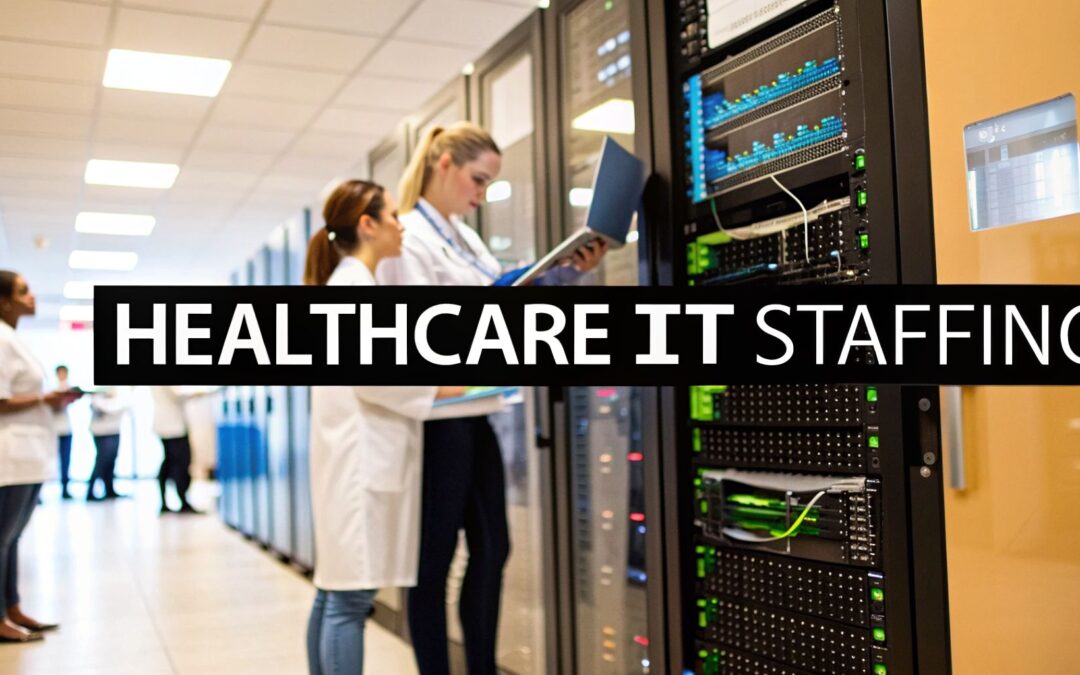
A healthcare IT staffing agency is your secret weapon for finding highly specialized technical talent. They aren't just another recruiting firm; they’re more like talent diagnosticians, connecting hospitals, clinics, and health tech companies with the precise expertise needed to solve complex clinical challenges.
What Is a Healthcare IT Staffing Agency

Let's stick with that idea of a "talent diagnostician." When a physician sees a patient, they don't just guess at a treatment; they assess the symptoms to make a precise diagnosis. A great healthcare IT staffing agency does the same for your organization's technical and operational pain points, "prescribing" the exact talent you need. This makes them fundamentally different from a general recruiter who might not grasp the critical nuances of a clinical environment.
Today’s healthcare system is built on an intricate web of technology. Everything from the electronic health records (EHR) you use every day to telehealth platforms and AI-powered diagnostic tools requires specialized IT professionals. The real challenge? Finding people who have both serious tech skills and a genuine understanding of clinical workflows and compliance.
That’s exactly where a dedicated healthcare IT staffing agency comes in. They live and breathe this world, specializing in finding, vetting, and placing the professionals who can thrive at this unique intersection of medicine and technology.
The Bridge Between Clinical Needs and Technical Solutions
It’s a common misconception that these agencies only provide temp staff for quick projects. While they’re fantastic at bringing in contract workers for a big push like an EHR migration, their services go much deeper. Many offer contract-to-hire options and direct placement for permanent roles, filling a huge range of positions from help desk support all the way to executive leadership.
At its core, a specialized agency’s job is to translate a clinical problem into a talent solution. For instance, a hospital struggling with clunky patient data entry doesn't just need an "IT person"—it needs an Epic-certified analyst who knows how to optimize clinical workflows. The agency is the one that makes that critical connection.
The value they bring is built on a foundation of deep industry knowledge. They know the difference between Cerner and Allscripts, the absolute importance of HIPAA compliance, and the specific skills needed to manage a picture archiving and communication system (PACS). This expertise allows them to:
- Hire Faster: They already have a curated network of qualified, pre-vetted candidates, which dramatically cuts down the time it takes to fill a critical role.
- Reduce Hiring Risk: Their screening process is intense. They make sure candidates have the right certifications, technical chops, and—just as importantly—the soft skills to succeed in a high-stakes clinical setting.
- Offer Strategic Flexibility: Need a full project team for a new system rollout? Or a single data scientist for a new research project? They provide flexible engagement models that fit your specific goals.
Beyond Traditional IT Roles
The work of a modern healthcare IT staffing firm has grown well beyond traditional IT support. As technology becomes more deeply woven into patient care, the roles they fill have become more specialized and have a much bigger impact.
For example, a health tech startup building a new AI diagnostic tool might need a team of clinical data annotators to accurately label medical images. A research hospital could need data engineers to build secure, compliant pipelines for sensitive patient information. A large hospital network might be searching for a clinical informatics specialist to serve as the crucial link between doctors and a software development team.
Ultimately, these agencies have become essential partners in pushing healthcare forward. By making sure organizations have the right technical talent at exactly the right time, a healthcare IT staffing agency helps improve patient outcomes, streamline operations, and build the future of medicine.
Core Services Modern Healthcare IT Agencies Provide
A great healthcare IT staffing agency does more than just fill an empty desk. They act as your strategic partner, giving you direct access to the highly specialized talent needed to run your daily operations and launch your most ambitious projects.
The services aren't a one-size-fits-all package. Instead, think of it as a menu of specific solutions designed to solve very real tech and clinical challenges. Getting to know this menu is the first step to seeing how the right partner can impact everything from patient data management to your next big AI initiative.
So, what kind of experts are we talking about? It helps to think of it like assembling a surgical team—every specialist has a critical role, and the success of the whole operation depends on each one. In health tech, these are the people who keep your systems humming, your data secure, and your innovations moving forward.
Clinical and Systems Expertise
The backbone of any modern health system is its core software. We're not talking about simple apps; these are sprawling ecosystems that touch every part of patient care. A specialized healthcare IT staffing agency connects you with the pros who know these systems cold.
Clinical Informatics Specialists: These are the crucial translators who bridge the gap between clinicians and technology. They deeply understand a doctor's or nurse's workflow and can turn those real-world needs into functional software requirements. For example, they might collaborate with developers to redesign an EHR screen, cutting down on clicks and giving clinicians back precious minutes with their patients.
EHR/EMR Specialists: These are the certified gurus for platforms like Epic, Cerner, and Meditech. They do it all—from initial implementation and major upgrades to day-to-day optimization and troubleshooting. When a hospital migrates to a new EHR, these are the folks on the ground making sure the transition is smooth, training staff, and stamping out the inevitable bugs before they disrupt patient care.
Here’s a key differentiator: a true healthcare IT staffing agency won’t just send you a general IT person. They provide talent with verified certifications for your specific systems. This means you get an expert who can hit the ground running, which is non-negotiable in a busy clinical setting.
Without these foundational roles, even the most advanced medical center would be buried in administrative chaos, struggling to manage patient information effectively.
Advanced Data and AI Teams
As healthcare leans more heavily on data, a new class of highly specialized roles has appeared. These professionals are the ones building the infrastructure that turns raw information into life-saving insights, powering analytics and training the next generation of medical AI. A forward-thinking agency is your primary source for this kind of talent.
Healthcare Data Engineers: Picture a hospital's data as water flowing from hundreds of sources—EHRs, lab machines, patient wearables, and imaging systems. Data engineers are the master plumbers. They build the secure, compliant pipelines that collect, clean, and funnel all that data into a central reservoir, like a data warehouse. This is the essential groundwork that makes any advanced analytics or machine learning even possible.
AI/ML Data Annotation Teams: An AI model is only as smart as the data it learns from. This is especially true in healthcare. An AI built to detect tumors in X-rays first needs to be trained on thousands of images where human experts have meticulously labeled every pixel of cancerous and healthy tissue. Data annotation teams, often staffed with people who have clinical backgrounds, perform this incredibly detailed work. Their precision directly impacts how accurate and reliable the final AI tool will be.
Bringing in a partner who truly understands these advanced data roles can shave months or even years off your innovation timeline. For any organization looking at data-heavy projects, finding these experts through a specialized agency is far more efficient than trying to build such a niche team from scratch. You can see how this sourcing works in practice by learning more about the role of a data science staffing agency in our detailed guide.
Ultimately, these services show how a healthcare IT staffing agency supports the entire technology spectrum—from keeping the lights on with legacy systems to pioneering the future of AI.
How Top Agencies Find and Vet Elite Health Tech Talent
Finding true experts in health tech isn't like general IT recruiting. At all. A top-tier healthcare IT staffing agency does far more than just match keywords on a resume. Think of them as running a sophisticated, multi-stage qualification process designed to take the risk out of your hiring and connect you with genuinely qualified professionals. This is what really separates a strategic partner from a simple resume service.
The best agencies start their work long before you even have a job opening. They are constantly cultivating deep, passive talent pools—networking in niche communities, keeping tabs on certifications, and building relationships. They know the best people are often not actively looking for a job but are open to the right opportunity when it comes along.
This proactive approach is a world away from reactive recruiting, where the search only begins when a need becomes urgent. By having an established network, an agency can slash the time it takes to find the right person, which is a massive advantage when a project deadline is looming or a critical system goes down.
Sourcing Beyond the Job Boards
Job boards have their place, but they're just the starting point. Specialized agencies dig much deeper, using a mix of channels to find top-tier candidates who aren't browsing public listings. This usually involves:
- Proprietary Databases: These are curated lists of pre-vetted professionals with specific skills, like experience with a particular EHR module or a rare certification.
- Industry Conferences and Events: Recruiters are on the ground at major events like HIMSS, meeting talent and getting a feel for who the real experts are.
- Referral Networks: They tap into their relationships with trusted industry veterans who can point them toward proven colleagues.
It's also worth noting how they use professional platforms. For a closer look at modern sourcing, an article like 7 Ways Recruitment Firms And Large Organizations Can Use Linkedin Recruiter To Hire The Best Talents shows how experts pinpoint candidates with hyper-specific skills, such as "Cerner Revenue Cycle certification," filtering out the noise.
The diagram below shows how this process works in practice, from foundational systems to advanced AI.

As you can see, the approach has to be tailored, whether you're staffing for core system support or a complex AI initiative.
The Multi-Stage Vetting Process
Once a promising candidate is found, the real evaluation begins. This is where a specialized agency truly earns its keep, ensuring a candidate has the technical chops, regulatory know-how, and right temperament for a healthcare environment.
Think about the difference between finding a general IT analyst versus a certified Cerner Millennium analyst. The second role demands a much more rigorous and specific screening. A specialized agency’s vetting would cover:
Credential Verification: They don’t just take a certification at face value. The agency actively confirms that credentials from Epic, Cerner, and other major vendors are valid and current. It’s a crucial first step for compliance.
Technical Assessments: Candidates face real-world skills tests. This might be a simulated troubleshooting scenario for a PACS administrator or a coding challenge for a healthcare data engineer to prove they can actually do the job.
Compliance Screening: Every single candidate is screened for their knowledge of HIPAA and HITECH regulations. Good agencies often require mandatory compliance training to make sure every contractor understands their duties when handling protected health information (PHI).
Soft Skill Evaluation: In healthcare, people skills are non-negotiable. The agency assesses a candidate’s ability to communicate clearly with clinicians, perform under pressure, and work as part of a team in a high-stakes setting.
The whole point of this meticulous process is to deliver someone who can contribute from day one. You get a professional who already understands the unique pressures and protocols of a clinical environment, not just a technician.
By handling this deep vetting, a healthcare IT staffing agency provides something much more valuable than a person—it delivers confidence. They do all the exhaustive screening so your team can stay focused on what really matters: delivering excellent care.
4. Navigating Staffing Models and Pricing
So, you've decided a healthcare IT staffing agency is the right move. That’s a great first step. But now comes the real strategic choice: which engagement model makes the most sense for you? Getting this right is crucial for keeping your talent strategy aligned with your budget and project deadlines.
Think of it like this: you wouldn’t rent a moving truck for a quick trip across town, and you wouldn't call a rideshare to move your entire house. Each staffing model is a different tool for a different job. Picking the right one means you get the results you need without overspending or creating unnecessary headaches.
Most agencies offer three core models: contract staffing, contract-to-hire, and direct placement. Let's dig into how each one works so you can decide which fits your situation best.
Contract Staffing for Project-Based Needs
Contract staffing is your go-to for flexibility. It’s built for projects with a clear beginning and end. Need to scale up fast for an EHR migration, a system upgrade, or a complex data project? This is your answer, allowing you to bring in expertise without bloating your permanent headcount.
In this model, the agency handles everything—finding, vetting, and employing the professional. You simply pay an all-inclusive hourly rate for the consultant's time. That rate covers their wages, benefits, payroll taxes, and the agency’s fee. It's clean and straightforward.
- Best For: Short-term projects, filling in for an employee on leave, or accessing a very specific skill set for a limited time.
- Pricing: A set hourly bill rate. You only pay for the hours worked, which makes budgeting for projects incredibly predictable.
- Key Benefit: Maximum flexibility. You get top-tier talent precisely when you need it and can scale back down the moment a project wraps up.
This approach is a lifesaver for healthcare organizations dealing with fluctuating workloads or one-off tech implementations. It gives you immediate access to specialized skills without the long-term overhead of a full-time hire.
Contract-to-Hire for a Trial Period
The contract-to-hire model is essentially a "try-before-you-buy" option. It's a brilliant way to see how a candidate performs on the job—assessing their technical skills, how they mesh with your team culture, and their overall work ethic—before you commit to a permanent offer. Honestly, it’s one of the best ways to de-risk a new hire.
Here’s how it works: the engagement starts as a typical contract, usually for three to six months. During that time, the professional is on the agency's payroll. If everyone agrees it's a great fit, you can seamlessly convert them to a full-time employee on your own team.
The contract-to-hire model is your best defense against a bad hire. The real cost of a hiring mistake is staggering—some studies pin it at 30% of the employee’s first-year salary. This model provides a vital evaluation window to make sure you're making a sound long-term investment.
Direct Placement for Permanent Roles
When you have a critical, long-term role to fill, direct placement is the way to go. This model is designed for hiring permanent staff, especially for senior leadership positions or roles that demand a rare combination of skills that are tough to find on your own.
In a direct placement scenario, the healthcare IT staffing agency becomes an extension of your recruitment team. They run the entire process, from sourcing and screening candidates to helping negotiate the final offer. Once you make the hire, that person is your employee from day one. For this comprehensive service, the agency charges a one-time fee.
- Best For: Filling permanent positions, from mid-level specialists all the way up to the C-suite.
- Pricing: A percentage of the candidate’s first-year salary, which is typically paid only after the person has been successfully hired.
- Key Benefit: Expert-led recruitment. You tap into the agency’s extensive network and proven vetting process to land the absolute best person for a crucial role.
Comparing Healthcare IT Staffing Engagement Models
To make the choice even clearer, this table breaks down the three primary engagement models. Use it to quickly compare which option aligns best with your project duration, budget, and long-term hiring goals.
| Engagement Model | Best For | Pricing Structure | Key Benefit |
|---|---|---|---|
| Contract Staffing | Short-term projects (3-12 months), specific initiatives, or covering employee leave. | Hourly bill rate. You pay only for the hours worked. | Flexibility. Scale your team up or down on demand. |
| Contract-to-Hire | "Try-before-you-buy" scenarios to test skills and cultural fit before a permanent offer. | Hourly bill rate during the contract period, with a conversion fee. | Reduced Risk. Ensures a candidate is the right long-term fit. |
| Direct Placement | Filling critical, permanent roles, especially senior or highly specialized positions. | One-time fee, calculated as a percentage of the new hire's first-year salary. | Expert Sourcing. Access to a deep talent pool for vital roles. |
Ultimately, there's no single "best" model—only the one that’s best for your immediate need. A good staffing partner will work with you to understand your goals and recommend the engagement structure that delivers the most value for your organization.
How to Choose the Right Staffing Partner

Picking a healthcare IT staffing agency isn’t just another vendor contract. It’s a strategic choice that has real-world consequences for your projects, your compliance, and ultimately, your patients. To find a true partner, you have to look past the slick sales presentations and really dig into the capabilities that make a difference.
Think of it this way: you wouldn't ask a family doctor to perform open-heart surgery. You’d find a top cardiac surgeon with years of specialized experience. The same logic applies here. You need a staffing firm that lives and breathes healthcare IT, not a generalist recruiter who just happens to have a few tech resumes on hand.
The right agency becomes an extension of your own team because they already understand your world. They don’t just fill an empty chair; they provide a vetted expert who can contribute from day one. That means it's on you to do the homework and separate the real experts from the pretenders.
Look for Deep Healthcare Roots
Your first and most important filter should be industry specialization. Sure, a generic IT firm can probably find a network engineer. But can they find one who intuitively understands the security protocols for handling protected health information (PHI)? That’s where a specialist is non-negotiable.
You’re looking for a firm whose entire business is built around healthcare. Their recruiters should speak your language, knowing the difference between Epic and Cerner, the critical role of HL7 interfaces, and the day-to-day pressures of a clinical environment. That deep-seated focus is what allows them to find people who have the right technical skills and the right industry context.
A partner with this kind of experience already has a network of professionals who have worked in hospitals, clinics, and health tech companies. That’s a huge head start, saving you from having to give new hires a crash course in medical terminology or HIPAA 101. It's also worth getting familiar with the different types of IT recruiting agencies to know what they can truly offer.
Dig Into Their Talent Pool and Sourcing Methods
A great sales pitch is worthless if the agency can’t actually deliver the right people. When you’re evaluating a potential partner, you need to get concrete answers about the depth and quality of their talent pool. A premier healthcare IT staffing agency won’t shy away from tough questions about how they find their candidates.
Don't be afraid to get granular. Ask them to walk you through their step-by-step process for sourcing a candidate with a rare, in-demand certification. How they answer that question will tell you everything you need to know about their proactivity and expertise.
A key sign of a top-tier agency is a well-nurtured network of passive candidates. These are the highly skilled pros who are already employed but might be open to the perfect opportunity. Firms that build these relationships can bring you better talent, much faster, than those who just post on job boards and hope for the best.
Don’t Skimp on Compliance and Vetting
In healthcare, compliance isn't just a box to check—it's the bedrock of trust. One slip-up can lead to crippling fines and a damaged reputation. That means your staffing partner's approach to compliance has to be absolutely airtight.
This is about much more than a simple background check. A reliable partner will have a documented process to ensure every single consultant understands and follows regulations like HIPAA and HITECH. They should be able to show you how they provide mandatory training and verify that a candidate's certifications are current and legitimate.
Worker misclassification is another huge landmine. Calling someone an independent contractor when they legally qualify as an employee can expose you to massive liability—one medical staffing firm was recently hit with a $9.3 million judgment for this. A trustworthy agency will be transparent about their employment practices and have protections, like strong indemnification clauses, to shield you from joint-employer risk.
A Checklist for Interviewing Potential Agencies
To help you get past the surface-level chatter, here is a checklist of direct questions to ask any potential healthcare IT staffing agency. Their answers will reveal their true capabilities.
1. Industry & Technical Expertise:
- "Describe your process for validating a candidate’s Epic or Cerner certifications."
- "Walk me through a time you filled a highly specialized role, like a clinical informatics specialist. Where did you find them?"
- "How does your recruiting team stay current on emerging health tech trends and new system versions?"
2. Sourcing & Speed:
- "Let's say we have a niche role with a two-week deadline. What's your sourcing strategy?"
- "What percentage of your placements come from your existing network versus active sourcing from job boards?"
- "Can you share a few case studies of projects similar to ours in size and scope?"
3. Compliance & Vetting:
- "What specific HIPAA training do you require for all your consultants before they start?"
- "How do you ensure your worker classification practices are compliant with FLSA and IRS standards?"
- "Can you show me your process for conducting technical assessments and soft-skill interviews for clinical-facing roles?"
Using this framework will help you move beyond the sales pitch and find a healthcare IT staffing agency that can be a genuine, long-term partner in your success.
The Future of Health Tech Staffing in an AI-Driven World
The world of health tech is moving at a breakneck pace, and any healthcare it staffing agency that isn't thinking about Artificial Intelligence is already behind. The future isn't just about filling the new jobs AI creates; it's about using AI to build smarter, faster, and more precise talent pipelines.
What we're seeing on the ground is that AI plays a fascinating dual role. On one hand, it's creating an explosion of demand for highly specialized experts in roles that barely existed a few years ago. We’re talking about AI model trainers, clinical data annotators, and machine learning engineers who live and breathe medical algorithms. These are the people building the next generation of diagnostic tools that will save lives.
On the other hand, the smartest agencies are using AI to sharpen their own recruiting game. Imagine using AI to accurately forecast workforce needs, automate the painstaking process of credential verification, or match a candidate’s deep skills to a role with incredible accuracy. As AI reshapes operations, understanding how tools like chatbots for IT support are changing daily workflows is becoming crucial for any modern healthcare it staffing agency.
The Rise of Specialized and Global Talent
As AI becomes more woven into the fabric of patient care, one thing has become crystal clear: an AI model is only as good as the data you feed it. This simple fact has created a surge in demand for new, highly specific services that a forward-thinking healthcare it staffing agency absolutely must be able to deliver.
A perfect example is the skyrocketing need for multilingual AI data annotation. To build AI tools that work for everyone—not just a single demographic—they must be trained on data from diverse patient populations. This requires teams of annotators who are not only clinically savvy but also fluent in multiple languages.
This new reality demands a completely different approach to finding talent. The key services defining the future include:
- Multilingual Data Annotation Teams: Assembling experts who can precisely label and validate clinical data across different languages, which is essential for reducing bias in AI models.
- Global Talent Sourcing: Looking beyond local markets to find the absolute best specialists for remote-first roles, whether they’re in North America, Europe, or Asia.
- AI-Powered Vetting: Using intelligent screening tools to rapidly verify specific technical skills and certifications, drastically shortening the hiring timeline without a single compromise on quality.
Strong partnerships are also becoming more critical than ever. For any organization trying to scale up its AI initiatives, finding a single provider that truly gets both staffing and data services is a massive win. You can get a much clearer picture of how these integrated services work by exploring specialized AI staffing solutions.
Ultimately, the future belongs to the agencies that adapt. It’s no longer enough to just find talent; you have to supply the new wave of AI experts while embracing AI to perfect your own processes. This blend of seasoned human expertise and smart technology is what will define the next chapter for every leading healthcare it staffing agency.
Frequently Asked Questions
Even with a clear understanding of the benefits, you probably still have a few practical questions. It's completely normal. Let's walk through some of the most common concerns that come up when organizations consider partnering with a healthcare IT staffing agency.
Is It More Expensive Than Hiring Directly?
On the surface, it might seem that way, but when you look at the total cost, an agency is almost always more cost-effective. Many leaders forget to account for the hidden, time-consuming costs of direct hiring—things like advertising fees, the countless hours your team spends sifting through resumes, and the painful financial hit of a bad hire, which can easily cost 30% of that person's first-year salary.
A good agency has already absorbed those recruitment costs. They also dramatically lower your risk of a mismatch. By bringing you pre-vetted, genuinely qualified people from the get-go, they help you avoid project delays and productivity slumps, which delivers a much stronger return in the long run.
How Quickly Can an Agency Fill a Role?
This is where agencies truly shine. They aren’t starting from a standstill. A specialized agency is constantly curating its network of both active and passive candidates, so they have a pipeline ready to go.
For a role like an EHR specialist or a clinical help desk technician, they can often have qualified candidates for you to review in a matter of days, not the weeks or months it can take to source someone from scratch. This speed is a game-changer when you're facing a tight project deadline or need to backfill a critical role unexpectedly.
The right healthcare IT staffing agency acts as a force multiplier for your talent acquisition team. They aren't replacing your internal efforts; they are augmenting them with specialized market access and speed, ensuring you never miss a beat on critical technology initiatives.
What Kind of ROI Can I Expect?
The return on your investment goes far beyond just filling an empty chair. It’s about tangible business outcomes. Think about it in these three key areas:
- Project Acceleration: Getting the right experts on board at the right time is the difference between a project that finishes on schedule and one that spirals over budget. This keeps your EHR migrations, system upgrades, and data initiatives on track.
- Reduced Compliance Risk: Top-tier agencies are sticklers for compliance. Their rigorous vetting for HIPAA knowledge and proper worker classification helps shield you from costly fines and legal headaches.
- Improved Clinical Operations: When you place a skilled clinical informatics specialist, you're not just filling a role. You're directly enabling optimized workflows that give clinicians more time to focus on what matters most: patient care.
Ultimately, the ROI is measured in successful projects, stable operations, and peace of mind.
Ready to find the specialized healthcare IT talent that can drive your projects forward? Zilo AI connects you with highly skilled, vetted professionals and offers robust data services to support your AI initiatives. Discover our manpower and data solutions.