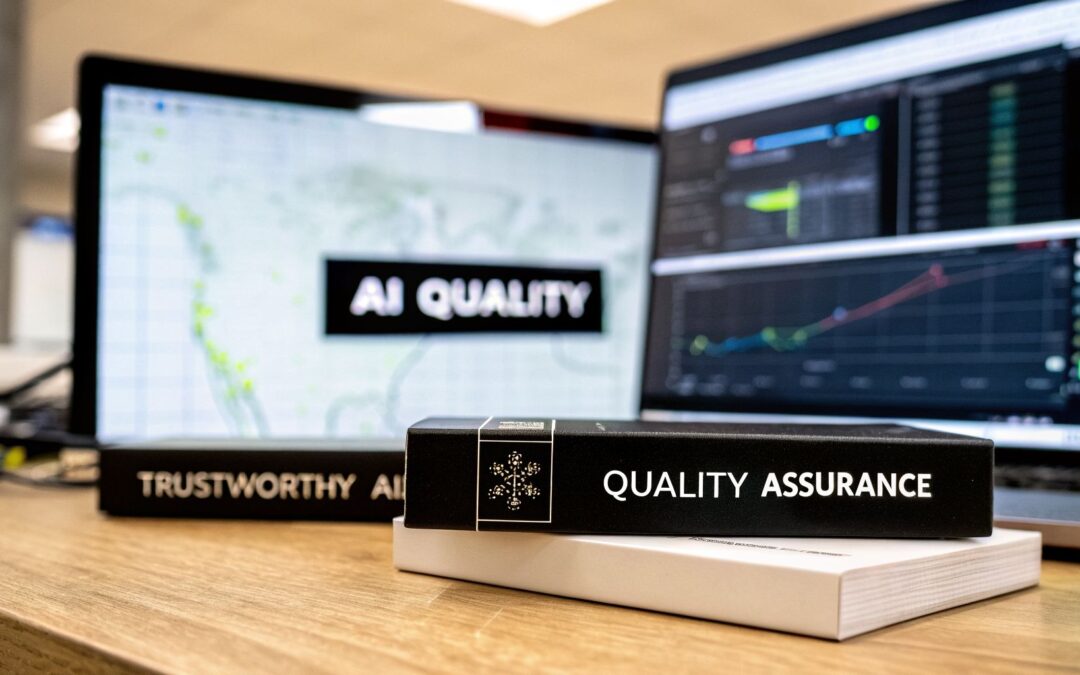
AI quality assurance is all about making sure your artificial intelligence systems actually work—and work well—in the real world. This isn't your classic software testing. We're moving past just checking for bugs and instead focusing on the unique, often unpredictable, nature of AI.
The core challenge is that AI models aren't static. They learn, they evolve, and they can degrade over time. So, AI QA is the continuous process of verifying their reliability, accuracy, fairness, and robustness.
Why AI Quality Assurance Is Your New Competitive Edge
It’s helpful to think about the difference between traditional and AI testing. Testing a normal piece of software is like inspecting a car on an assembly line; you check if every part is identical and functions exactly as designed. It’s predictable.
AI quality assurance, on the other hand, is more like training a new driver. You’ve given them the rules of the road, but you need to constantly monitor their performance, correct their mistakes, and ensure they don’t develop bad habits or biases. The system learns and adapts, which means it can surprise you. This is why AI QA isn't just a technical task—it's a critical business strategy.
To really get a handle on this, it's useful to break down the core components of a modern AI QA strategy.
Core Pillars of Modern AI Quality Assurance
| Pillar | Focus Area | Key Objective |
|---|---|---|
| Data Quality | Training, validation, and testing datasets | Ensure data is accurate, relevant, complete, and free from biases that could skew model behavior. |
| Model Performance | Predictive accuracy, precision, recall, F1-score | Validate that the model meets performance benchmarks and delivers reliable, consistent results. |
| Robustness & Security | Adversarial attacks, edge cases, data drift | Test the model's resilience against unexpected inputs and changing real-world conditions. |
| Fairness & Ethics | Algorithmic bias, explainability (XAI) | Prevent discriminatory outcomes and ensure the model's decisions are transparent and defensible. |
These pillars form the foundation for building AI systems that people can actually trust.
Mitigating Critical Business Risks
Without a solid AI QA framework, you're essentially flying blind. A flawed model can spiral into a public relations disaster, cause significant financial loss, or erode customer trust in an instant. The real goal of AI quality assurance is to get ahead of these problems.
Here are the big risks you’re actively managing:
- Algorithmic Bias: This is a huge one. AI QA works to ensure your model doesn’t favor one demographic over another, which can lead to legal nightmares and alienate huge segments of your user base.
- Performance Failures: You want to avoid becoming the next embarrassing headline. Think of a chatbot spewing nonsense or an image recognition tool making offensive classifications. Proper testing catches these failures before your customers do.
- Financial Impact: Inaccurate models have real-world costs. Whether it’s a faulty fraud detection system or a flawed demand forecast, bad predictions can directly drain your bottom line.
"For business leaders, the pressing question isn’t whether to modernize QA with new technologies but how quickly and strategically it can be done. Standing still means falling behind in release velocity and customer experience."
Shifting to this proactive mindset turns QA from a simple cost center into a genuine source of business value. If you're looking for a deeper dive on how to make this shift, you can learn how to integrate AI into your quality assurance strategy effectively.
Driving ROI and Gaining a Market Advantage
The numbers don't lie. The global AI Quality Assurance market was valued at $2.45 billion in 2023 and is expected to explode to $18.7 billion by 2030. This isn't just hype; it's a clear signal that companies are scrambling to build reliable AI as regulators and customers demand better performance.
For any company, from a nimble startup to a large enterprise, making AI quality a priority is how you win. A dependable, well-vetted AI system leads directly to tangible benefits:
- Increased Customer Trust: People are far more willing to use and stick with a product that is consistent, fair, and just plain works.
- Enhanced ROI: When your models are reliable, they produce accurate insights. This leads to smarter business decisions, streamlined operations, and better financial outcomes.
- Faster Innovation: Once you have a rock-solid QA process in place, your team can build and deploy new AI features with confidence, getting you to market much faster.
In the end, great AI quality assurance is what separates the lasting, successful AI products from the cautionary tales.
Mastering Data-Centric And Model-Centric QA
When it comes to building high-performing AI, quality assurance isn't a single activity—it’s a mindset built on two complementary pillars: the data-centric and model-centric approaches. These aren't an either/or choice. In reality, they're two sides of the same coin, and truly great AI systems master both.
Think of it like training a world-class athlete. The data-centric approach is the nutrition, sleep, and conditioning plan—the raw fuel and foundation. The model-centric approach is the specific coaching and technique refinement for their sport. You can't have a champion without both.
This is where the real work begins, and getting the data right is the single most critical factor for building an AI you can trust.
The Data-Centric Approach: The Ingredients For Success
In a data-centric world, your primary obsession is the quality of your data. This is about treating your datasets not as a resource to be consumed, but as a product to be perfected. No matter how brilliant your algorithm is, it can't overcome the limitations of flawed, biased, or messy data.
This is where teams often spend the bulk of their time because improvements here deliver an outsized return on the final model’s performance. The core work involves:
- Rigorous Data Validation: Scrutinizing datasets for accuracy, completeness, and consistency. Are the labels correct? Is the formatting consistent? Are there gaps?
- Strategic Data Cleansing: Proactively finding and fixing or removing errors, duplicates, and irrelevant information that could throw your model off track.
- Intelligent Data Augmentation: Artificially expanding your dataset by creating modified copies of existing data. This exposes the model to more variations and helps it perform better in real-world scenarios.
A data-centric philosophy means you treat your data like a product. It needs constant iteration, version control, and a relentless focus on quality, just like any other mission-critical asset in your business.
Building a solid foundation with top-tier data is non-negotiable. For any team looking to scale their AI initiatives, our guide on sourcing high-quality AI training data breaks down the essential steps. Zilo AI’s expert annotation and workforce services ensure your data is flawlessly labeled and validated from day one, giving your models the pristine fuel they need to excel.
The map below shows just how a strong AI QA process, rooted in a data-centric foundation, becomes a core driver of business strategy.

As you can see, robust AI QA is far more than a technical checkbox; it's a strategic advantage that helps you mitigate risk and outmaneuver the competition.
The Model-Centric Approach: Perfecting The Recipe
Once you're confident in your data, the spotlight shifts to the model itself. The model-centric approach is about refining your algorithm to unlock the full potential of the high-quality data you've prepared. If data is the ingredients, this is where you perfect the recipe.
This has traditionally been the main focus for data science teams—endless cycles of tweaking and tuning the model’s architecture and parameters.
Here, you're fine-tuning the "engine" of your AI system. Key activities in a model-centric QA process include:
- Algorithm Selection: Carefully choosing the right kind of model—like a neural network, gradient-boosted tree, or other architecture—that best fits the problem you're trying to solve.
- Architecture Refinement: Adjusting the internal structure of the model, such as the number of layers or neurons, to improve its ability to learn complex patterns without becoming inefficient.
- Hyperparameter Tuning: Systematically experimenting with the model's configuration settings (like learning rate or batch size) to find the perfect combination that yields the most accurate and reliable results.
In the end, you can't pick one approach and ignore the other. The most sophisticated model in the world will fail if fed poor-quality data. Likewise, a perfect dataset is useless if the algorithm is poorly chosen or badly tuned. True AI quality assurance is born from this synergy—pairing a pristine, expertly managed dataset with a meticulously tuned and validated model. This is the secret to building AI that is not only powerful but also trustworthy.
Your Toolkit of Essential AI Testing Strategies
Once you understand the difference between data-centric and model-centric QA, it’s time to fill your toolkit with practical testing strategies. Testing AI isn't like testing traditional software, which is often predictable. AI quality assurance is a whole different ballgame—it's dynamic and requires a multi-layered approach. You’re not just checking if the AI works, but also how it holds up under pressure and if it can be easily fooled.
Let's stick with our example: an AI built to identify dog breeds from images. To get it ready for the real world, we need a set of core testing strategies that go way beyond simple accuracy checks.

Functional Testing The Core Logic
First on the list is functional testing. This is your ground truth. It answers one fundamental question: does the AI actually do what we built it to do? It's the most straightforward way to confirm the model's basic logic is sound and its predictions are accurate under normal conditions.
For our dog breed classifier, this means feeding it a massive and varied set of high-quality, labeled images.
- Positive Test Cases: We show it a picture of a Golden Retriever. Does it correctly identify it as a "Golden Retriever"? We'll do this across thousands of validated images to establish a baseline for accuracy.
- Negative Test Cases: What happens if we upload a picture of a cat or a car? The model should confidently say "not a dog" or give extremely low probability scores to all dog breeds.
- Edge Case Testing: This is where we get tricky. We'll test with blurry photos, dogs partially hidden by a fence, or images of very rare breeds to see how it handles less-than-perfect inputs.
This stage is absolutely foundational. If a model can't pass these basic tests, there's no sense in moving on to more complex evaluations. For really nuanced situations, human-in-the-loop machine learning is often the key to properly validating these tricky cases.
Performance Testing Under Pressure
Okay, so we know the model can do the job. But can it do it at scale? That's where performance testing comes in. This is all about measuring the model’s speed, scalability, and resource usage when it's under a heavy workload. A model that takes ten seconds to identify a single photo just won’t cut it for a real-time app.
With our dog breed AI, we’d run several key performance tests:
- Load Testing: We'll simulate thousands of users uploading images all at once. We need to measure the response time (latency) to make sure it doesn’t crawl to a halt.
- Stress Testing: We intentionally push the system past its expected limits to find its breaking point. This helps us understand its boundaries and ensure it fails gracefully instead of crashing the whole system.
- Efficiency Testing: How much CPU, GPU, or memory does the model gobble up for each prediction? This is critical for keeping operational costs in check, especially when you're deployed on the cloud.
Adversarial Testing Protecting Against Deception
Now for the really interesting part. Adversarial testing is a security-focused discipline where you actively try to trick your own model. Deep learning models can be surprisingly fragile and vulnerable to tiny, almost invisible changes in input data.
An adversarial attack might involve altering just a few pixels in a picture of a panda. To the human eye, it's still clearly a panda, but a top-tier model might suddenly classify it as a gibbon with over 99% confidence. This reveals a massive vulnerability that standard testing would completely miss.
In our dog classifier example, an adversarial test could mean subtly tweaking an image of a Labrador to make the model misclassify it as an ostrich. By finding these weak spots ourselves, we can retrain the model on these tricky examples. This makes it far more robust and secure against anyone trying to exploit it maliciously. As you build out your toolkit, it's worth looking into how an AI QA agent can help automate and improve this process.
Leveraging AI For Smarter Automation
Finally, one of the biggest shifts in AI quality assurance is the practice of using AI to test other AI. The use of AI-driven testing tools has exploded, with 67% of organizations now incorporating them into their QA workflows. These tools aren't just hype; AI-powered visual testing can increase test coverage by up to 90% over manual methods, and self-healing scripts can cut down on maintenance time by 70%. You can dive deeper into these trends by exploring AI quality assurance adoption from recent reports.
These intelligent systems can analyze your application, automatically generate smarter test cases, find bugs faster, and even predict which parts of your code are most at risk. This speeds up development and lets your QA team focus on the creative, complex testing that humans do best—giving you a serious strategic advantage.
Measuring What Matters for AI Model Performance
How do you know if your AI model is actually working? Without the right metrics, you’re essentially flying blind. To really nail ai quality assurance, you have to measure what truly matters, and that means looking far beyond simple accuracy.
Just knowing how often a model gets something "right" can be a trap. It doesn't tell the whole story. We need to pop the hood and examine the Key Performance Indicators (KPIs) that show how the model behaves in the real world. These technical scores are what connect your algorithm's code to real business results—like better efficiency, happier customers, or lower risk.
Beyond Accuracy With Precision and Recall
Let's break down three of the most important metrics with a simple analogy: a spam filter. Imagine you've built a new AI-powered filter that boasts 99% accuracy. Sounds great on paper, right? But what does that number really hide? This is where precision and recall come in to give you the full picture.
Precision: This asks, "Of all the emails we flagged as spam, how many were actually spam?" High precision means that when your filter marks an email as junk, it's almost certainly correct. If precision is low, you'll find important client emails and invoices sitting in the spam folder, which is a recipe for disaster.
Recall: This asks a different but equally important question: "Of all the spam that hit our servers, how much did we actually catch?" High recall means your filter is a great detective, finding the vast majority of junk mail. If recall is low, your users' inboxes will be flooded with spam, leading to frustration and a poor user experience.
You'll quickly find that these two metrics are often in a tug-of-war. Tune your filter for extremely high precision, and you might let some sneaky spam messages slip through (lower recall). Go for aggressive, high recall, and you risk misclassifying legitimate emails (lower precision).
Finding The Balance With F1-Score
So, how do you find a healthy middle ground? That's exactly what the F1-score is for. It calculates the harmonic mean of precision and recall, rolling them into a single, balanced score. A high F1-score tells you the model is doing a good job of being both accurate and thorough.
The key is knowing which metric to prioritize for your specific goal.
- For a medical AI that spots signs of cancer, recall is everything. You'd much rather have a few false alarms (flagging a healthy patient for a second look) than miss even a single real case.
- For an AI that recommends shows on Netflix, precision matters more. You want the recommendations to be spot-on, even if that means the AI doesn't suggest every single movie the user might possibly like.
An AI quality assurance strategy isn't about chasing a perfect score on one metric. It's about consciously choosing the right metric for the problem you're solving and understanding the business implications of that choice.
Measuring Fairness To Prevent Bias
Beyond raw performance, we have to measure fairness. A model can be incredibly accurate and still produce biased or discriminatory results that can damage your brand and create serious legal risks. Fairness metrics are designed specifically to spot and quantify this kind of algorithmic bias.
Common fairness metrics include:
- Demographic Parity: This checks if positive outcomes (like getting a loan approved) are distributed evenly across different groups (e.g., based on age, race, or gender).
- Equal Opportunity: This ensures the model performs equally well for all groups when it comes to catching true positives. For instance, is the model just as good at identifying qualified candidates from all demographic backgrounds?
- Predictive Equality: This verifies that the model's error rates, especially false positives, are consistent across different groups. You want to ensure one group isn't being unfairly penalized by mistakes more often than another.
Finding bias is the first step. Fixing it is the next. This usually means circling back to your data. At Zilo AI, our expert manpower services are a perfect fit for this critical work. Our teams can meticulously review, re-label, and supplement your datasets to correct the imbalances discovered during testing. This ensures your AI is not just powerful, but also fair and trustworthy for everyone.
Building Your Framework for AI Governance and Monitoring

Getting an AI model into production feels like crossing the finish line, but it’s really just the start of the race. The intense work of training and testing is over, but now the real job begins: making sure that model continues to deliver value, day in and day out. This is where AI governance and ongoing monitoring come into play, forming the backbone of your ai quality assurance efforts.
AI governance is essentially the flight plan for your model. It's the set of rules that dictates how your AI should behave out in the real world, ensuring it operates ethically, transparently, and legally. Flying without it is more than just risky—it can damage your brand and expose your company to serious legal trouble.
Establishing Clear Governance Policies
A solid AI governance framework isn't just a document; it's the constitution for all your AI systems. It’s built from a handful of clear, actionable principles that guide how your organization will responsibly develop, deploy, and manage AI.
It all starts with a few key commitments:
- Ethical Guidelines: This is where you draw your lines in the sand. Define what your AI will and will not be used for, with clear commitments to fairness and preventing harm.
- Regulatory Compliance: Your models must live within the law. This means staying on top of existing rules like GDPR and HIPAA, as well as preparing for new AI-specific regulations.
- Accountability and Ownership: When a model makes a decision, someone has to be accountable. Clearly map out who is responsible for the AI’s performance, from the engineers who built it to the business leaders who own the outcome.
Setting these rules before a model goes live is crucial. It helps you avoid panicked, reactive fixes when something inevitably goes sideways. To get started building your own robust framework, check out our guide on data governance best practices.
Monitoring for Model Drift and Performance Degradation
Once your AI is live, it’s interacting with a world that never stands still. New data streams, changing user behaviors, and unexpected global events can all cause a model’s accuracy and relevance to fade over time. We call this model drift, and it’s one of the biggest silent killers of AI ROI.
You wouldn't want a pilot to only check their instruments during takeoff and then hope for the best. Continuous monitoring is like that pilot running constant system checks throughout the flight. You need to be just as vigilant with your AI.
Effective AI monitoring is about creating an early warning system. It allows you to detect subtle drops in performance or shifts in data patterns before they escalate into critical business problems.
This is where you see the real economic sense in ai quality assurance. The market for AI governance alone is expected to jump from $890 million in 2024 to $5.8 billion by 2029. Why? Because reliable systems lead to tangible results, like 25% better compliance and a 30% lift in customer trust. For a closer look at these trends, you can discover more insights about QA and governance growth.
The Importance of Explainability and Audits
A huge piece of the governance puzzle is explainability (XAI). When your model makes a high-stakes decision—like declining a loan application or flagging a medical image—you absolutely must be able to answer the question, "Why?" Explainability tools pull back the curtain on the "black box," making your AI models auditable, transparent, and worthy of trust.
This isn’t just a nice-to-have technical feature; it’s a business imperative. With auditable models, you can:
- Justify Decisions: Confidently explain outcomes to customers, regulators, and internal stakeholders.
- Debug More Effectively: Quickly find the source of an error or a biased output.
- Build User Trust: Prove to your users that your AI is making decisions based on sound and fair logic.
This is an area where Zilo AI's manpower services can be a game-changer. Our expert teams can step in as human auditors, meticulously reviewing model outputs and flagged predictions. They verify that the AI’s choices align with your fairness standards and governance policies, providing the critical human oversight needed to protect your investment and build a reputation for quality.
Frequently Asked Questions About AI Quality Assurance
As you start putting ai quality assurance into practice, a lot of questions are bound to pop up. Let's tackle some of the most common ones that teams run into when moving from theory to real-world application.
What Is The First Step To Implementing An AI QA Strategy?
Your very first move should be to embrace a data-centric mindset. Forget about the model for a second—it all starts with your data.
Before a single line of code is written, you need to be obsessed with evaluating and preparing your dataset. This means creating crystal-clear annotation guidelines, validating every piece of data for quality and consistency, and making sure your dataset actually reflects the messy, unpredictable world your AI will operate in. A solid data foundation is everything.
How Is Testing An AI Model Different From Testing Traditional Software?
Testing regular software is straightforward. It’s deterministic: a specific input always gives you a predictable output. Testing an AI is a completely different ballgame because you're dealing with a probabilistic system. Its answers are based on learned patterns, not hard-coded rules.
You aren't just checking if the code runs without errors. You're trying to confirm if the model's judgments are accurate, fair, and strong enough to handle weird, unexpected data. This means using new tools and techniques like adversarial testing, bias detection, and constant monitoring for performance dips (model drift), things you just don't see in traditional QA.
AI quality assurance is a fundamental shift from verifying code to validating behavior. You're not just a bug hunter; you're an assessor of judgment, performance, and fairness in a system that learns.
Can AI Quality Assurance Be Fully Automated?
Not yet, and probably not for a long time. While automation is a huge help for things like running test cases or monitoring performance, you simply can't take humans out of the equation entirely.
- Validating Nuanced Data: A machine can't grasp the subtle context or subjectivity in complex data. Only a person can do that.
- Interpreting Model Behavior: When a model gives a bizarre output, it often takes human intuition to figure out why.
- Making Ethical Judgments: You can't delegate decisions about fairness, bias, and ethics to an algorithm. That requires human oversight.
The gold standard remains a "human-in-the-loop" approach, where skilled people are used to verify annotations and check those tricky edge cases. It's the only way to build AI you can truly trust.
How Do I Measure The ROI Of Investing In AI QA?
You measure the ROI of AI QA by looking at it from two angles: risk mitigation and performance enhancement. Stop thinking of QA as a "cost" and start seeing it as an investment that prevents much bigger, more expensive problems later on.
Here are a few key things to track:
- Reduced Production Failures: Add up the money saved by avoiding system crashes, bad business decisions based on faulty outputs, and frantic late-night fixes.
- Improved Customer Satisfaction: Connect the dots between better model performance and happier users—look at retention, engagement, and positive feedback.
- Faster Time-to-Market: Good, automated QA processes get your product out the door faster. Measure how much you’ve sped up your development cycles.
- Enhanced Brand Reputation: Think about the immense value of not having your company’s name in a headline about a biased or insecure AI.
Ready to build a trustworthy and reliable AI system? Zilo AI provides the expert annotation, data validation, and human-in-the-loop manpower services you need to ensure your AI meets the highest standards of quality. Learn more about Zilo's services.