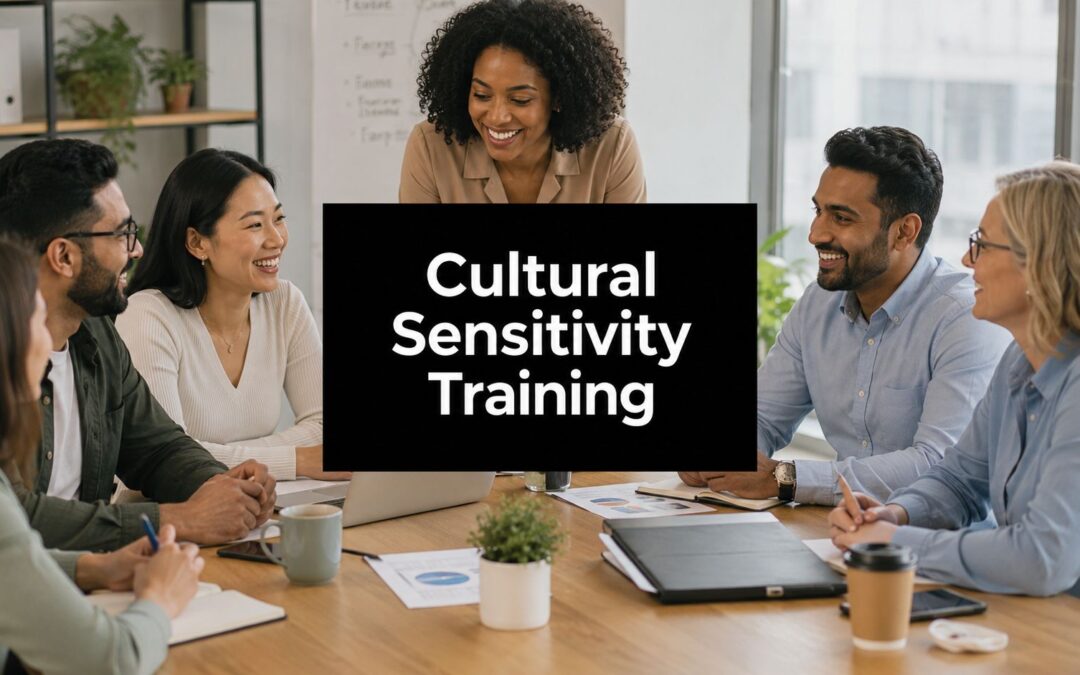
A product manager in San Francisco writes annotation guidelines one way. A vendor team in Manila interprets them another way. A reviewer in Berlin flags “inconsistency,” but the issue isn't quality drift. It's culture drift. The team is using the same labels, the same platform, and the same deadlines, but they aren't working from the same assumptions about tone, intent, ambiguity, or what counts as “obvious.”
That's where cultural sensitivity training stops being an HR checkbox and becomes an operating requirement.
In tech companies, especially those building AI products, global support workflows, and multilingual customer experiences, cross-cultural misunderstandings don't stay interpersonal for long. They show up in rework, slower decisions, avoidable conflict, poor manager calibration, uneven customer handling, and biased datasets. If you're implementing this training for the first time, the core question isn't whether your company values inclusion. It's whether your systems can support reliable collaboration across languages, norms, and markets.
What Is Cultural Sensitivity Training and Why It Matters Now
Cultural sensitivity training teaches employees how culture shapes communication, interpretation, decision-making, and workplace behavior. At a basic level, that includes recognizing bias, understanding different norms, and adjusting behavior in real interactions. In practice, for a tech company, it means fewer avoidable misunderstandings in distributed teams and better judgment when products, data, and customer interactions cross borders.
This matters now because global work is no longer limited to large multinational enterprises. Startups hire remote engineers across regions, AI teams use multilingual annotation workforces, and support organizations serve customers whose expectations around tone, directness, time, and authority differ widely. A manager can misread silence as agreement. An annotator can label sarcasm as earnest. A customer success agent can sound efficient in one market and rude in another.
It's not a soft-skill workshop
The biggest mistake I see is framing cultural sensitivity training as an awareness session. Awareness matters, but it won't fix broken workflows by itself. Research on culturally sensitive care found that the biggest failure point is often organizational structure, not just a lack of awareness. Barriers such as resource scarcity, limited intercultural contact, and provider uncertainty were linked to weaker culturally sensitive care, which is why training without workflow support and leadership reinforcement is unlikely to close the gap, as discussed in this research on structural barriers to culturally sensitive practice.
That finding translates cleanly to tech. If your company runs global standups only in fast spoken English, uses vague annotation instructions, leaves escalation paths unclear, and evaluates managers only on delivery speed, then one workshop won't change much. People revert to the system they work in.
Practical rule: Train the person, then fix the process they return to on Monday.
The operational case is straightforward. Cultural sensitivity training helps teams reduce friction around language, etiquette, communication style, and interpretation. It also supports hiring, retention, and manager effectiveness, which are already tied up with broader human resources management challenges in scaling companies.
Where the business value shows up
For a tech company, cultural sensitivity training matters in three places:
- Team execution: Distributed teams coordinate better when they understand how colleagues give feedback, raise concerns, or signal disagreement.
- Customer-facing work: Support, sales, and onboarding teams avoid avoidable mistakes when they adapt communication style and assumptions.
- AI and data quality: Annotation, moderation, and language teams make better calls when they understand cultural context instead of treating every edge case as noise.
If you treat cultural sensitivity as optional, you'll pay for it elsewhere. Usually in quality review, attrition, customer complaints, or delayed launches in new markets.
The Building Blocks of an Effective Program
Most weak programs try to teach “respect” in broad terms. Strong programs teach observable competence. The most useful framework has three layers: awareness, knowledge, and skills. That aligns with common program design guidance on cultural sensitivity training, including the use of role-playing, simulations, case discussions, and e-learning to turn abstract ideas into workplace behavior, as summarized in this overview of awareness, knowledge, and skills in cultural sensitivity training.
A good curriculum also focuses on what effective programs measure. A 2023 systematic review found that effective curricula most often measured cultural attitudes (89.2%), knowledge (81.1%), and skills (67.6%). It also found that core topics such as sociocultural information, identity, and stereotypes appeared in over 80% of programs that improved attitudes, according to this systematic review of cultural competence training.

Awareness means bias recognition, not guilt
Awareness is the entry point. Employees need to understand that their own communication style is culturally shaped, not neutral. Engineers who value blunt feedback may see indirectness as evasive. Managers who equate participation with confidence may underrate quieter contributors. Annotators may assume their interpretation of emotion, offense, or politeness is universal.
Awareness training should help people spot those assumptions early.
Useful awareness content includes:
- Bias identification: Help employees notice default assumptions before they affect hiring, feedback, labeling, or moderation.
- Stereotype interruption: Teach people how to pause before turning a pattern into a shortcut.
- Self-location: Ask participants to examine how their own norms affect what they consider professional, clear, respectful, or urgent.
Knowledge means context, not trivia
Many vendors often make a mistake here. They fill sessions with country facts and etiquette lists. That's easy to deliver and easy to forget.
Knowledge should focus on the context people need to work well together:
- Sociocultural background: Enough historical and social context to understand why certain behaviors or expectations exist.
- Identity and lived experience: How language, nationality, race or ethnicity, disability, age, and other factors shape workplace interactions.
- Communication norms: Directness, turn-taking, silence, hierarchy, escalation, and conflict style.
The test of knowledge isn't whether employees remember customs. It's whether they can interpret behavior more accurately under pressure.
Skills mean adaptation under real conditions
Skills are where training becomes useful. This is the part that should change how meetings run, how feedback is delivered, and how edge cases get resolved.
Practical skill-building includes:
- Role-play and simulations: Managers practice giving feedback across styles. Support teams practice de-escalation without making cultural assumptions.
- Case discussions: Product, trust and safety, and data teams review ambiguous examples together and compare interpretations.
- Applied team norms: Teams define what “clear” means in writing, meetings, handoffs, and escalations.
If you're comparing providers or building internally, use that three-part structure as your filter. It's also consistent with stronger HR best practices for capability building. If a program has inspiration but no practice, it won't last.
How to Design and Deliver Your Training Initiative
The design work matters more than the slide deck. The best cultural sensitivity training programs reflect the actual friction points inside the company. A customer support team serving multilingual users needs something different from an annotation team labeling sentiment, and both need something different from engineering managers running distributed squads.
One practical design principle stands out. Training should be adapted to the organization's actual cross-cultural exposure. Programs that reflect the audience's client or workforce mix are more likely to reduce miscommunication caused by differences in language, etiquette, and communication style, as described in this guidance on tailoring cultural sensitivity training.
Start with a workflow audit
Before you buy training, audit where culture affects work.
Look at moments such as:
- Hiring and onboarding: Are interview rubrics punishing communication styles that differ from the dominant office culture?
- Team collaboration: Where do projects stall because people interpret speed, ownership, or disagreement differently?
- Customer interaction: Which markets generate complaints about tone, trust, responsiveness, or clarity?
- Data operations: Where do label disputes cluster in multilingual or subjective tasks?
- Escalation and reporting: Do employees know how to raise concerns involving bias, exclusion, or cross-cultural conflict?
The point isn't to create a grand theory. It's to identify where better judgment would improve outcomes.
Build role-based modules
Don't roll out one generic course and call it a program. Give each group scenarios from its own work.
Here's a sample structure you can adapt:
| Module Focus | Target Audience | Learning Objective | Sample Activity | Delivery Format |
|---|---|---|---|---|
| Inclusive communication in distributed teams | Engineering managers | Improve clarity, feedback delivery, and meeting participation across communication styles | Review a sprint retrospective transcript and rewrite manager responses for clarity and inclusion | Live workshop |
| Multilingual customer interaction | Support and success teams | Reduce misunderstandings in tone, pacing, and comprehension | Practice responding to complex customer issues using simplified language and escalation prompts | Blended e-learning and role-play |
| Cultural variance in labeling | Data annotators and QA reviewers | Improve consistency when text, image, or audio content has culturally dependent meaning | Compare disputed labels, discuss interpretation gaps, and refine annotation guidelines | Facilitated calibration session |
| Inclusive product communication | Product, UX, and content teams | Identify assumptions in product copy, onboarding flows, and error messaging | Review interface text for idioms, ambiguity, and inaccessible phrasing | Workshop with asynchronous review |
| Bias-aware people management | People managers and HRBPs | Improve feedback, conflict handling, and promotion calibration across cultures | Run a case clinic using anonymized performance scenarios | Manager lab |
Choose formats that change behavior
A lot of companies default to an e-learning module because it's scalable. That's fine for baseline concepts. It's not enough for behavior change.
Use formats based on the type of learning needed:
- E-learning: Best for shared vocabulary, policy basics, and pre-work.
- Live workshops: Best for discussion, reflection, and manager calibration.
- Simulations: Best for support, sales, moderation, and leadership scenarios.
- Case reviews: Best for data annotation, trust and safety, and cross-functional teams handling ambiguous content.
- Microlearning nudges: Best for reinforcement after the core session.
Write the operational layer into the program
Training fails when it ends with “be respectful.” Employees need concrete instructions.
Include practical rules such as:
- Use simple language: Avoid idioms, region-specific slang, and layered instructions in documentation.
- Define escalation paths: Make it clear when employees should ask for clarification, interpretation support, or a second reviewer.
- Set meeting norms: Publish expectations for turn-taking, response windows, decision records, and follow-up summaries.
- Revise templates: Rewrite onboarding documents, support macros, and annotation guides to remove assumptions that only one audience matters.
If employees leave training with insight but no scripts, templates, or escalation rules, they'll improvise. Improvisation is where inconsistency returns.
Pilot before company-wide rollout
Run the first version with one team that has visible cross-cultural complexity. A multilingual support function, a globally distributed engineering pod, or an annotation team is usually a better pilot than headquarters staff.
After the pilot, review:
- where participants still felt uncertain
- which examples felt realistic
- what managers needed but didn't get
- which workflows still pushed people back into old habits
Then adjust the curriculum, the examples, and the policy layer before scaling it.
Measuring the Success of Cultural Sensitivity Training
If you can't measure it, leadership will treat it as optional. The good news is that cultural sensitivity training doesn't have to be evaluated only through satisfaction surveys. You can assess whether people learned, whether managers changed behavior, and whether teams operate with less friction afterward.
One useful anchor is cultural intelligence. In a study of master's-level nursing students, post-training cultural intelligence scores rose significantly, with p = 0.001 and p = 0.004, and mean CQS scores reaching up to 86.02, according to this study on measurable gains in cultural intelligence after training. That matters because it shows structured workshops can improve cross-cultural capability in ways that can be assessed rather than guessed.

Measure at three levels
The mistake is focusing only on course completion. Completion tells you nothing about workplace effect.
Track outcomes at three levels:
| Level | What to measure | What it tells you |
|---|---|---|
| Learning | Pre- and post-assessment, scenario judgment, manager confidence | Whether employees understood the concepts and can apply them |
| Behavior | Meeting norms adoption, escalation quality, annotation disagreement patterns, manager feedback quality | Whether people changed how they work |
| Business impact | Employee relations issues, customer complaint themes, quality review trends, retention signals in global teams | Whether the operating environment improved |
For HR and L&D leaders, cultural intelligence assessments can help structure the measurement layer. If you want a practical outside reference, this guide to cultural intelligence for HR is useful for thinking through assessment design and how to interpret capability more rigorously.
Use indicators your executives already respect
Don't build a separate reporting universe if you can help it. Tie measurement to systems leadership already reviews.
For example:
- Employee surveys: Add questions about clarity, inclusion in meetings, and confidence working across cultures.
- Manager effectiveness reviews: Evaluate whether managers adapt communication and create psychologically safe participation.
- Quality operations: Track whether multilingual annotation or moderation teams show fewer unresolved interpretation disputes over time.
- People data: Review patterns in complaints, attrition feedback, or onboarding friction involving distributed teams.
Measurement advice: Don't promise a clean ROI formula. Show a chain of evidence from learning, to behavior, to operating outcomes.
What not to do
Avoid two traps.
First, don't rely on “people liked the workshop.” That's not evidence of capability. Second, don't isolate training from the environment. If managers aren't held accountable for reinforcing the behaviors, results will flatten even if participants scored well immediately afterward.
The strongest reporting combines assessment data with operational evidence from the team's real work.
Putting Training into Practice for AI and Data Teams
A model launch is two weeks out. Product sees inconsistent toxicity labels across English, Hindi, and Spanish review queues. QA reports “low agreement,” but the actual problem is narrower and more serious. Annotators are applying different cultural rules to sarcasm, politeness, insult, and intent. If leaders treat that as a simple accuracy issue, they hard-code bias into the dataset.
In AI and data operations, cultural sensitivity training has a direct operational purpose. It improves how people make judgment calls under ambiguity, especially in globally distributed teams handling language, image, video, and safety-related content.
A data annotation team reviewing sentiment, toxicity, intent, humor, gestures, dress, or context-rich imagery will make interpretation calls every day. Those calls reflect language background, local norms, and prior experience. Without a shared method for handling cultural variance, one group's assumptions start passing as ground truth.

Where AI teams get into trouble
Consider a common case. A global company is training a sentiment model on customer reviews and social posts. Annotators in one market read indirect criticism as neutral because the language is polite. Annotators in another market label the same phrasing as negative because the dissatisfaction is obvious in context. The disagreement is patterned, not random, and it usually points to missing guidance rather than poor individual performance.
The same issue shows up in image and video tasks. A hand gesture, clothing choice, family interaction, or physical distance between people can signal very different things across regions. If the instruction set assumes one reading, the model learns that assumption.
For teams working in human-in-the-loop AI operations, this is as much a management problem as a technical one. Team leads need better annotation policy, clearer escalation paths, and training that teaches reviewers when to label, when to flag, and when to defer.
Operational practices that work
The best training for AI teams is tied to workflow design. General awareness content has a place, but it will not fix inconsistent labeling on subjective tasks.
Use practices such as these:
- Write multilingual-ready guidelines: Use plain language, define ambiguous terms, and remove idioms from task prompts and policy documents.
- Set language thresholds for task assignment: Do not ask reviewers to infer nuance in a language they only partly understand.
- Separate observation from interpretation: Ask annotators to identify visible or audible facts first, then classify meaning, then record confidence.
- Document culture-sensitive categories: Politeness, offense, gender expression, family roles, and humor usually need examples from more than one market.
- Create an escalation path for ambiguity: Reviewers should know when a case needs secondary review instead of forced consensus.
This is also where translation and localization get confused. A translated instruction may still fail if the examples, tone, or assumptions do not fit the annotator's context. For teams supporting multilingual workflows, Translators USA on translation vs localization is a useful reference when deciding whether a guideline needs language conversion or real adaptation.
Build cultural variance into quality control
QA systems often create the wrong incentive. If every disagreement is treated as annotator error, reviewers learn to conform to the dominant interpretation instead of surfacing genuine ambiguity. That may raise agreement scores in the short term while lowering dataset quality.
A better review design does four things:
- Flag culturally dependent labels for secondary review rather than requiring instant agreement.
- Capture rationale on difficult examples so future reviewers can see how the team handled context.
- Split objective and interpretive tasks where possible. “Contains text” and “tone is insulting” should not be reviewed the same way.
- Calibrate with diverse reviewers before locking gold-standard datasets for subjective categories.
I usually advise tech clients to test this on one high-friction queue first, often sentiment, safety, or multilingual support data. That pilot shows where the problem sits. Sometimes it is training content. Sometimes it is poor taxonomy design. Sometimes the issue is manager behavior, especially when leads push for speed and suppress escalation.
Here's a useful training clip to prompt discussion with data and product teams:
One vendor option in this space is Zilo AI, which provides multilingual annotation, translation, transcription, and related manpower support for AI workflows. That kind of service matters when a company needs language coverage and process discipline together, not just more labeling capacity.
For AI teams, cultural sensitivity training protects dataset quality, model behavior, and product credibility in markets the headquarters team does not fully understand.
Sustaining a Culturally Sensitive Workplace Culture
A manager in Manila flags a labeling guideline as confusing. The product lead in San Francisco waves it through because the queue is behind. Two weeks later, the team finds inconsistent outputs across regions, reviewers are frustrated, and model quality drops on the very market the company wanted to grow. That is how cultural sensitivity problems usually show up in tech. Not as a values debate, but as rework, quality drift, and preventable friction between teams.
Companies that sustain progress build cultural sensitivity into operating habits. HR can set expectations, but the day-to-day work sits with managers, QA leads, product owners, and anyone writing policies, prompts, scripts, or annotation guidance. If those inputs carry one market's assumptions into a global workflow, training fades fast.
What reinforcement looks like in practice depends on where your risk sits. For engineering and product teams, it often starts with decision-making norms. For annotation and support teams, it usually starts with review processes and escalation paths. In both cases, the goal is the same: fewer avoidable misunderstandings and better judgment under pressure.
A durable approach usually includes:
- Manager accountability: Include inclusive communication, escalation handling, and team climate in manager evaluations.
- Regular calibration: Revisit disputed cases in support, moderation, and annotation work so teams can adjust guidance as context changes.
- Clear reporting channels: Give employees a reliable way to raise cross-cultural friction, bias concerns, or accessibility barriers without risking retaliation.
- Content review: Update training, policies, customer messaging, and labeling instructions as products expand into new languages and markets.
Translation and localization also need different owners and review standards. Translation changes words. Localization adapts meaning, tone, examples, and context for a specific audience. For teams handling multilingual products or support content, this explanation of translation vs localization is a useful reference when deciding what needs linguistic conversion and what needs cultural adaptation.
The companies that get this right treat training as part of quality control. That matters even more in AI programs, where a poorly localized instruction set or a culturally narrow review standard can shape the dataset, the model, and the customer experience.
Zilo AI, mentioned earlier, is one example of the kind of operational support companies use when they need multilingual annotation, transcription, translation, and workforce coverage aligned with cross-cultural AI work. The bigger point is practical. Tie training to the workflows that affect product quality, customer trust, and manager behavior, or it will stay theoretical.