At its heart, a staffing agency acts as a strategic connector, linking companies with talented professionals for all sorts of roles—whether temporary, contract-based, or permanent. Picture them as the ultimate matchmaker between a business that needs a specific skill set and the pool of talent that has it. They handle the entire process, from finding and screening candidates to managing payroll and compliance.
What Exactly Is a Staffing Agency

Let's go beyond a dry definition. Instead of thinking of them as just another job board, imagine a staffing agency as a talent curator for a highly specialized marketplace. This curator doesn't just post a list of available people; they actively hunt for, thoroughly vet, and perfectly match professionals to a company's unique needs.
This kind of partnership is built on delivering speed, flexibility, and specialized skills—three things that are absolutely critical in fast-paced fields like tech and AI. For companies, this translates into the freedom to scale their workforce up or down on a dime, all without the long-term commitments and administrative headaches of direct hiring.
The Bridge Between Talent and Opportunity
A modern staffing agency is much more than a simple go-between; it creates real value for both the businesses it serves and the professionals it represents. Their job is about far more than just filling an empty seat.
For a business, working with an agency unlocks several key advantages. They provide immediate access to a pre-screened talent pool, handle complex logistics like payroll and benefits, and offer the flexibility to bring in specialists for short-term projects.
For professionals, the perks are just as strong. Agencies can open doors to exclusive job opportunities that are never advertised publicly. They also offer career advice and take care of contract negotiations, helping individuals find roles that are a perfect fit for their skills and ambitions. This model is quite different from other hiring approaches, which you can explore in our guide on what is recruitment outsourcing.
The table below breaks down the core functions of a staffing agency, showing how they serve both clients and candidates.
Core Functions of a Staffing Agency at a Glance
| Function | Value for Businesses | Value for Job Seekers |
|---|---|---|
| Sourcing & Recruiting | Taps into an extensive, pre-vetted network of talent, saving time. | Provides access to unlisted jobs and exclusive opportunities. |
| Screening & Vetting | Conducts skills assessments, background checks, and interviews. | Matches skills and career goals with suitable roles. |
| Payroll & Administration | Manages pay, benefits, taxes, and worker's compensation. | Ensures timely and accurate payment and handles contract details. |
| Flexibility & Scalability | Fills roles quickly for projects, leave coverage, or seasonal peaks. | Offers a variety of work arrangements (temp, contract, perm). |
| Market Expertise | Offers insights on salary trends, talent availability, and regulations. | Provides career guidance and helps with resume building. |
As you can see, a good agency functions as a complete support system, streamlining the entire hiring lifecycle for everyone involved.
The modern staff agency is a key driver of workforce agility. It empowers businesses to tap into specialized expertise on demand, enabling them to innovate faster and respond to market changes without the overhead of a permanently expanded workforce.
And this industry is huge. The global recruiting market hit a staggering USD 690.3 billion in the current fiscal year, a noticeable increase from USD 642.28 billion the year before. Just in the U.S., staffing firms help around 11 million people find temporary and contract work each year, proving just how essential they are to the economy. You can find more details in this report on the global recruiting market on mordorintelligence.com.
Understanding this foundational role is the first step toward appreciating how agencies can provide more advanced services, from global hiring support to building specialized data annotation teams.
Understanding Different Types of Staffing Agencies
Not all staffing agencies are cut from the same cloth. Think of it like this: you wouldn't take a high-performance sports car to a mechanic who only works on heavy-duty trucks. Staffing firms are similar; they often specialize in specific kinds of employment, and knowing the difference is the first step to finding a partner that actually gets what you need.

The world of staffing is pretty diverse. The right choice for your company really boils down to what you're trying to accomplish, both right now and down the road.
Core Staffing Agency Models
Most agencies operate on one of three main models. Each one is like a different tool in your hiring toolkit, designed for a specific job.
- Temporary Staffing: This is your go-to for short-term gaps. Need to cover for someone on maternity leave? Facing a massive holiday rush? Or just need a few extra sets of hands to push a project over the finish line? Temp agencies have qualified people ready to jump in for a set period.
- Permanent Placement (Direct Hire): When you're looking to grow your core team, a permanent placement agency essentially becomes an extension of your own HR department. They do the heavy lifting—sourcing, screening, and interviewing—to find you a great long-term employee, saving your team a ton of time.
- Contract-to-Hire: This is the classic "try before you buy" option, and it’s incredibly useful. A candidate joins your team on a contract basis for a predetermined time. If it's a great fit for both sides, you can bring them on as a permanent employee at the end of the term. It’s a fantastic way to make sure someone is the right fit for your culture and the role itself.
This kind of flexibility is central to the modern staff agency definition, giving businesses the agility to scale their workforce precisely when they need to.
The Rise of the Specialist Agency
Beyond these classic models, the biggest shift we’ve seen is the rise of the specialist agency. A generalist agency is a jack-of-all-trades, but a specialist is a true master of one. They dig deep into a single industry, skill set, or role, building an incredible network of talent and genuine market insight.
Let’s say you're a tech company building an AI voice assistant that needs to understand Tagalog, Swahili, and Korean. A generalist agency would likely be starting from scratch, struggling to find people with that niche linguistic and technical background.
A specialized data annotation agency, on the other hand, lives and breathes this stuff. They already have a bench of vetted linguists and annotators. They know the common pitfalls, can guarantee quality from day one, and will get your project moving much, much faster.
This level of focus gives you a serious edge. When you work with an expert who already speaks your language, you get better candidates, quicker hires, and frankly, better results. The agency stops being just a vendor and becomes a real strategic partner who's invested in seeing your project succeed.
The Real Business Impact of a Staffing Partner
Working with a staffing agency isn't just about filling an empty seat. It's a strategic move with a real, measurable impact on your business. The true value comes from how a partnership can transform your team's capacity, helping you move faster, tap into better talent, and keep your focus where it belongs—on growing your business.
Let’s imagine a tech startup that just landed funding for a new AI model. Their core team is stacked with brilliant engineers and data scientists, but they suddenly need a massive team of skilled data annotators to label thousands of images. Without help, this monumental task would completely derail their main mission, tying up their best people in the weeds of recruiting, hiring, and HR admin.
Accelerating Growth and Innovation
This is where a strategic staffing partner completely changes the game. They take full ownership of building that team, handling everything from finding and vetting candidates to managing payroll and compliance. This frees up your internal experts to do what they do best: innovate.
Instead of spending weeks or even months trying to assemble a team from scratch, you can have qualified people ready to go in just a few days. The ripple effect is huge:
- Faster Time-to-Market: Projects get moving immediately, helping you launch products and features well ahead of your competitors.
- Reduced Administrative Burden: Your team gets to skip the tedious work of posting jobs, sifting through résumés, and conducting endless initial interviews.
- Access to Passive Candidates: Great agencies have deep networks of skilled professionals who aren't actively job hunting but are open to the perfect opportunity.
That agency fee? It’s not just a cost. Think of it as an investment in speed, expertise, and a laser-focused operational strategy. You can dive deeper into this in our article on workforce optimization strategies.
Navigating a Changing Industry
The staffing world itself is changing fast, driven by new tech and evolving regulations. Artificial intelligence, once a novelty, is now a standard tool for top agencies, fundamentally reshaping how they find and screen talent.
A modern staff agency definition has to include technological savvy and regulatory know-how. They aren't just people-brokers anymore; they are tech-enabled talent partners that help businesses navigate a complex hiring landscape safely and efficiently.
Recent industry data tells the story. In the U.S., the American Staffing Association's Staffing Index hit 93, with staffing employment growing by about 4.7% year-over-year—a clear sign of a strong market. At the same time, new AI hiring laws and compliance audits are pushing agencies to adopt higher standards for data security and operational excellence. You can find more insights on the trends shaping the staffing industry on staffinghub.com.
This shift means that when you partner with a modern agency, you're getting a team that's truly built for the future of work.
How to Choose the Right Staffing Agency
Picking the right staffing partner isn't just about filling a seat—it's a strategic decision that can make or break your project and even shape your company's trajectory. This is about finding an extension of your own team, a partner who gets what you're trying to build and can deliver the exact talent to make it happen. A little due diligence upfront is your best defense against bad hires and wasted budgets.
Forget the glossy brochures for a moment. The first thing you need to verify is their actual specialty. A generalist agency might be fine for standard administrative roles, but when you're in a highly technical field like AI or software development, you need a specialist. A partner who lives and breathes your industry will already know the jargon, understand the subtle technical requirements, and, most importantly, have a ready-made network of qualified people. That alone can save you weeks of searching.
Look Under the Hood at Their Process and Technology
Once you've found a specialist, it's time to dig into how they actually operate. A top-tier agency should have a rock-solid, transparent screening process. Don't hesitate to ask them to walk you through it. How do they really test for skills? Who checks the references? How do they gauge whether someone will fit into your company culture? These questions are critical, especially for roles that demand specific certifications or security clearances.
Just as important is the tech they use. The best agencies today are powered by sophisticated tools for everything from sourcing candidates to tracking applicants and managing performance. A partner with a modern tech stack can find talent faster and give you clear, data-driven updates along the way, so you're never left wondering what's going on.
This decision tree helps visualize the key moments when bringing on a staffing partner makes the most strategic sense for team growth.
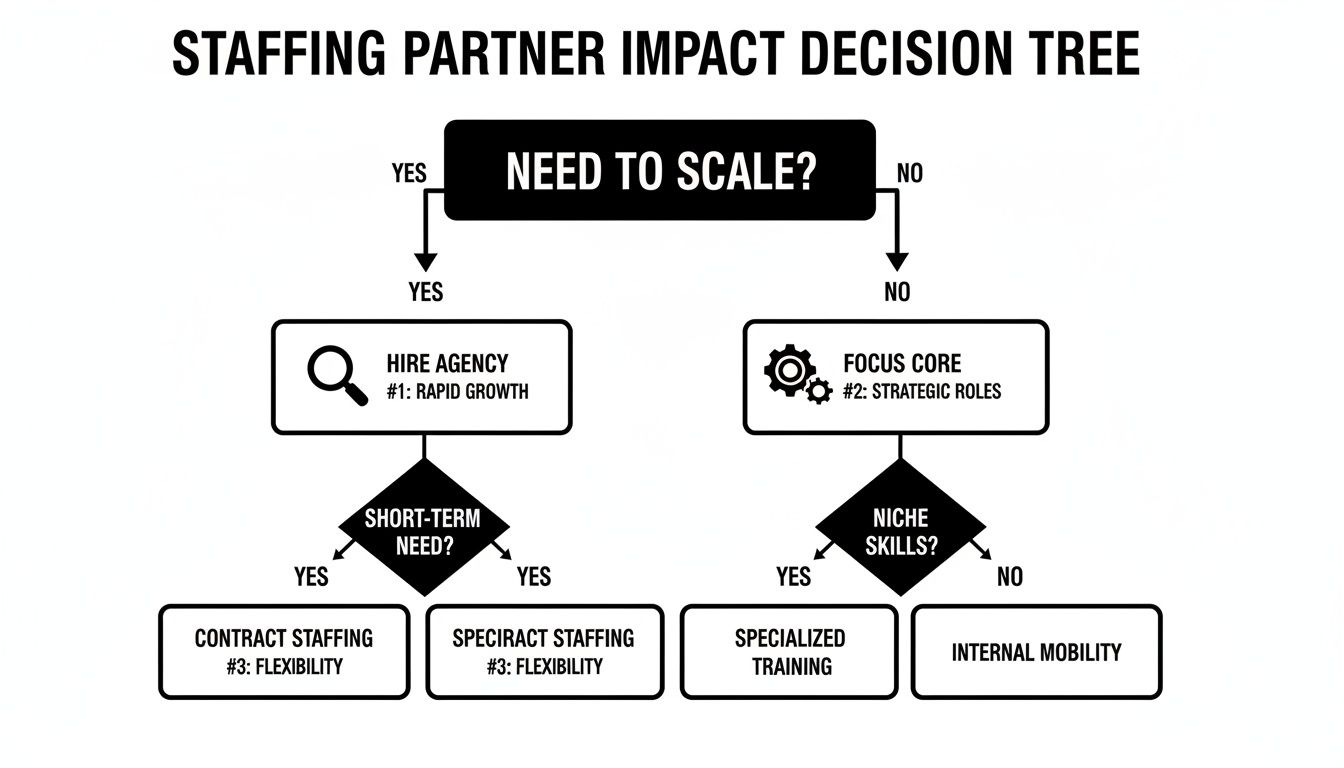
As the graphic shows, when you need to scale quickly or bring in specialized skills you don't have in-house, an agency becomes an invaluable ally for accelerating growth.
Verify Their Approach to Compliance and Security
For any business, security and compliance are table stakes. But for tech and AI companies handling sensitive data, they are absolutely non-negotiable. If you're hiring a team for a data annotation project, for example, you need unshakable confidence in your partner's security measures.
In today's world, a core part of the staff agency definition involves acting as a compliance shield. A great agency protects you from legal headaches by managing everything from global labor laws and data privacy rules to proper worker classification.
Ask them to show you their security certifications. Get specifics on how they handle confidential data. And if you’re hiring people in other countries, make sure they have proven expertise in international labor laws to keep you out of legal hot water. To go a bit deeper on this, you might find our guide on the top IT recruiting agencies helpful.
Understand the Pricing and Fine Print
Finally, get crystal clear on the money and the contract. Staffing agencies have a few common ways of charging for their services, and you need to know which model fits your budget and hiring needs.
- Percentage of Salary: This is the go-to for permanent hires. The agency's fee is simply a cut of the candidate's first-year salary.
- Hourly Bill Rate: For temporary and contract workers, you'll see this model. The rate covers the worker's pay plus the agency's markup.
- Retained Search: If you're hunting for a C-suite executive or a rare "unicorn" talent, you might pay an upfront fee to retain an agency's dedicated focus.
Before you sign anything, read the Service Level Agreement (SLA) carefully. A good SLA will spell out exactly what the agency will deliver, the timelines, how success will be measured, and any guarantees they offer. A clear, fair agreement is the bedrock of a great partnership.
Choosing the right staffing agency requires a structured approach. This checklist breaks down the essential criteria to ensure you find a partner that truly aligns with your technical needs and business goals.
Evaluation Checklist for Selecting a Staffing Agency
| Evaluation Criteria | What to Look For | Key Questions to Ask |
|---|---|---|
| Industry Specialization | Proven experience in your specific niche (e.g., AI, data annotation, software development). A portfolio of relevant case studies and client testimonials. | "Can you share examples of similar roles you've filled for other companies in our industry?" |
| Recruitment Process | A transparent, multi-stage screening process that includes technical assessments, background checks, and cultural fit interviews. | "Walk me through your entire candidate vetting process, from sourcing to final offer." |
| Data Security & Compliance | Certifications (like ISO 27001, SOC 2). Clear protocols for data handling and GDPR/CCPA compliance. Expertise in global labor laws if hiring internationally. | "What specific measures do you have in place to protect our sensitive data and intellectual property?" |
| Language & Geographic Coverage | The ability to source talent fluent in required languages and located in relevant time zones for your project. | "What is your capacity for sourcing candidates with [X language] proficiency in [Y region]?" |
| Technology & Tools | Use of modern Applicant Tracking Systems (ATS), sourcing platforms, and communication tools for efficiency and transparency. | "What technology platforms do you use to manage the recruitment workflow and communicate with clients?" |
| Service Level Agreement (SLA) | A detailed SLA outlining key performance indicators (KPIs) like time-to-fill, candidate quality metrics, and performance guarantees. | "What are your standard performance guarantees, and what happens if a placement doesn't work out?" |
| Pricing Model | A clear, flexible pricing structure (e.g., percentage, hourly rate, retained) that aligns with your budget and hiring volume. No hidden fees. | "Can you provide a full breakdown of your fee structure and any additional costs we should be aware of?" |
By systematically working through these points, you can move beyond a simple vendor transaction and build a lasting, strategic partnership that fuels your team's success.
When a Staffing Agency Is Your Best Move

Deciding when to call in a staffing agency is more art than science. It’s not just about filling an empty seat—it's a strategic call you make when you recognize that their expertise can fuel growth, solve a nagging problem, or simply give you an edge. These are the moments when a staffing partner stops being a "nice-to-have" and becomes a critical part of your game plan.
Think about a tech startup that just landed a big round of funding. The investors want results, and the pressure is on to scale the development team yesterday. Their internal HR person is already drowning in work. This is the perfect time to bring in an agency.
Instead of getting bogged down in a hiring process that could drag on for months, the startup can tap into an agency's network of vetted talent. Suddenly, they're onboarding skilled developers in weeks, not quarters. The agency runs the whole recruitment show, so the core team can get back to what they do best: building the product.
Scaling Specialized Teams on Demand
The need for a partner becomes undeniable when you require niche skills at scale. Let’s say an established company decides to build a new voice assistant. Training that AI model requires a huge team of data annotators fluent in several languages, some of them fairly obscure.
Trying to find that specific mix of linguistic and technical talent on your own is a logistical nightmare. A specialized agency, on the other hand, lives for this kind of challenge and can put together a global team fast.
- Business Challenge: You need 50 data annotators who are fluent in Japanese, German, and Swahili for a project that lasts six months.
- Agency Solution: A specialized data annotation firm reaches into its global talent pool and quickly finds vetted professionals who tick every box—language, technical skill, availability.
- Positive Outcome: The AI model gets trained with high-quality, diverse data, hitting the project deadline and setting up a successful product launch across different countries.
A core part of the modern staff agency definition is its ability to provide not just people, but precise, on-demand expertise. They are the essential link for businesses that need to execute complex projects without building a permanent, specialized workforce.
Managing Fluctuations and Seasonal Peaks
Another classic use case is handling predictable swings in workload. A global e-commerce brand knows for a fact that its customer support tickets will triple during the holiday rush. Hiring permanent staff for a three-month spike is just bad business—it's expensive and inefficient.
This is where a staffing agency provides a much more elegant solution. They can supply experienced, multilingual customer support agents on a temporary basis. The brand keeps its service quality high during the busiest time of the year without taking on the long-term costs of a larger permanent team.
In all these scenarios, the agency isn't just a recruiter; it’s a problem-solver, delivering a targeted fix for a specific business need. That’s when you know a partnership is the right move.
The Future of Staffing and Global Talent
The whole concept of "the office" is being completely redefined, and the modern staff agency is changing right along with it. The future of work isn't about being tied to one building or even one country—it’s about finding the sharpest minds, no matter where they are. Staffing agencies are at the very heart of this global movement.
The explosion in remote work has torn down geographic walls, opening up a truly borderless talent pool. This means companies can now find highly specialized skills in markets that were once impossible to reach. Take the Asia-Pacific region, for instance, which has become the fastest-growing hub in the entire global staffing market.
Markets like China and India are seeing incredible double-digit growth of 15% and 11%, respectively. Agencies are the bridge connecting businesses to these vibrant new talent ecosystems. You can dive deeper into these global staffing industry trends on workwell-global.com.
The Rise of Borderless Hiring
A huge piece of this puzzle is the growing reliance on Employer of Record (EOR) services. An EOR essentially becomes the legal employer for your international team members, handling all the headaches of local payroll, taxes, and compliance for you.
Think of an EOR as a passport for your global talent strategy. It lets you hire the perfect person for the job, anywhere in the world, without the massive administrative nightmare of setting up a legal entity in every single country.
This model gives businesses a level of agility they've never had before. You can build a truly world-class team with the most qualified people, all without getting bogged down in red tape.
Technology is also pouring fuel on this fire. AI-powered platforms now help agencies vet and match candidates on a global scale with breathtaking speed and accuracy. This tech-forward approach ensures that as your business looks to the future, your staffing partner is already geared up to find the global talent you need to win.
Unpacking a Few Common Questions
If you're new to the idea of working with a staffing agency, you've probably got some questions. Let's tackle a few of the most common ones and clear up some misconceptions right off the bat.
Aren't Staffing Agencies and Recruiters the Same Thing?
It's a common mix-up, but they play different roles. Think of it like this: a headhunter or recruiter is like a specialist surgeon. You bring them in for one specific, high-stakes operation—finding your next VP of Engineering, for example. They focus on a single, senior-level permanent role.
A staffing agency, on the other hand, is more like a full-service clinic. They can handle a much wider range of needs, from filling a dozen temporary data annotation roles for a three-month project to finding a handful of permanent customer support hires. They're built for volume and variety.
So, How Do These Agencies Get Paid?
This is the big one, but the model is straightforward. The most important thing to know is that the job candidate never pays a fee. The agency's client—that's you, the hiring company—covers the cost.
It usually breaks down in one of two ways:
- For temporary or contract staff: You pay the agency an hourly bill rate. This single rate covers the worker's wages, taxes, benefits, and the agency's service fee. It’s a simple, all-in-one cost.
- For permanent placements: If you hire a candidate they find for a full-time role, the agency charges a one-time fee, which is typically a percentage of the employee’s first-year salary.
This model keeps the agency focused on finding the right person for your business, not on charging the talent.
Is It True That Temporary Staff Aren't as Committed?
This is probably the biggest myth out there. The reality is that for many skilled professionals, contract work is their career. They are experts who enjoy moving from one interesting project to the next, and their professional reputation is everything. A shoddy performance on one gig means they won't get the next one.
The very definition of a modern staff agency is built on a foundation of trust and quality. They cultivate talent pools of highly motivated people who understand that their performance on your project directly shapes their future career opportunities and their standing with the agency.
Plus, many contractors view temporary assignments as a "try before you buy" opportunity for both sides. They are often highly motivated to prove their value in the hopes of landing a permanent offer. A good agency is an expert at spotting this drive and ensuring you get dedicated talent, no matter the contract length.
Ready to build a flexible, world-class team without the administrative burden? Zilo AI connects you with highly skilled professionals for everything from data annotation to global support, allowing you to scale faster and focus on what you do best. Learn how we can help you grow.