Trying to recruit top-tier data scientists can feel less like hiring and more like a full-blown talent war. This guide isn't about generic advice; it's a practical, field-tested playbook for attracting and, more importantly, landing the professionals who will shape your company's future.
Why Is Hiring a Data Scientist So Hard Right Now?
The demand for data science talent is absolutely exploding, largely fueled by the relentless growth of AI and big data analytics. It’s not just a feeling—the numbers back it up. The U.S. Bureau of Labor Statistics projects that jobs for data scientists will surge by a staggering 34% between 2024 and 2034.
That translates to roughly 23,400 job openings popping up every single year. This isn't just a statistic; it's the reality of a talent crunch that’s forcing companies to get smarter about how they hire.
This scarcity means that a well-defined, structured hiring strategy isn't just a "nice-to-have"—it's a business necessity. Winning in this market requires a plan that goes way beyond just posting a job ad and crossing your fingers.
A Modern Playbook for Hiring
Your success will come down to a deliberate, well-executed process. It's about deeply understanding the market, defining your needs with surgical precision, and crafting a candidate experience that the best people in the field can't turn down. This guide is your roadmap to building that world-class data team.
At its core, a successful data science recruitment strategy breaks down into three fundamental phases: defining what you need, finding the right people, and hiring the absolute best fit for your team.
This simple workflow shows the key stages, moving logically from defining the role to finding candidates and finally, making the hire.
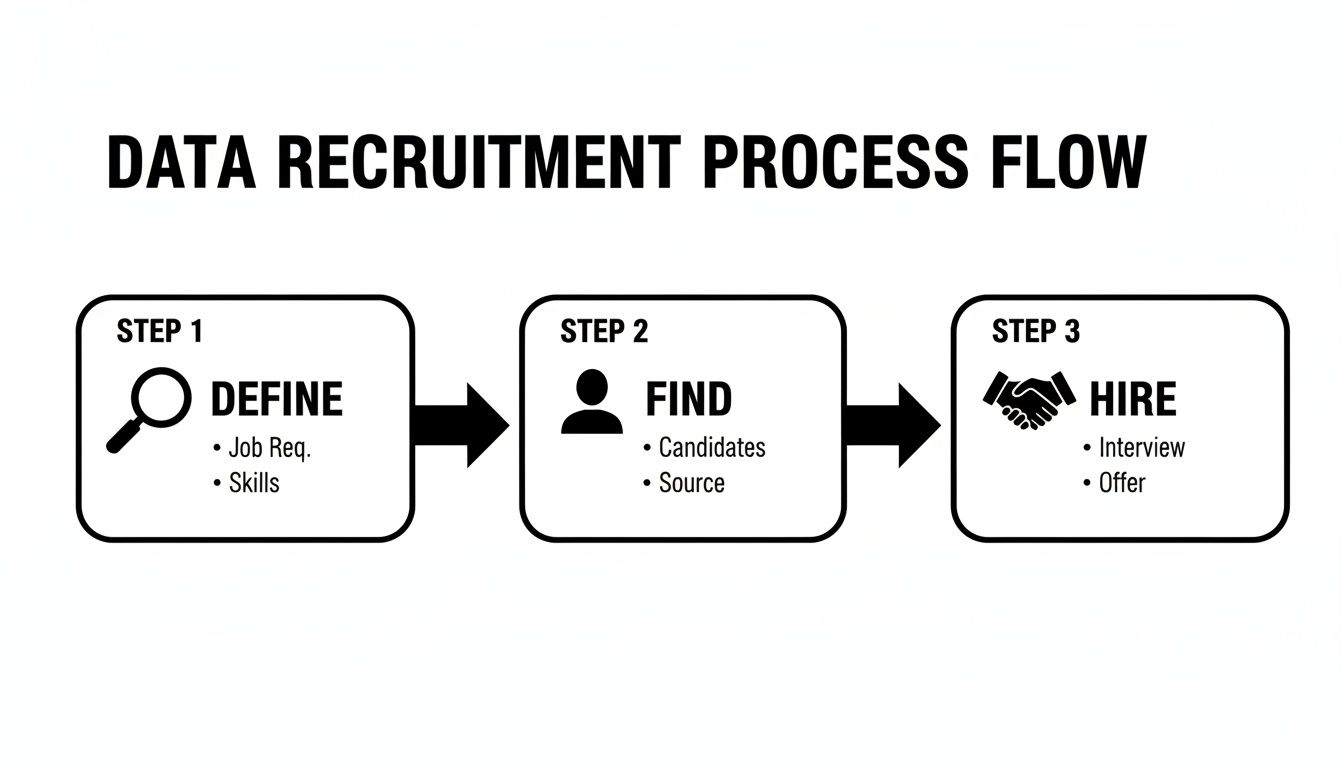
As the visual shows, a great hire is the result of a clear progression where each step logically builds on the one before it.
The Phases of a Winning Strategy
Throughout this playbook, we're going to dive deep into each of these critical phases. The goal is to give you the specific tools and tactics you need to compete for elite talent, even if you don't have the brand recognition of a FAANG company.
We'll break down how to handle:
- Defining Roles and Skills: Pinpointing the exact data science specialty your business needs to solve its most pressing problems.
- Sourcing and Outreach: Going beyond the usual job boards to find and actually engage the passive candidates who aren't actively looking.
- Technical and Behavioral Assessments: Crafting evaluations that do a great job of predicting on-the-job performance and how well someone will fit into your culture.
- Onboarding and Scaling: Making sure your new hires are set up for success from day one and that your team can grow without breaking.
A well-defined recruitment strategy is your single greatest advantage in a competitive market. It transforms hiring from a reactive necessity into a proactive, strategic function that drives business growth.
If you're looking to build out a more comprehensive framework, you'll find our guide on creating a recruitment strategy plan incredibly helpful.
Before you even think about writing a job description, let's talk about the single most important step in hiring a data scientist: getting crystal clear on what you actually need. The goal isn't just to hire "a data scientist." It's to find the right person to solve a very specific business problem. A fuzzy role definition is a recipe for disaster—it guarantees a mountain of irrelevant resumes and a colossal waste of everyone's time.
The title "Data Scientist" has become a huge, ambiguous umbrella term. Posting a job for a "Data Scientist" is like a hospital putting out an ad for "a doctor" when they desperately need a brain surgeon. You have to diagnose the pain point first.
Are you swimming in data but struggling to understand what happened last quarter? You probably need a Data Analyst. Are you trying to build predictive features into your app, like a recommendation engine? That’s a job for a Machine Learning Engineer. Or maybe you're venturing into uncharted territory, trying to invent new algorithmic solutions? That's when you call in a Research Scientist.
From Vague Title to Precise Profile
To truly define the role, you need to dig deep with your team and stakeholders. Forget starting with a list of programming languages. Instead, sit down and hammer out the answers to these questions:
- The Business Goal: What specific, measurable outcome is this person responsible for? Think "reduce customer churn by 5%" or "increase marketing campaign ROI by 15%," not just "analyze data."
- The Day-to-Day: What will they actually be doing? Building dashboards in Tableau? Pushing models into a live production environment? Or will their main deliverable be a research paper?
- The Key Collaborators: Who are their primary partners in crime? Product managers? The engineering team? The C-suite? This tells you a ton about the soft skills and communication style they'll need to succeed.
Answering these questions helps you build an "ideal candidate profile" that becomes the north star for your entire search. It shifts the focus from a generic laundry list of skills to the real-world impact they'll have on the business.
The best job descriptions aren't a wish list of every technology under the sun. They're a compelling story about the challenging and impactful problems a candidate will get to solve.
This focus on the "why" is what attracts top-tier talent. The best people are driven by interesting challenges, not just a list of tools. For example, instead of saying "Must know Python and TensorFlow," frame it as, "You will build and deploy the core machine learning models that power our real-time fraud detection system." See the difference? One is a requirement; the other is a mission.
Common Data Science Specializations
To help you narrow it down even further, it’s crucial to understand the different flavors of data roles out there. While the lines can sometimes blur, each specialization has a distinct center of gravity. Getting this wrong is one of the most common mistakes I see companies make.
Here's a quick cheat sheet to help you pinpoint the expertise you're looking for.
Data Science Role Specializations at a Glance
This table breaks down the most common roles to help you align your business needs with the right skill set.
| Role Title | Primary Focus | Key Technical Skills | Business Impact |
|---|---|---|---|
| Data Analyst | Interpreting historical data to answer business questions ("What happened?") | SQL, R/Python for analysis, Data Visualization (Tableau, Power BI) | Provides the crucial insights that guide strategic decisions and track company performance. |
| Data Scientist | Building predictive models and running experiments to forecast outcomes ("What will happen?") | Statistical Modeling, Machine Learning Libraries (scikit-learn), Experiment Design | Optimizes business processes, personalizes user experiences, and predicts future trends. |
| Machine Learning Engineer | Deploying, scaling, and maintaining machine learning models in production environments. | Python, Cloud Platforms (AWS, GCP), MLOps Tools, Software Engineering | Builds the robust, scalable infrastructure that makes machine learning a reality in a live product. |
| Research Scientist | Developing novel algorithms and pushing the boundaries of what's possible with data. | Advanced Mathematics, Deep Learning Frameworks (PyTorch, TensorFlow) | Drives long-term innovation and creates the foundational IP that can become a major competitive advantage. |
By precisely defining the problem and matching it with the right specialization, you create a job spec that does the hard work for you. It acts as a powerful filter, naturally turning away the wrong candidates while becoming a magnet for the high-performers who are genuinely excited to tackle your company's unique challenges. This upfront clarity is the bedrock of a successful hire.
How to Find and Engage Top Data Scientists
Let’s be honest: the best data scientists aren't polishing their resumes or browsing job boards. They're too busy. They’re deep in the code, competing in data challenges, or contributing to open-source projects that genuinely excite them. If you want to hire them, you can't just post a job and wait. You have to go where they are.
While platforms like LinkedIn are a decent starting point, the real talent—the people who live and breathe data—are found in communities where their work speaks for itself. To find them, you need to think less like a traditional recruiter and more like a data scientist.

This means your focus has to shift from sifting through resumes to spotting real-world contributions. You’re looking for demonstrated skill, not just a list of keywords.
Sourcing Beyond the Obvious Channels
If you only source from generic pools, you’ll only find generic candidates. To uncover exceptional talent, you need to embed yourself in the ecosystems they actually use and respect. This is more hands-on than just running a keyword search.
Here are a few high-impact places I always look:
- GitHub Repositories: I love digging through GitHub. Look for people contributing to well-known machine learning libraries or maintaining their own fascinating projects. A well-documented repo or a thoughtful pull request tells you more about their skills than any resume ever could.
- Kaggle Competitions: This is the proving ground. I search for top performers in competitions relevant to our industry. Their profiles often give you a peek into their methodologies and the tools they love. It's a goldmine.
- Academic and Research Circles: Platforms like arXiv or Google Scholar can point you to the experts publishing genuinely new research. Reaching out to the author of a paper that tackles a problem your business is facing can lead to some incredible hires.
- Specialized Communities: Don't sleep on niche Slack channels, Discord servers, or forums. Communities dedicated to specific domains like NLP or computer vision are full of passionate, deeply knowledgeable people who are off the mainstream radar.
The most compelling outreach is a conversation, not a transaction. Reference a specific project, a clever line of code, or an insightful comment they made. This proves you've done your homework and value their actual work.
That kind of personalization is what cuts through the noise of lazy recruiter spam. It shows you’re actually interested in their expertise.
Crafting Outreach That Gets a Response
So you've found someone who looks perfect. Now what? Your first message is everything. A generic "I have a great opportunity for you" is a one-way ticket to their trash folder. Real engagement is built on authenticity and respect for their time and work.
Keep your initial message short, sweet, and to the point. Most importantly, show them you understand what they do. Reference something specific that caught your eye, like a talk they gave or a clever algorithm you saw in one of their public repositories.
A Simple Outreach Framework That Works
- Start with a Specific Compliment: Lead with their work. "Hi [Name], I was really impressed with your approach to the [Specific Kaggle Competition] problem, especially how you handled feature engineering."
- Connect it to Your Challenge: Briefly tie their work back to a problem your team is facing. "At [Your Company], we're tackling a similar challenge in [your domain], and your experience could be a game-changer for us."
- Make a Low-Pressure Ask: Suggest an informal chat, not a formal interview. "Would you be open to a quick 15-minute chat next week to trade ideas? No resume needed."
This approach puts you on their level—it's a peer-to-peer discussion, which is far more appealing to a senior data scientist than a stuffy screening call. If you want to go deeper on this first step, we’ve written before about the critical role of sourcing in the recruitment process.
Ultimately, great data science recruiting is about building relationships. It’s about creating an employer brand that the technical community actually respects. When your own team is active in open source, speaking at conferences, and sharing their work, they become your most powerful magnet for attracting more great people.
Designing Technical Assessments That Actually Predict Performance
Let's be honest: whiteboard algorithm challenges and brain teasers are dinosaurs. They’re a terrible way to see if someone can actually do the job. All they really test is how well a candidate can recall a textbook algorithm under a mountain of stress, which has next to nothing to do with solving the messy, ambiguous business problems you face every day. A good technical assessment needs to mirror the real work.
This has never been more important. We’re in the middle of a massive global talent crunch for data scientists. There are hundreds of thousands of open roles, and that shortage is putting a serious strain on companies trying to build out their AI and ML capabilities. It’s no surprise that hybrid business-tech roles can take 60% longer to fill, or that 74% of companies say they're struggling to scale their AI efforts. As detailed in recent data science hiring statistics, a sharp, accurate assessment process is your best bet for closing that gap.
The whole point is to design a challenge that shows you how a candidate thinks, how they code, and how they communicate—all in a context that makes sense for the role you’re hiring for.
Choosing the Right Assessment Format
There's no silver bullet here. The "best" technical test is the one that aligns with the role you’ve meticulously defined. An assessment for a Machine Learning Engineer should look totally different from one designed for a Data Analyst. Remember, the kind of test you give sends a powerful message to candidates about what your team truly values.
In my experience, these three formats give you the clearest signal in modern data science recruitment:
- The Take-Home Assignment: This is a fantastic way to see how someone works on their own with a realistic (though smaller) project. It lets them work in their own environment, on their own time, which is a huge sign of respect.
- The Live Pair-Programming Session: This is less about finding the one perfect answer and more about observing how a candidate tackles a problem and works with a teammate. It’s a priceless look into their coding habits, how they debug, and whether they can explain their technical ideas clearly.
- The System Design Challenge: This one is best saved for senior or engineering-heavy roles. It’s designed to test a candidate's ability to see the bigger picture—how a model plugs into a production environment, complete with data pipelines, APIs, and monitoring.
A well-designed technical assessment respects the candidate's time while giving you a clear signal of their capabilities. The ideal task is challenging but completable within a reasonable timeframe (e.g., 2-4 hours for a take-home).
For example, you could provide a messy, real-world dataset and ask them to run some exploratory analysis and share their initial thoughts. This simple request can tell you so much about their data intuition, their problem-solving process, and their storytelling skills.
Crafting Realistic and Fair Scenarios
Using generic problems will only get you generic hires. The most effective assessments are born from the actual challenges your team has already solved. Not only does this make the task far more interesting for the candidate, but it gives you a much better signal about whether they’ll thrive in your specific work environment.
Example Scenario for a Data Scientist Role
Forget asking them to predict who survived the Titanic. Instead, give them an anonymized slice of customer behavior data with a direct business question: "Based on this data, what are the key drivers of customer churn, and what one or two interventions would you propose?"
A task like this assesses multiple skills at once:
- Data Cleaning and Wrangling: Real data is a mess. How do they deal with missing values or weird outliers?
- Feature Engineering: Do they have the creativity to engineer new, insightful variables from the raw data?
- Modeling Approach: What model do they choose, and more importantly, can they defend that choice?
- Business Acumen: Can they connect the dots from their statistical findings to a practical business recommendation?
For a pair-programming session, you could ask them to build a simple Flask or FastAPI endpoint for a model you provide. It’s a practical exercise that tests their coding skills and their grasp of fundamental deployment concepts.
Building an Objective Evaluation Rubric
Without a clear rubric, assessments are just a collection of gut feelings, which opens the door to all sorts of bias. A structured scorecard is non-negotiable; it ensures you’re measuring every single candidate against the exact same criteria. This is how you make fair, consistent, and scalable hiring decisions.
Your rubric should break down the evaluation into specific, observable behaviors.
| Category | What to Look For | Score (1-5) |
|---|---|---|
| Code Quality | Is the code clean, well-commented, and logically structured? Does it follow best practices? | |
| Technical Approach | Did they choose appropriate algorithms and techniques? Was their methodology sound? | |
| Problem-Solving | How did they handle ambiguity or unexpected challenges in the data? | |
| Communication | Can they clearly explain their thought process, assumptions, and conclusions? |
Using a scorecard like this moves your evaluation from a subjective "I liked their solution" to a data-backed decision. This rigor doesn't just help you find the best problem-solvers—it creates a more equitable and defensible hiring process for everyone involved.
Running Interviews and Closing Your Top Candidate
Technical skills will get a candidate through the door, but they're only half the story. The interview is where you find out if that brilliant problem-solver can also collaborate, communicate effectively, and truly understand how their work plugs into the bigger business picture. This is your chance to get past the code and assess the human element that separates a good hire from a great one.

A well-structured interview process is your best defense against a bad hire. It's not about being rigid; it's about being fair. When you ask every candidate for the same role the same core questions, you create a level playing field. This consistency is crucial for dialing down unconscious bias and making a decision based on evidence, not just a gut feeling.
Designing a High-Signal Interview Loop
The whole point of the interview isn't to trip someone up. It's to spark a conversation that reveals how they think. I've found the most effective approach is a mix of behavioral questions and practical case studies that mimic real-world challenges.
- Behavioral Questions: Stick to the STAR method (Situation, Task, Action, Result) to ground answers in actual experience. Ask things like, "Tell me about a time you had to explain a complex model to a non-technical stakeholder. How did you approach it, and what was the outcome?"
- Case Study Questions: Give them a simplified version of a problem your team has actually tackled. For instance, "We've noticed a 10% drop in user engagement over the last month. What data would you pull first, and what would be your initial hypotheses?"
This combination lets you see their soft skills and problem-solving chops in action. You're not looking for one perfect answer. You're evaluating their thought process, their curiosity, and whether they have a natural instinct for business impact.
Using Scorecards to Minimize Bias
Let's be honest, human memory is fickle, and "I just got a good feeling about them" is a terrible hiring strategy. An interview scorecard is a simple but powerful tool that forces your interview panel to anchor their feedback in predefined competencies, not just personalities. It's a game-changer for any serious data science recruitment process.
Here’s a simple template to get you started. A scorecard like this helps standardize feedback and keeps the final debrief focused on what matters most.
Data Science Interview Scorecard Template
| Competency | Evaluation Criteria | Rating (1-5) | Interviewer Notes |
|---|---|---|---|
| Business Acumen | Connects technical work to business value; asks clarifying questions about goals. | ||
| Communication | Explains complex ideas clearly; actively listens; structures their thoughts logically. | ||
| Collaboration | Describes working with others constructively; handles feedback and disagreement. | ||
| Problem-Solving | Breaks down ambiguous problems; demonstrates curiosity and a systematic approach. |
Using a structure like this ensures everyone on your hiring panel is on the same page, evaluating candidates against the skills that actually predict success in the role.
Your interview process should be a two-way street. The best candidates are evaluating you just as much as you are evaluating them. Make it a positive, respectful, and challenging experience.
From Debrief to Offer
Getting through the final interviews feels like the finish line, but it's not. This last leg of the race is where many companies stumble and lose their top choice to a competitor who moves faster.
Hold a Prompt Debrief
Get the debrief session on the calendar for the same day as the final interview. Impressions fade quickly. A great way to avoid groupthink is to have each interviewer submit their scorecard ratings before the discussion starts.
Benchmark and Extend the Offer
You have to move with urgency. Have your compensation benchmarks ready to go before the final interview, and be prepared to make a competitive offer within 24-48 hours. Top data science talent is always in high demand and almost certainly has other offers on the table. Speed is a massive advantage.
Navigate the Negotiation
Expect a counter-offer. Try to understand what truly motivates your top candidate—it’s not always just about the base salary. It might be the chance to work on a specific type of problem, a budget for professional development, or more flexible working arrangements.
Closing a top-tier candidate requires a process that is focused, efficient, and empathetic. By structuring your interviews, using data to drive your decisions, and acting decisively, you dramatically improve your odds of landing the talent that will push your business forward.
Onboarding and Scaling Your Data Science Team
Making the hire is a huge milestone, but it’s not the finish line. In many ways, it's just the start. The real work begins now: turning that promising new candidate into a high-impact, long-term member of your team. Without a solid plan for their first few weeks, even the most brilliant data scientist can get stuck in a frustrating cycle of access requests and context-hunting, killing their initial momentum.
A great onboarding experience is all about setting someone up to be productive right away. It's so much more than just HR paperwork. It’s a strategic plan to integrate your new hire into the team's workflow, culture, and technical environment as seamlessly as possible. The goal? Get them contributing to meaningful work within their first week.
Your First-Week Onboarding Checklist
To get your new data scientist up and running, a clear, actionable checklist is non-negotiable. It cuts through the confusion and ensures they have everything they need to start contributing from day one. Think of it as their roadmap for integrating into the company.
Your checklist should be built around three key areas:
- Tools and Systems Access: This is the absolute baseline. They need immediate access to your code repositories (like GitHub or GitLab), cloud environments (AWS, GCP, Azure), databases, and any specialized analytics platforms you use.
- Data and Documentation: Grant them permissions to the specific datasets they’ll be working with. Just as important, point them directly to your data dictionaries, project wikis (like Confluence), and existing model documentation. No one should have to guess where things live.
- People and Projects: Get introductory meetings on the calendar with their direct team, key cross-functional partners (like product managers or engineers), and their primary stakeholders. Give them a rundown of the team's current projects and where things stand.
Onboarding is your first, best chance to prove that you run a supportive and well-organized team. A chaotic first week sends a terrible message and can plant early seeds of doubt in a new hire’s mind.
This structured approach doesn't just get them up to speed faster; it immediately reinforces that they made the right decision by joining your company. For a deeper dive, you can explore some excellent employee onboarding best practices that apply far beyond data science roles.
Scaling Your Team with Strategic Partners
As your team’s ambitions grow, you’ll inevitably hit a wall. More often than not, that wall is built from the sheer volume of foundational work needed to fuel advanced AI models—especially large-scale data annotation. This is where thinking strategically about scaling becomes a critical part of your data science recruitment and retention efforts.
Asking your highly-paid data scientists to spend their days manually labeling thousands of images or text snippets is a surefire way to burn them out and waste their talent. This is the perfect time to bring in a workforce partner.
Services that specialize in tasks like text, image, or voice annotation can operate as a seamless extension of your team. By offloading this essential but incredibly time-intensive work, you free up your core data scientists to focus on what you actually hired them for: building models, running experiments, and delivering strategic insights that move the business forward. It's not just about efficiency; it's about making your team a place where top talent gets to solve genuinely interesting problems.
Common Questions We Hear About Data Science Recruiting
If you're new to hiring data scientists, you're not alone. A lot of the same questions pop up time and again. Let's cut through the noise and get straight to the answers you actually need.
Is a PhD Really Necessary Anymore?
This is probably the most common question I get. Ten years ago, the answer was almost always "yes." Today? Not so much. While a PhD is still valuable for highly specialized R&D or niche research roles, the landscape has completely changed.
For most Data Analyst and Machine Learning Engineer positions, practical experience and a killer project portfolio will trump an advanced degree every time. I'd rather see a candidate who has built and deployed a real-world model than one who has only published papers.
How Long is This Going to Take?
You need to be realistic here. The market for data talent is incredibly competitive. If you're thinking you'll fill a role in two weeks, you're going to be disappointed.
Right now, a typical hiring process for a data scientist takes anywhere from 45 to 90 days. That's from the day you post the job to the day you get a signed offer. If you drag your feet, you will lose your best candidates. I’ve seen it happen countless times—a great candidate gets a competing offer while a hiring manager is still trying to schedule the "final" round.
What affects that timeline?
- Seniority: It's just going to take longer to find and vet a Principal Data Scientist than a junior analyst.
- Your Interview Process: A multi-stage technical assessment with a take-home, a live coding challenge, and multiple panel interviews will naturally extend things.
- Location, Location, Location: Trying to hire in a major tech hub? The competition is fierce, so you have to move fast.
What Should We Be Paying?
And now for the million-dollar question—or, more accurately, the hundred-thousand-dollar question. Compensation is a huge deal, and you can't afford to get it wrong.
While it's always shifting, a good rule of thumb in the U.S. is that entry-level salaries start around $100,000. For seasoned, experienced pros, you're easily looking at $200,000 or more. Don't just guess. Do your homework. Use real-time salary benchmark tools for your specific city and the candidate's experience level to build an offer that stands a chance.
My best advice? Be proactive and stay informed. If you understand what's happening in the market regarding timelines, qualifications, and pay, you can set expectations internally and build a process that actually attracts top talent instead of scaring it away.
As your AI and data ambitions grow, you'll inevitably hit a bottleneck: data annotation. This work is absolutely critical, but it's also incredibly time-consuming.
Let your data science team focus on building models, not labeling images. A partner like Zilo AI can handle the heavy lifting of image, text, and voice annotation, freeing up your experts to drive real innovation and get your projects to market faster.