High-quality, accurately labeled data is the foundation of any successful machine learning model. Without it, even the most advanced algorithms will fail to deliver reliable results. The process of annotating this data, however, is resource-intensive, requiring significant time, specialized tools, and a trained workforce. For many organizations, from tech startups to enterprise AI teams, building an in-house labeling operation is simply not feasible. This is where a dedicated data labeling company becomes a critical partner.
This guide is designed to help you navigate the crowded market of data annotation service providers. We have curated a detailed list of the top companies, moving beyond marketing claims to provide a practical, comparative analysis. You will find a straightforward evaluation of each provider's strengths, weaknesses, and ideal use cases.
Each entry in this resource list includes a breakdown of key decision-making factors:
- Core Services: Analysis of their offerings in image, text, audio, and video annotation.
- Industry Specialization: Focus on sectors like healthcare, retail, or autonomous vehicles.
- Quality Control & Security: Examination of their QA processes and data security certifications.
- Pricing Models: Overview of common structures like per-task, hourly, or FTE pricing.
We provide direct links and screenshots for each data labeling company to simplify your research. Whether you're a startup needing to scale quickly or an enterprise team with complex, high-volume annotation needs, this list will equip you with the information to select the right partner for your project.
1. Zilo AI
Zilo AI secures its position as a top-tier data labeling company by offering a distinct, integrated solution that addresses two critical needs in AI development: expert talent and high-quality labeled data. Instead of focusing solely on annotation services, Zilo combines IT staffing with a full suite of AI-ready data solutions. This model is particularly effective for organizations that need to scale their teams with vetted technical experts while simultaneously launching large-scale data labeling projects.

This dual approach allows businesses to build production-grade ML systems faster. For instance, a healthcare startup can hire specialized ML engineers and, in parallel, commission Zilo's team to annotate thousands of medical images for a diagnostic algorithm, all through a single, coordinated engagement. This synergy simplifies vendor management and ensures that the human talent and data pipelines are aligned from the start.
Key Strengths and Capabilities
Zilo’s operational scale is a major asset, with a trained workforce of over 1,600 annotation and ASR experts and a portfolio of more than 10 million annotated data points. This capacity is crucial for enterprises in sectors like retail and finance that require consistent, high-volume labeling.
Their services are organized into key domains:
- Specialized Vision Annotation: Zilo handles complex computer vision tasks beyond basic tagging. This includes 2D/3D bounding boxes, polygons, and semantic segmentation for LiDAR sensor data in autonomous driving or for analyzing geospatial imagery in agriculture tech.
- Advanced Speech and Audio Services: For voice-enabled applications, Zilo provides high-accuracy transcription with features like word-level timestamping and speaker diarization. Their extensive language support, which includes numerous global and regional dialects, is essential for building culturally aware and robust ASR systems.
- Integrated IT Staffing: Clients can hire Data Engineers, AI Architects, and NLP specialists directly through Zilo. The process involves a simple workflow where Zilo shortlists vetted candidates for client interviews, streamlining the hiring process for technical roles.
Practical Considerations
While the combined service offering is compelling, prospective clients should note the absence of public pricing and service-level agreements (SLAs) on the website. Engagement requires direct contact for a custom quote, which is common for bespoke enterprise services but may be a hurdle for teams needing quick, standardized pricing. Furthermore, the site does not list third-party security certifications like ISO 27001 or SOC 2. Organizations with strict compliance or data security requirements should request this documentation during their evaluation process. For those new to the field, Zilo provides resources to help understand the fundamentals of data annotation.
Website: https://ziloservices.com
2. Scale AI
Scale AI has established itself as a go-to data labeling company for organizations needing high-volume, production-grade training data, especially in complex computer vision and Generative AI domains. The platform offers end-to-end managed services, handling entire data pipelines from raw data to labeled datasets ready for model training. This makes it particularly effective for enterprise teams working on autonomous vehicles (AV), robotics, and advanced document processing that require mature tooling and scalable, expert-led annotation.

What sets Scale apart is its dual-offering structure. Beyond its managed enterprise programs, it provides Scale Rapid, a self-serve platform with no minimums, allowing smaller teams or projects to start quickly. The company also offers a GenAI Data Engine specifically for Reinforcement Learning from Human Feedback (RLHF), model evaluation, and safety fine-tuning, positioning it strongly in the LLM space.
Key Details & Considerations
- Pricing: Enterprise services are custom-quoted and represent a premium investment. The Scale Rapid self-serve platform offers more accessible entry points.
- Best For: Teams needing robust, scalable pipelines for complex 2D/3D sensor fusion, AV data, and LLM fine-tuning.
- Pros: Broad capabilities across vision and GenAI, strong API/SDK support, and well-documented, production-ready workflows.
- Cons: Premium pricing can be a barrier for startups. Recent organizational changes might warrant extra due diligence during procurement.
Website: https://scale.com
3. Acquirox
Acquirox provides AI training data and data annotation services for companies developing machine learning and generative AI systems. Its services help organizations prepare and structure datasets for AI model training, with a focus on producing consistent, usable data for different machine learning applications. By outsourcing data preparation and annotation to a specialized provider, AI teams can reduce the operational workload involved in managing labeling projects internally.
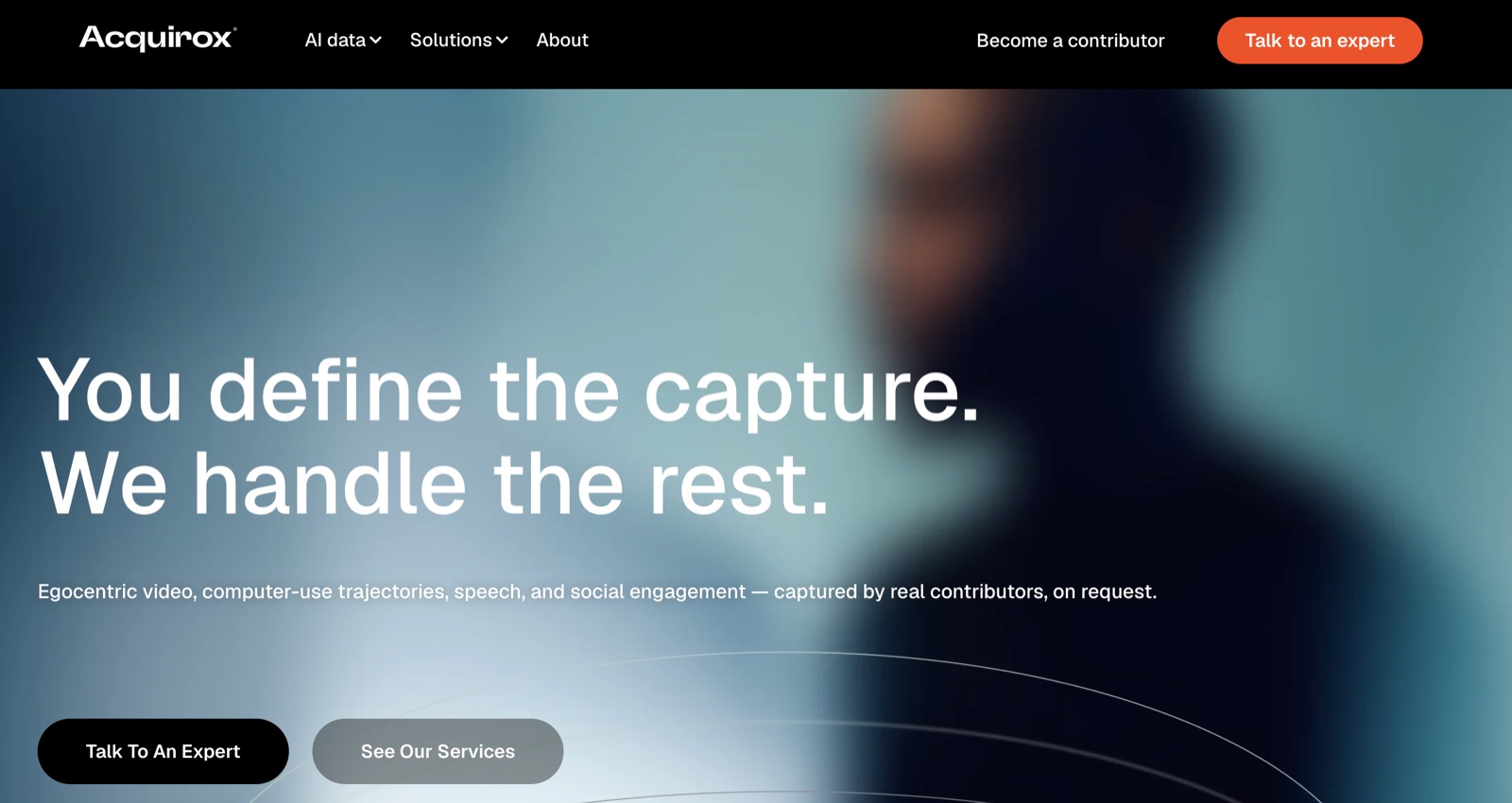
Acquirox is suited to organizations that need external support with AI training data rather than a standalone annotation platform. Its services can be considered for projects where reliable data preparation, annotation, and quality-focused workflows are important to the development and improvement of AI models.
Key Details & Considerations
- Best For: Companies looking for outsourced AI training data and data annotation support for machine learning and generative AI projects.
- Services: AI training data preparation, data annotation, and related support for machine learning workflows.
- Engagement: Services can be tailored to the requirements and scope of individual projects.
- Consideration: Teams should discuss project requirements, quality-control processes, turnaround times, and pricing directly with Acquirox before starting an engagement.
4. Sama
Sama operates as a premium, fully managed data labeling company, specializing in delivering highly accurate training data for complex computer vision models. The company combines its proprietary Platform 2.0 with a rigorously trained, in-house workforce, focusing on expert-in-the-loop annotation and validation. This approach is particularly effective for enterprises in retail, agriculture, autonomous driving (AV/ADAS), and geospatial sectors that demand consistent, high-quality data with minimal error rates.

What distinguishes Sama is its intense focus on process discipline and quality assurance. Their Platform 2.0 suite, which includes SamaIQ for data-driven quality insights and SamaAssure for automated checks, supports a workflow built on iterative calibration and continuous feedback loops. This methodology ensures annotators and models are consistently aligned, making Sama a strong choice for long-term, mission-critical AI projects where data quality directly impacts model performance and safety.
Key Details & Considerations
- Pricing: Custom-quoted based on project scope, complexity, and volume. Positioned as an enterprise-grade managed service.
- Best For: Organizations needing exceptionally high-quality annotation for complex image, video, and sensor fusion data, especially with long-term projects.
- Pros: Claims an industry-leading 99.5% acceptance rate through strong QA processes, provides ethical AI supply chain assurance, and maintains long-standing enterprise partnerships.
- Cons: Primarily a managed service, offering less direct control than self-serve platforms. The model is better suited to larger, planned projects than small, ad hoc annotation tasks.
Website: https://www.sama.com
5. iMerit
iMerit positions itself as a full-service data labeling company that combines expert-led managed services with its powerful Ango Hub platform. The company specializes in delivering production-grade data annotation across a wide array of modalities, including computer vision, NLP, and complex 3D sensor fusion. This end-to-end approach makes it a strong partner for enterprises in regulated or specialized industries like healthcare, autonomous systems, geospatial intelligence, and sports analytics that require deep domain knowledge and secure, auditable data pipelines.

What makes iMerit unique is its focus on building dedicated, expert-in-the-loop teams who become extensions of their clients' internal ML departments. By embedding these skilled annotators into client workflows, they provide not just labels but also valuable edge-case feedback and quality assurance. This model is particularly effective for complex, multimodal projects requiring nuanced judgment, such as annotating surgical videos or identifying critical objects in agricultural drone footage. Their Ango Hub platform further supports this by offering robust workflow automation and quality control tools.
Key Details & Considerations
- Pricing: Services are delivered via custom-quoted managed engagements. Pricing is opaque and requires a detailed statement of work (SOW) after a scoping process.
- Best For: Enterprise teams with complex, multimodal data needs in specialized fields requiring expert-led quality assurance and secure data handling.
- Pros: Deep domain expertise with documented production use cases, broad modality support (image, video, LiDAR, text), and enterprise-grade security and delivery.
- Cons: Primarily functions as a managed service, which is less ideal for teams seeking a pure self-serve tool. The custom SOW process means a longer procurement cycle.
Website: https://imerit.net
6. TELUS International AI Data Solutions (formerly Lionbridge AI / Playment)
TELUS International AI Data Solutions stands out as a massive global data labeling company, built from the acquisitions of Lionbridge AI and Playment. This combination gives it immense capacity for large-scale, multilingual data projects, serving enterprises that need diverse datasets for global product launches. The company supports complex multimodal annotation, including 3D sensor fusion, video, image, and audio across an impressive 500+ languages and dialects.
What makes TELUS a frequent choice for Fortune 500 companies is its end-to-end service model, which covers everything from initial data collection and creation to annotation, validation, and even Reinforcement Learning from Human Feedback (RLHF) for LLMs. Its proprietary platforms, like the Ground Truth studio, are designed for enterprise-grade workflows, ensuring security and quality control for sensitive projects in sectors like finance and healthcare.
Key Details & Considerations
- Pricing: Entirely custom-quoted based on project scope, volume, and complexity. Services are geared toward significant enterprise budgets.
- Best For: Global corporations requiring high-volume, multilingual data annotation, especially for voice assistants, search relevance, and autonomous systems.
- Pros: Unmatched linguistic diversity and global workforce scale. A comprehensive service catalog covers data creation, labeling, and model evaluation.
- Cons: Procurement processes can be slow, typical of a large vendor. Some proprietary tooling may lead to platform lock-in, making it difficult to switch providers.
Website: https://www.telusdigital.com/solutions/ai-data-solutions
7. Appen
Appen is a long-standing data labeling company with over 25 years of experience, known for its extensive crowd-sourcing capabilities and enterprise-grade services. It offers a wide range of human annotation across text, audio, image, and video, making it a reliable choice for large-scale data collection and labeling programs. The company's deep expertise in speech and NLP projects is a notable advantage for organizations building conversational AI, search relevance, and translation models.

What distinguishes Appen is its global workforce, which can be deployed for rapid project ramp-ups and massive data collection efforts. This model supports both fully managed services for enterprise clients and more flexible crowd management options. The platform’s mature delivery processes and quality control mechanisms are designed to handle complex requirements, making it a frequent partner for major tech companies. For teams new to the annotation process, understanding the basics of machine learning data labeling can help in effectively managing a partnership with a provider like Appen.
Key Details & Considerations
- Pricing: Custom-quoted based on project scope, volume, and service level agreements. Generally positioned for enterprise budgets.
- Best For: Large enterprises requiring diverse, high-volume data for speech, NLP, and computer vision models, particularly those needing a global reach.
- Pros: Broad modality coverage and mature delivery processes, with global crowd operations suitable for rapid scaling and multilingual support.
- Cons: Project quality and responsiveness can vary; conducting pilots and setting clear SLAs is recommended. Some online worker feedback warrants monitoring for compliance and ethics.
Website: https://www.appen.com
8. CloudFactory
CloudFactory operates as a specialized data labeling company by providing managed, trained teams that integrate directly into client workflows. This "team-as-a-service" model is particularly effective for organizations needing continuous, high-touch data annotation and validation. Its strength lies in handling ongoing production labeling for regulated or high-stakes industries, such as retail computer vision, medical data triage, and detailed geospatial analysis, where consistent quality and a deep understanding of the task are paramount.

The company’s approach centers on its workforce management platform and operational playbooks, which are designed to ensure throughput and maintain quality over long-term projects. Instead of offering a pure self-serve tool, CloudFactory acts as an extension of your own team, bringing structured processes and a dedicated workforce to your data pipeline. This model allows for continuous improvement and adaptation as project requirements evolve, making it a reliable choice for scaling AI operations with a human-in-the-loop component.
Key Details & Considerations
- Pricing: Custom-quoted based on team size, project complexity, and required service levels. The model is built for ongoing engagements rather than one-off tasks.
- Best For: Companies needing a dedicated, managed workforce for repeatable production labeling and data validation tasks.
- Pros: Strong for long-term projects requiring continuous quality improvement, clear operational playbooks, and a team integration model that fosters deep domain expertise.
- Cons: Not a pure self-serve platform, so onboarding requires more time. Highly specialized or complex 3D annotation tasks may need support from external partners.
Website: https://www.cloudfactory.com
9. Surge AI
Surge AI has carved out a niche as a high-end data labeling company focused on complex Natural Language Processing (NLP) and Generative AI evaluation. It provides expert human labeling teams and a robust platform designed for clients who need exceptional accuracy for tasks like Reinforcement Learning from Human Feedback (RLHF), safety moderation, and content evaluation. The company operates primarily through enterprise managed programs, offering dedicated teams, custom quality assurance workflows, and specific Service-Level Agreements (SLAs).

What makes Surge AI distinct is its deliberate focus on expert human intelligence for nuanced linguistic tasks. Instead of relying on a generalized crowd, it builds teams of raters with specific domain knowledge, making it a strong choice for LLM training and vendor bake-offs where quality is the primary metric. Its services are structured to support the entire GenAI lifecycle, from initial data collection and instruction-following datasets to model red-teaming and safety analysis.
Key Details & Considerations
- Pricing: Enterprise services are custom-quoted and priced at a premium, reflecting the high-touch, expert-led model. It is not positioned as a low-cost commodity provider.
- Best For: AI teams building and fine-tuning LLMs, requiring high-quality RLHF, model evaluation, and safety data.
- Pros: Excellent fit for complex NLP, RLHF-style preference labeling, and evaluation. Offers nimble, white-glove enterprise support.
- Cons: Smaller scale than major BPOs, so capacity planning is necessary for extremely large volume projects. Premium pricing may not suit budget-focused initiatives.
Website: https://www.surgehq.ai
10. Defined.ai
Defined.ai has carved out a distinct niche as a data labeling company by prioritizing ethical, enterprise-grade data collection and annotation with extensive global reach. It serves organizations that need high-quality, diverse, and ethically-sourced data, especially for training multilingual AI models. The platform combines a managed crowd-as-a-service (CaaS) model with a large marketplace of off-the-shelf datasets, offering flexibility for different project scales and timelines.
What makes Defined.ai stand out is its strong emphasis on fair crowd compensation and data diversity, which is crucial for building unbiased AI systems. This focus is particularly valuable for companies developing conversational AI, speech recognition, and LLMs that must perform reliably across many languages and dialects. Its dual-procurement model allows teams to either order custom-collected data or quickly acquire pre-existing datasets for immediate use.
Key Details & Considerations
- Pricing: Custom-quoted for managed CaaS projects, with prices varying significantly based on language, modality, and task complexity. Marketplace datasets are sold individually.
- Best For: Global companies needing multilingual speech, text, and image data; teams with strong ethical sourcing and data diversity requirements.
- Pros: Strong focus on global language coverage and ethical crowd operations, flexible engagement models fit different procurement strategies.
- Cons: Off-the-shelf marketplace datasets may not fit highly specialized domains without further customization.
Website: https://defined.ai
11. LXT
LXT distinguishes itself as a data labeling company by focusing on enterprise-grade data collection, annotation, and evaluation, particularly for complex multilingual speech, NLP, and Generative AI applications. The company delivers its services through a fully managed model, assigning dedicated project managers and quality assurance teams to ensure alignment with client goals. This approach is ideal for organizations requiring high-touch support for large-scale, global data initiatives like Reinforcement Learning from Human Feedback (RLHF), Supervised Fine-Tuning (SFT), and model red teaming.

A key factor in LXT's offering is its extensive global reach, facilitated by a partnership with Clickworker that provides access to over 8 million contributors across more than 1,000 language locales. This massive network, combined with ISO 27001 certification and options for secure physical facilities, makes LXT a strong partner for projects involving sensitive or regulated data. Human-in-the-loop services can be embedded directly into ML pipelines, ensuring continuous data quality and model improvement for enterprise systems.
Key Details & Considerations
- Pricing: All services are custom-quoted based on project scope, complexity, and required security protocols. Pricing reflects a managed service model.
- Best For: Global enterprises needing high-quality, multilingual speech and text data for NLP and GenAI, especially those in regulated industries.
- Pros: Well-suited for multilingual speech/NLP projects due to its massive contributor network. The strong security posture (ISO 27001, secure site options) is a major benefit for sensitive work.
- Cons: Primarily delivered as managed engagements with limited self-serve options. Lead times may apply for securing domain experts for highly specialized projects.
Website: https://www.lxt.ai
12. DataForce by TransPerfect
As the AI division of TransPerfect, DataForce offers managed data collection and annotation services with a distinct advantage in global scale and localization. This makes it an exceptional data labeling company for large, multilingual programs where linguistic accuracy is just as critical as annotation quality. The service integrates data labeling directly with translation and localization workflows, a unique combination for enterprises developing AI products for international markets.

DataForce combines a massive global crowd with dedicated enterprise program management, providing a flexible mix of tooling and services. Its platform features enhanced video and image annotation tools with customizable workflows, supported by the enterprise-grade security and process maturity of its parent company. This makes it a strong contender for organizations in regulated industries that need both scale and compliance.
Key Details & Considerations
- Pricing: Enterprise services are custom-quoted. Pricing reflects the managed service model and global scope.
- Best For: Global enterprises needing integrated, multilingual data annotation and collection for AI models, especially in regulated sectors.
- Pros: Strong fit for large-scale multilingual projects, flexible blend of tools and managed services, and benefits from TransPerfect's enterprise security.
- Cons: Enterprise procurement can be a heavier lift. Online feedback from the worker community is mixed, so careful management of SLAs and QA is advisable.
Website: https://www.dataforce.ai
13. Labelbox – Managed Services (Labelbox Boost/Workforce)
Labelbox is widely recognized for its collaborative data-centric AI platform, but it also functions as a data labeling company through its managed services offerings. This combination is ideal for teams who want best-in-class tooling and an integrated, vendor-managed annotation team without the operational overhead of managing separate vendors. Labelbox Boost provides on-demand, per-project services, while its enterprise-level Workforce solution offers a fully managed, dedicated team.

The primary advantage is having a single, unified system for both the software and the human-in-the-loop services. This allows for seamless quality control, real-time workforce monitoring, and programmatic management of labeling tasks through its Python SDK and APIs. It's an efficient path for organizations already standardized on the Labelbox platform to scale their labeling capacity without adding complexity. If you're deciding on a platform, you can learn more about the different types of data annotation platforms available before committing.
Key Details & Considerations
- Pricing: Managed services are typically available with enterprise plans, and pricing is custom-quoted and generally opaque. Boost services offer a more flexible entry point.
- Best For: Teams already using or standardizing on the Labelbox platform who need to augment their internal teams with managed external labelers.
- Pros: A unified tool and workforce under one vendor simplifies operations. The platform offers deep quality control and monitoring features.
- Cons: If your organization uses a different tool, migrating to Labelbox for its services could be a significant undertaking. The managed services are also tied to higher-tier plans.
Website: https://labelbox.com
Top 13 Data Labeling Companies Comparison
| Provider | Core features | Quality & UX | Value & Pricing | Target audience | Unique selling points |
|---|---|---|---|---|---|
| Zilo AI (recommended) 🏆 | IT staffing + text/image/voice annotation; ASR & vision tooling | 1,600+ experts; 10M+ labels; ★★★★☆ | 💰 Custom quotes; bundled staffing+data value | 👥 Startups, enterprise AI/ML teams, research | ✨ One partner for hire + high-quality multilingual labeling; word-level ASR timestamps |
| Scale AI | End-to-end training data, Rapid self-serve, 2D/3D AV tools | Mature pipelines & docs; ★★★★★ | 💰 Premium; custom-quoted | 👥 AV/robotics, large enterprises needing scale | ✨ GenAI Data Engine; strong tooling + managed pipelines |
| Acquirox | AI training data preparation and data annotation | Quality-focused workflows | 💰 Tailored to project scope; pricing on request | 👥 Companies outsourcing AI training data for ML and generative AI | ✨ Outsourced data preparation and annotation to reduce in-house labeling workload |
| Sama | Managed human-in-loop annotation; SamaIQ/SamaAssure | Rigorous QA & calibration; ★★★★☆ | 💰 Managed service pricing (enterprise) | 👥 Retail, AV/ADAS, geospatial enterprises | ✨ Iterative calibration, sampling portal for consistent quality |
| iMerit | Multimodal annotation; Ango Hub automation & PS | Expert-led QA; ★★★★☆ | 💰 Custom SOWs; enterprise pricing | 👥 Sports analytics, AV, healthcare | ✨ Domain teams + workflow automation for production pipelines |
| TELUS International AI Data Solutions | Global data collection, RLHF, 500+ languages | Enterprise-grade delivery; ★★★★★ | 💰 Enterprise pricing; high-scale value | 👥 Very large multilingual/regulated programs | ✨ Massive global workforce; localization + RLHF capabilities |
| Appen | Crowd operations for speech, NLP, image & video | Mature ops but variable by project; ★★★☆☆ | 💰 Crowd-priced; scalable but variable | 👥 Rapid ramp-ups, speech/NLP programs | ✨ 25+ years of crowd experience and global reach |
| CloudFactory | Managed teams + workforce ops platform | Strong for continuous production labeling; ★★★★☆ | 💰 Team-as-a-service pricing | 👥 Regulated/high-stakes domains needing team integration | ✨ Operational playbooks and integrated workforce model |
| Surge AI | Expert raters for NLP, RLHF, evaluation & safety | White-glove enterprise SLAs; ★★★★☆ | 💰 Premium for expert evaluation work | 👥 LLM training, RLHF, safety, moderation teams | ✨ Focused on high-accuracy evaluation & safety workflows |
| Defined.ai | Crowd-as-a-service + dataset marketplace | Ethics- and diversity-focused QA; ★★★★☆ | 💰 Marketplace + managed pricing; varies by locale | 👥 Ethical sourcing, multilingual LLM fine-tuning | ✨ Off-the-shelf datasets + diversity-focused crowd ops |
| LXT | Multilingual speech/NLP; secure facilities (ISO 27001) | Security-first delivery; ★★★★☆ | 💰 Managed engagements; secure-site options | 👥 Regulated speech/NLP projects | ✨ ISO 27001, 8M+ contributors via partner networks |
| DataForce (TransPerfect) | Managed annotation + localization integration | Enterprise maturity; ★★★★☆ | 💰 Enterprise SOWs; integration value | 👥 Localization-heavy enterprises, regulated sectors | ✨ Combines labeling with translation/localization workflows |
| Labelbox – Managed Services | Labelbox platform + optional managed workforce | Unified tooling + QC; ★★★★☆ | 💰 Enterprise plans; opaque pricing | 👥 Teams standardizing on Labelbox, enterprises | ✨ Best-in-class tooling paired with optional managed labeling |
Final Thoughts
The journey to developing a high-performing AI model is built on a foundation of accurately labeled data. As we've explored, the path to acquiring that data is not a one-size-fits-all process. The market for data annotation services is rich with diverse providers, each with its own strengths, specializations, and operational models. Your final choice will significantly influence your project's timeline, budget, and the ultimate quality of your AI application.
This guide has walked you through a curated selection of providers, from industry giants like Appen and TELUS International, known for their massive global workforces, to specialized powerhouses like Sama, with its focus on ethical AI and social impact. We’ve seen how companies like Scale AI and Surge AI are pushing the boundaries with advanced tooling and human-in-the-loop systems, while others like CloudFactory and iMerit offer managed workforces that act as true extensions of your internal team. The key is that there is a data labeling company perfectly suited for every unique need, whether you're a startup needing rapid scaling or an enterprise tackling complex, niche data sets in regulated industries like healthcare or finance.
Key Takeaways for Selecting Your Partner
Recapping our analysis, the decision-making process boils down to a few critical evaluation points. Don't let impressive client lists or marketing claims be the sole driver of your choice. Instead, focus on the factors that directly map to your project's success.
- Quality is Non-Negotiable: Look beyond simple accuracy percentages. Dig into the specifics of their quality control mechanisms. Do they use consensus, gold sets, or real-time review? A provider's transparency about their QA process is a strong indicator of their commitment to excellence.
- Expertise Matters: Generalist providers have their place, but for specialized tasks in medical imaging (DICOM), autonomous driving (LiDAR), or financial document analysis, a partner with proven domain expertise is invaluable. They understand the nuance and context, which prevents costly errors and rework.
- Security & Compliance are Paramount: If your data is sensitive, this is a deal-breaker. Verify certifications like SOC 2 Type II, ISO 27001, and HIPAA compliance. Understand their data handling protocols, from transfer to storage and deletion.
- The Right Pricing Model: The choice between per-task, per-hour, or a full-time equivalent (FTE) model depends entirely on your project's scope and predictability. Startups might prefer the flexibility of per-task pricing, while large-scale, ongoing projects may find more value and stability in a dedicated team model.
Actionable Next Steps: A Practical Checklist
Before you sign a contract with any data labeling company, work through these final steps to ensure a successful partnership. This structured approach helps move from theoretical research to practical implementation.
- Define Your Pilot Project: Select a small, representative subset of your data (e.g., 1,000 images, 50 hours of audio). This will be your testing ground.
- Shortlist 2-3 Providers: Based on our guide, pick the top contenders that align with your industry, data type, and budget.
- Run a Paid Pilot: Do not rely on free trials alone. A paid pilot forces the provider to treat it like a real project and gives you a genuine sense of their quality, communication, and turnaround times.
- Evaluate the Results: Assess the labeled data not just for accuracy but also for consistency and adherence to your instructions. How was the communication with their project manager? Did they meet the agreed-upon SLA?
- Review the Master Service Agreement (MSA): Scrutinize the terms related to data ownership, security protocols, liability, and the process for scaling up or down.
Choosing the right partner is less about finding the "best" data labeling company and more about finding the right one for your specific context. The ideal partner will feel less like a vendor and more like an integral part of your AI development lifecycle. By investing the time to rigorously evaluate your options, you are not just buying a service; you are building a critical component of your AI strategy and setting your models up for success from day one.
Ready to move from evaluation to execution with a partner that prioritizes quality, security, and a bespoke approach? Zilo AI combines advanced annotation platforms with expertly managed teams to deliver production-grade training data for the world’s most ambitious AI projects. Discover how Zilo AI can provide the high-quality, secure, and scalable data labeling solution your team needs.