If you're deciding whether to use a human transcriptionist, an AI tool, or a mix of both, you're probably facing the same problem many teams face. Audio is piling up faster than anyone can use it.
Sales calls sit in folders. User interviews stay inside video files. Internal meetings happen, decisions get made, then nobody can search what was said a week later. The value is there, but it isn't accessible.
That gap is where an audio transcriptionist becomes important. Not as a basic typist, but as the person who turns speech into text your team can review, search, tag, quote, audit, and analyze. In high-stakes work, that last layer of judgment still matters.
From Sound to Strategy Why Audio Data Needs a Human Touch
A product team finishes ten customer interviews. A compliance team records calls for documentation. A healthcare group dictates notes that need to be usable later. In each case, the business has captured information, but not yet converted it into something operational.
Audio is rich, but messy. People interrupt each other. Terms are misheard. Speakers switch mid-sentence. Someone uses a product nickname that only the team understands. Another person trails off, then restarts. Raw recordings preserve all of that, but they don't make it easy to act on.
An audio transcriptionist solves that business problem by turning spoken content into accurate written text. Once the content exists in text form, teams can search for decisions, pull quotes for reports, check terminology, create records, and feed downstream workflows like analytics or annotation.
Why text changes the value of audio
Leaders often assume the recording itself is enough. It usually isn't.
A transcript makes spoken information usable in ways audio alone doesn't:
- Searchability: Teams can find names, topics, and decisions without replaying full recordings.
- Documentation: Legal, healthcare, and research teams can maintain clearer records.
- Analysis: Researchers and operations teams can code themes, compare responses, and review patterns.
- Access: More stakeholders can review written material than sit through long recordings.
If you're clarifying the basics for colleagues, this primer on what is transcribed is a useful companion because it helps separate the source material from the final written output.
Audio captures the moment. A transcript makes the moment reusable.
Where business leaders get confused
The most common misunderstanding is thinking transcription starts and ends with word conversion. It doesn't.
A useful transcript has to answer practical questions:
- Who said what?
- Was that statement complete or interrupted?
- Does the wording need to be verbatim, or cleaned for readability?
- Is the transcript going into a legal file, a research repository, a CRM, or an AI workflow?
Those choices affect cost, turnaround, and risk. That's why the modern transcriptionist matters more than many buyers expect. In many organizations, they aren't just producing text. They're making spoken business data reliable enough to use.
The Core Role of an Audio Transcriptionist
An audio transcriptionist is a translator between mediums. They take speech, with all its pauses, overlap, accents, false starts, and context, and convert it into text that another person can trust.

That sounds simple until you watch skilled transcriptionists work. They don't just hear words. They separate speakers, infer sentence boundaries, flag unclear passages, standardize formatting, and make judgment calls about what belongs in the final record.
What the job includes
A professional transcriptionist usually works through several layers at once:
- Listening closely: They replay difficult sections, slow playback, and isolate unclear speech.
- Identifying structure: They mark speakers, paragraph breaks, timestamps, and other formatting elements.
- Checking language: They correct punctuation, confirm names, and verify technical terms where needed.
- Delivering for the use case: A legal transcript, research transcript, and media transcript don't follow the same standard.
If you're trying to explain the concept to a non-specialist, this guide to the true meaning of transcription helps because it frames transcription as interpretation with discipline, not random typing.
Why this is a real profession, not clerical busywork
The role supports industries where accuracy has operational consequences. According to the U.S. Bureau of Labor Statistics, medical transcriptionists, a key subset of audio transcriptionists, accounted for approximately 43,900 jobs in 2024 and had a median annual wage of $37,550, while the broader transcription market was valued at $21.01 billion in 2022 and is projected to reach $35.8 billion by 2032 (BLS).
That matters for a business leader because it shows two things at once. First, transcription is established work with formal labor demand. Second, the market is expanding because organizations keep generating more speech data.
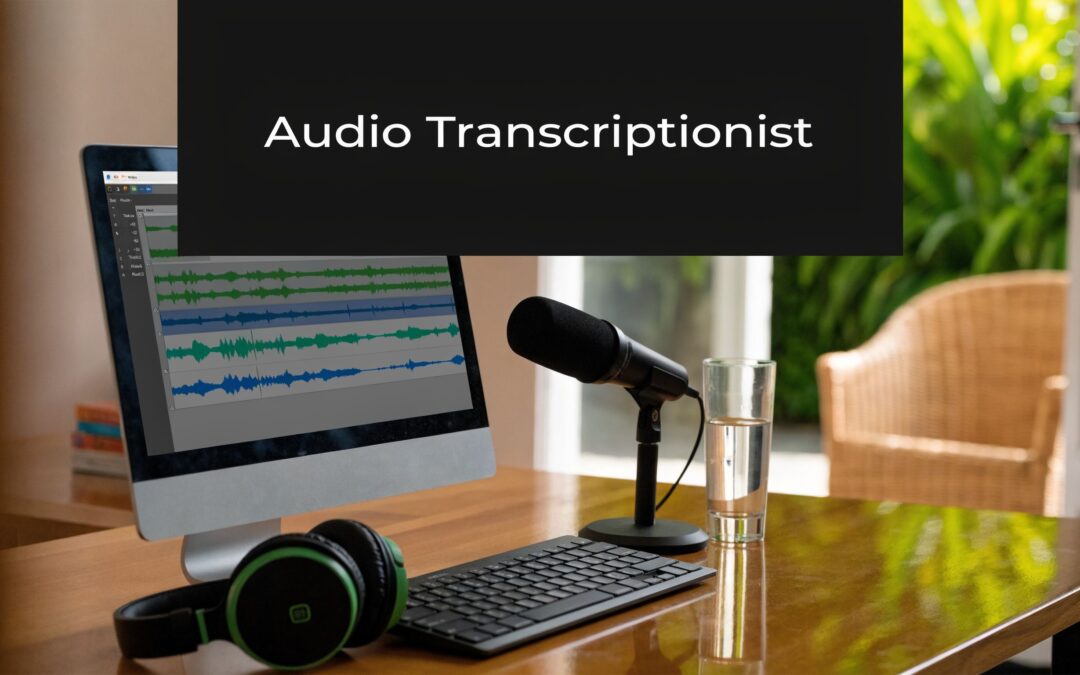
A short visual example helps show the day-to-day reality of the role:
The manager's view of quality
When I evaluate transcripts, I don't start by asking whether every word is present. I start by asking whether the transcript is dependable enough for its intended use.
That means checking things like:
- Speaker clarity: Can a reader follow the conversation without confusion?
- Terminology accuracy: Were industry-specific terms captured correctly?
- Formatting fit: Does the output match the workflow it's entering?
- Risk level: Would an error create a compliance, research, or customer issue?
Practical rule: A transcript isn't good because it exists. It's good because another team can use it without second-guessing it.
Understanding Transcription Types and Specializations
Not all transcripts aim for the same outcome. Some need to preserve every spoken detail. Others need to be easier to read. If you pick the wrong style, the transcript can be technically accurate but still wrong for the job.
Two common transcript styles
The first decision is usually about how closely the text should mirror the original speech.
| Transcription Type | Description | Best For |
|---|---|---|
| Full verbatim | Captures speech closely, including filler words, repetitions, false starts, and non-verbal cues when required | Legal review, qualitative research, discourse analysis |
| Clean verbatim | Preserves meaning but removes some fillers, stumbles, and obvious speech clutter for readability | Business meetings, content repurposing, executive review |
A researcher studying hesitation patterns may want every "um," pause, and restart retained. A product manager reviewing user pain points usually wants the cleaner version so they can scan it quickly.
Why specialization changes the hiring decision
Here, many buyers make expensive mistakes. They assume any capable English transcriptionist can handle any project. That isn't true in high-stakes work.
Specialized verticals require terminology mastery and subject familiarity. Medical transcriptionists need fluency in medical procedures, legal transcriptionists need familiarity with depositions and court proceedings, and multilingual transcriptionists need to understand cultural nuance and context-specific meanings that don't translate directly (Upwork job description guide).
A few examples make the difference clear:
- Medical work: A transcriptionist has to recognize procedure names, medication references, and dictated shorthand.
- Legal work: They need to follow formal proceedings, identify speakers correctly, and preserve exact wording where the record matters.
- Multilingual work: They must hear beyond literal translation and understand how meaning shifts across languages and cultures.
Generalist versus specialist
A generalist can be a good fit for lower-risk work like internal meetings or simple interviews. A specialist is the safer choice when the transcript becomes part of a formal record or analytical dataset.
Ask these questions before assigning work:
- Does the content include technical language?
- Will anyone quote the transcript in an official setting?
- Does the transcript need cultural or bilingual interpretation?
- Will another team use it for research, annotation, or compliance?
If the transcript will support a decision, an audit trail, or a formal record, domain knowledge isn't a luxury. It's part of accuracy.
A simple buying lens
Use this rule of thumb:
- Choose clean verbatim when readability matters most.
- Choose full verbatim when speech behavior itself matters.
- Choose a specialist when terminology, regulation, or multilingual nuance raises the risk of misinterpretation.
That distinction is one of the clearest answers to the question, what is an audio transcriptionist. The best ones don't just type what they hear. They know what kind of transcript the business needs.
The Modern Workflow Human AI and Hybrid Models
A compliance officer needs a board-ready transcript by 9 a.m. The recording includes cross-talk, industry acronyms, and one sentence that could change how a risk event is interpreted. In that situation, the central question is not whether AI can produce text quickly. It is who will catch the errors before they become part of the record.

Businesses now choose between three operating models: human-only, AI-only, and hybrid. The right choice depends less on novelty and more on consequence. A missing word in an internal brainstorm may be harmless. A wrong medication name, speaker label, or quoted statement can create legal, operational, or reputational risk.
Human-only transcription
In a human-only workflow, the transcriptionist builds the transcript from the audio itself. That gives one person control over meaning, formatting, terminology checks, and speaker attribution from start to finish.
This model fits work where judgment carries more weight than speed:
- High-stakes records: hearings, regulated interviews, clinical dictation, and investigative material
- Difficult audio: overlapping speakers, background noise, poor microphones, or heavy accent variation
- Ambiguous language: places where context decides whether a phrase is harmless, technical, or legally significant
The tradeoff is time and labor. You are paying for careful listening, repeated review, and researched decisions, not just text entry.
AI-only transcription
AI transcription works like a fast first-pass scanner. It turns speech into searchable text quickly, which makes it useful for low-risk internal work.
For teams comparing platforms, this guide to qualitative research transcription software options is a practical starting point because it helps you assess workflow fit, editing features, and review needs, not just headline speed.
AI-only output is usually a good fit for:
- rough meeting notes
- internal summaries
- early draft review
- large audio volumes where small errors are acceptable
Its weakness is predictable. Software can miss domain terms, confuse similar-sounding words, split one speaker into two, or smooth over uncertainty as if it were fact. Those errors are easy to ignore when the transcript is only a convenience. They are expensive when teams reuse the text in reports, case files, training data, or customer records.
Why hybrid is now the practical default
Hybrid transcription combines machine speed with human judgment. AI creates the draft. A trained transcriptionist then edits, verifies, and signs off on the final version.
That human role has changed. In many organizations, the transcriptionist now acts as an expert editor and AI wrangler. The job is less about typing every word from a blank page and more about checking what the machine got wrong, what it failed to hear, and what it presented with too much confidence.
That matters because AI errors are rarely evenly distributed. Clean audio may look fine at a glance, then hide problems in names, timestamps, speaker changes, or technical phrases. A good editor treats the AI draft the way a finance team treats imported spreadsheet data. Useful as a starting point, never safe to approve without review.
Industry guidance from Rev on AI and human transcription accuracy supports this buying logic. Automated transcription is fast, but human review remains the safer model when transcripts need high accuracy or will be used in legal, medical, research, or client-facing settings.
A decision view for business leaders
Use this table as an operational shortcut:
| Model | Primary advantage | Main limitation | Best fit |
|---|---|---|---|
| Human-only | Strong contextual judgment and direct quality control | Slower turnaround and higher labor cost | Sensitive, high-risk, or difficult audio |
| AI-only | Fast draft generation at scale | More errors in nuanced or messy audio | Low-risk internal use |
| Hybrid | Better balance of speed, cost, and review quality | Still depends on skilled human editors | Most business workflows with moderate to high stakes |
The safest way to use AI transcription is to treat it as draft production, then assign a qualified human to verify what the business will rely on.
That is the modern answer to what is an audio transcriptionist. In a hybrid workflow, the transcriptionist is the final quality layer between raw speech recognition and a transcript the business can trust.
The Essential Skills for 99 Percent Accuracy
When people underestimate transcription work, they usually focus on typing speed and ignore the harder parts. Typing matters, but it isn't what separates an amateur from a professional.
The true difference is how well someone listens, interprets, verifies, and stays accurate under strain.
Accuracy starts with cognitive work
A single hour of audio can require approximately six hours of human transcription work, a 6:1 ratio, because the transcriptionist has to distinguish multiple speakers, capture non-verbal cues, process context, and stay focused while filtering distractions. That cognitive load also creates listener fatigue, and error rates can rise significantly after just two hours of continuous work (GMR Transcription).
That explains why good transcripts don't happen by accident. The work is mentally dense.
Skills that matter
The strongest transcriptionists usually share a small set of hard-to-automate abilities:
- Active listening: They hear differences between similar-sounding words and catch meaning from context.
- Language control: They know when punctuation changes meaning and when grammar should or shouldn't be cleaned up.
- Research ability: They verify product names, medical terms, surnames, acronyms, and place names instead of guessing.
- Speaker management: They track overlap, interruptions, and changes in who is talking.
- Tool fluency: They know how to work with foot pedals, playback controls, noise reduction, and editing software.
If your team handles interviews regularly, this guide on interview workflows is practical because it shows how transcription quality affects the usefulness of the final research record: https://ziloservices.com/blogs/how-to-transcribe-interviews/
What businesses should screen for
If you're hiring or evaluating a vendor, don't only ask for a sample transcript. Ask how the person handles ambiguity.
Useful questions include:
- How do you mark inaudible sections?
- What's your process for verifying technical terms?
- How do you treat overlapping speakers?
- When do you preserve filler words, and when do you clean them?
- What do you do when the audio quality is poor?
A weak transcriptionist guesses. A strong one follows standards and flags uncertainty clearly.
Good transcription isn't about pretending every word is obvious. It's about handling uncertainty without hiding it.
Why this matters in AI-era workflows
In hybrid work, these same human skills become even more valuable. The editor has to spot where the machine sounded confident but was wrong. That's often harder than transcribing from scratch because bad AI output can look polished on first read.
The businesses that get reliable transcripts usually respect the craft behind them. They don't treat the human reviewer as a final spell-checker. They treat that person as the quality gate.
Where Transcription Drives Business Value Across Industries
A hospital compliance lead reviews a dictated note. A litigation team checks a witness statement. A product manager scans ten customer interviews before a roadmap meeting. In each case, the business is making a decision from spoken information. If the text is incomplete, misheard, or stripped of context, the decision quality drops with it.
That is why transcription matters beyond documentation. It turns speech into a working business asset.

Analysts at Grand View Research describe transcription as a growing market tied to healthcare, legal, media, and enterprise demand for searchable, usable records: Grand View Research's transcription market analysis. The business reason is straightforward. Audio is hard to scan, compare, audit, and feed into reporting systems. Text is much easier to work with.
The newer shift is just as important. AI can draft transcripts quickly, but high-stakes teams still need a human to review terminology, speaker attribution, meaning, and omissions. In practice, the modern transcriptionist often works like the final quality controller for machine output. They catch the expensive mistakes that software can present in polished language.
Industry examples that matter
Healthcare
Clinicians often dictate notes because speaking is faster than typing during a full schedule. But speed at capture only helps if the final record is accurate.
In healthcare, one wrong drug name, dosage term, or symptom can create billing issues, coding errors, or clinical confusion later. Human review matters because medical audio includes accents, background noise, abbreviations, and specialty vocabulary that generic AI often handles unevenly.
Legal
Legal teams do not just need a readable transcript. They need a defensible one.
Depositions, hearings, interviews, and client recordings depend on exact wording, speaker identification, and a clear record of uncertainty where audio is unclear. AI can help produce a first draft fast. A trained transcriptionist or legal editor makes sure the transcript reflects what was said, not what the software guessed was likely.
Media and content teams
For media teams, transcription works like an indexing layer for spoken content. A podcast episode or webinar becomes searchable, quotable, and reusable once it exists in text.
That text supports captions, article drafts, clips, summaries, SEO pages, and archive search. If your team is weighing whether to keep this work in-house or outsource it, this guide to outsource transcription services for repeatable content and operational workflows gives a practical view of what to look for.
Research and product teams
Researchers need more than a rough transcript. They need consistent text they can code across interviews.
A missing phrase can distort a theme. A wrong speaker tag can change who said what. In hybrid workflows, AI speeds up first-pass transcription, while human reviewers protect the integrity of the dataset before analysts start tagging insights or pulling quotes for reports.
BFSI and enterprise operations
Banks, insurers, support centers, and large operations teams record conversations for oversight, service review, training, and dispute handling. Those recordings become more useful when they can be searched, sampled, and checked against policy.
This is also where hybrid transcription has strong business value. AI can process volume. Human reviewers can verify the small set of files where wording, compliance language, or customer intent carries higher risk.
The broader business takeaway
Transcription creates value in two ways.
First, it gives teams a reliable written version of conversations so they can review, compare, share, and act faster. Second, it prepares speech data for downstream use in analytics, quality monitoring, knowledge management, and AI systems.
For business leaders, the main choice is rarely human or AI in isolation. It is how much risk sits inside the audio, and where a human editor should step in. In low-risk, high-volume cases, AI may cover most of the work. In regulated or high-consequence settings, the transcriptionist becomes the person who turns a fast draft into a record the business can trust.
A transcript often becomes the version of the conversation that the organization relies on later.
How to Hire and Partner for Transcription Success
Businesses usually have three options. They can hire freelancers, use a traditional agency, or work with a specialized service partner.
Freelancers can be a good fit for occasional low-volume work. Agencies can help when you need project handling. A specialized partner tends to make more sense when you need repeatable quality, domain coverage, multilingual capability, and operational scale.
What to look for before you commit
A strong transcription partner should offer more than availability.
Look for:
- Pre-vetted talent: You want people who can handle your domain, not just generic audio.
- Workflow discipline: Ask how drafts are reviewed, corrected, and quality checked.
- Scalability: A good partner should handle volume changes without quality dropping.
- Language coverage: This matters if your business works across markets or mixed-language content.
- Use-case fit: The output should match research, compliance, media, or annotation needs.
If you're weighing the outsourcing route, this overview is a useful starting point because it breaks down what businesses should expect from external support: https://ziloservices.com/blogs/outsource-transcription-services/
The best partnerships reduce management overhead. Your team shouldn't have to train every new transcriber, chase formatting consistency, or rebuild quality control from scratch for each project. You want a process you can trust.
If your team needs dependable transcription, multilingual support, or human-in-the-loop data services, Zilo AI helps businesses connect with skilled transcription and language professionals who can support research, operations, and AI-ready workflows at scale.