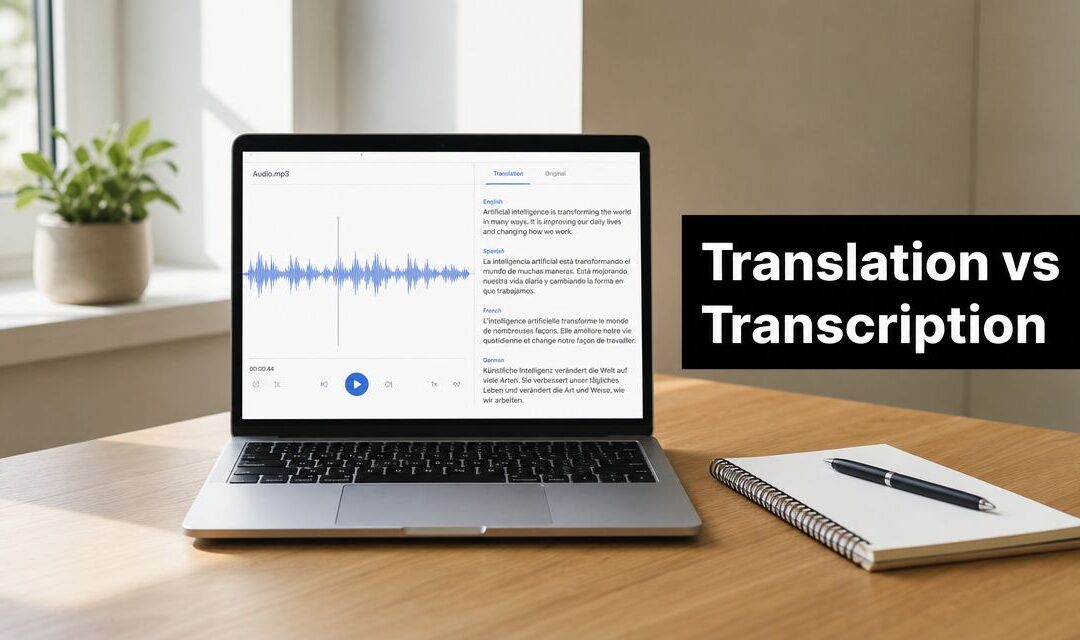
You've got a recorded customer interview, a product demo, a webinar, or a batch of research calls. Someone on your team says, “We need this translated.” Someone else says, “No, we need it transcribed first.” Both might be right, and that's where projects start to drift.
I've seen this happen in marketing teams, research groups, and operations departments. The source file is clear enough. The goal isn't. If you choose the wrong service at the start, you get the wrong deliverable, the wrong workflow, and a lot of unnecessary revision.
The simplest way to think about translation vs transcription is this: one changes format, the other changes language. But in real projects, the better question is operational. What do you have, what do you need at the end, and who needs to use it?
Do You Need to Translate or Transcribe Your Content
A common situation looks like this. A team has a recorded panel discussion in Spanish. The product team wants a written record for internal review. The marketing team wants English subtitles. The research team wants to code the speaker responses for themes.
Those are three different outcomes from one source file.
If your main need is a written version of what was said, in the same language, you're looking at transcription. If your need is to make the content understandable in another language, you're looking at translation. If you need both, the order matters.
A project manager usually starts with three checks:
- Source format: Is the source audio, video, or already written text?
- Target audience: Are they reading in the same language or another one?
- Final use: Is this for analysis, compliance, subtitles, training, publication, or searchability?
That's why the first decision isn't linguistic. It's functional.
Practical rule: If the content only exists as speech, you often need a text step before you can do anything else well.
For example, a UX research team may record interviews in English and need searchable text for coding. That's a transcription job. A global HR team may have a written handbook in English and need it in Japanese. That's a translation job. A training team with an English webinar for a multilingual workforce may need an English transcript first, then translated subtitles and supporting documents.
If your team is still sorting out what kind of transcript you need, this guide to outsource transcription services is useful because it frames transcription as a deliverable choice, not just a typing task.
Here's the key point. The words sound similar, but the business decision is different. One preserves spoken content in text. The other carries meaning across languages.
The Core Definitions Transcription and Translation
At the simplest level, transcription means turning spoken content into written text in the same language. Translation means converting meaning from a source language into a different language.
That distinction seems obvious until a project includes audio, captions, multilingual users, and AI tools. Then teams start using the words loosely and procurement requests get messy.

A quick comparison
| Question | Transcription | Translation |
|---|---|---|
| Input | Spoken audio or video | Usually text, sometimes speech routed through text |
| Output | Written text in the same language | Content in another language |
| Main goal | Capture what was said | Convey what it means |
| Best for | Records, captions, analysis, search | Cross-border communication, multilingual access |
| Core risk | Mishearing words | Misstating meaning or tone |
Why these terms exist
The terms come from molecular biology, and that origin helps. In the central dogma, DNA is transcribed into RNA, and RNA is translated into protein. In eukaryotes, these happen in different places in the cell, with transcription in the nucleus and translation in the cytoplasm, which is one reason they're taught as distinct stages of information processing in this PMC review on transcription and translation.
That's a useful memory aid for language work too.
- Transcription copies content into another form without changing the language.
- Translation changes the output so a different system, or a different audience, can use the meaning.
If you record an English sales call and turn it into English text, that's transcription. If you take that English text and produce French copy for a regional team, that's translation.
The most important difference is not the file type. It's whether the language stays the same.
Where people get confused
Confusion usually shows up in two places.
First, people say “translate this video” when they mean “create subtitles.” Subtitles may require transcription, translation, timing, and quality review. That's a workflow, not a single task.
Second, teams use “transcript” to mean “clean final script.” A transcript can be rough, verbatim, speaker-labeled, or edited. The intended use matters.
If you want a fast refresher on language service vocabulary, this list of essential transcription terms for marketers is handy because it explains the labels buyers run into when requesting deliverables.
A Detailed Side by Side Comparison
The operational gap between translation and transcription becomes clearer when you compare them across the same criteria.

Inputs and outputs
Transcription starts with speech. The transcriptionist, or an ASR system plus reviewer, listens to audio and produces text. The language stays constant.
Translation usually starts with text, even when the original source is spoken. That's why many audio projects move through a transcript first. The translator works from a stable written source and creates an equivalent version in another language.
Key distinction: Transcription answers “What was said?” Translation answers “How should this be expressed for another language audience?”
A biology analogy helps here. RNA is described as typically capping out at around 10,000 bases, while DNA averages about 100 million bases, which is one reason transcription is often understood as creating a shorter, more manageable copy of information in this IDT explanation of transcription and translation differences.
That maps well to business workflows. A long meeting recording becomes a usable text record. That text can then feed review, search, tagging, compliance, or translation.
Core task and decision logic
Transcription is an accuracy-of-capture task. The operator needs to identify words, speakers, pauses if required, and terminology. Audio quality matters a lot. So do accents, overlap, and subject matter.
Translation is an accuracy-of-meaning task. The translator has to interpret context, tone, domain language, and audience expectation. Literal wording often isn't the goal. Correct intent is.
A side by side view makes the split easier to manage:
For transcription
- Input reality: live speech, recorded calls, interviews, webinars
- Primary challenge: hearing correctly
- Typical output: transcript, captions source text, searchable archive
For translation
- Input reality: source text, approved transcript, UI strings, manuals
- Primary challenge: expressing meaning correctly
- Typical output: multilingual content for readers or viewers
Skills and review needs
A good transcription workflow depends on listening skill, subject familiarity, formatting discipline, and clear QA rules. Teams often need decisions on speaker labels, timestamps, filler words, and whether they want verbatim or cleaned output.
A good translation workflow depends on bilingual writing ability, terminology management, and audience fit. That includes cultural choices, not just language conversion.
To see the distinction in another format, this short explainer is useful:
What to order when you're unsure
Use this fast checklist:
| If your project needs… | Order… |
|---|---|
| A written record of a call | Transcription |
| An English brochure in German | Translation |
| Subtitles in the same language as the speaker | Transcription plus timing |
| Subtitles in another language | Transcription then translation |
| Research coding from interview audio | Transcription |
| A multilingual website launch | Translation |
The biggest mistake buyers make is ordering by file type instead of by final use. A video file doesn't automatically mean translation. A PDF doesn't automatically mean transcription. Start with the end deliverable.
Real World Use Cases and Workflows
The easiest way to settle translation vs transcription is to look at what the team is trying to do after delivery.

Research teams
A university lab runs interviews with clinicians. The recordings are rich, but audio alone is hard to analyze. The team needs text they can search, tag, quote, and code in qualitative analysis software.
That's a transcription-first workflow. If the interviews are later shared with an international partner, the approved transcript may then move into translation. For teams doing this often, a practical reference on how to transcribe interviews helps set expectations on formatting and review.
Marketing and media teams
A brand records a webinar in English and wants to repurpose it into blog posts, captions, clips, and regional versions. The first asset to stabilize is the transcript. Once the transcript is cleaned, the team can create subtitles, adapt website copy, and localize campaign materials.
That sequence mirrors a useful idea from biology. In bacteria, transcription and translation can be physically coupled, and that coupling can improve efficiency in this PNAS paper on coupled transcription and translation. In business terms, the closer you connect transcript creation, editing, and translation, the less friction you create downstream.
Tight handoffs matter. A clean transcript gives every later step a better source.
If your goal is video growth rather than internal documentation, this guide on how to grow your YouTube audience globally is useful because it connects multilingual video workflows to audience reach.
Legal and operations workflows
A legal team may need a deposition transcribed for recordkeeping and case preparation. If stakeholders in another jurisdiction need access, the transcript then becomes the source for translation. The same pattern appears in compliance training, customer support archives, and multilingual employee communications.
Here's the operational version of that workflow:
- Capture the speech with transcription.
- Review and clean the text for the project's real purpose.
- Translate the approved source if another language audience needs it.
- Publish in the right format, such as subtitles, reports, training guides, or searchable records.
When teams skip step two, every later stage becomes harder.
Evaluating Cost Accuracy and Turnaround Time
Buyers usually compare language services on three variables: cost, accuracy, and turnaround time. Those variables matter, but they don't move independently.
What changes effort in transcription
Transcription effort rises when the source audio is difficult. Poor sound, crosstalk, regional accents, technical vocabulary, and unclear speaker separation all slow review and increase the need for human correction.
The choice of transcript style also changes the job:
- Verbatim output: includes fillers, false starts, and speech patterns when needed for legal, research, or discourse analysis.
- Clean read output: removes distractions so readers can use the content more easily.
- Timestamped output: adds navigation value, but also adds handling rules.
What changes effort in translation
Translation effort depends less on sound quality and more on the quality of the source text. If the source is inconsistent, repetitive, or full of unresolved terminology, the translator spends time solving upstream problems instead of writing the target text.
Project managers earn their keep by defining glossary rules, approving source copy, and preventing teams from sending unstable text into multilingual production.
Faster isn't just a staffing decision. It's a source-quality decision.
A useful biological parallel comes from E. coli. Transcription can proceed at about 80 nucleotides per second, while translation proceeds at about 20 amino acids per second. Because 3 nucleotides code for one amino acid, the rates are nearly matched, and a roughly 1 kb gene can be transcribed in about 10 seconds and translated on a similar timescale in this BioNumbers explanation of transcription and translation speed.
For language projects, the lesson isn't the biological number itself. It's the relationship. Different processes can still be tightly interdependent. If one stage lags, the whole schedule shifts.
How to evaluate a quote
When comparing vendors or workflows, ask these questions:
- What is the source condition? Clean webinar audio is not the same as field research recorded on phones.
- What is the accuracy threshold? Internal note-taking needs a different standard than legal evidence or regulated content.
- What is the final deliverable? Transcript, subtitle file, translated article, multilingual training pack, or annotated dataset.
- Who owns QA? Someone has to approve terminology, names, formatting, and exceptions.
If your team is using automation as part of the workflow, this overview of technology in translation is a good reference for how machine support and human review fit together.
Common Pitfalls to Avoid
The most expensive mistakes usually happen before the language specialist starts working.
Sending raw transcripts straight into translation
In eukaryotes, transcription creates pre-mRNA that often needs processing, including splicing, before translation can happen correctly. That's one reason the “DNA becomes protein” shortcut causes confusion, as explained in this ATDBio overview of transcription, translation, and processing.
The business version is simple. A raw transcript often isn't ready to translate.
If speaker names are wrong, sentences break in the wrong place, jargon is unresolved, or ASR inserts obvious errors, those issues carry into the translated output. The translator then has to guess what the speaker meant.
Clean the source before you scale the mistake.
Ordering the wrong transcript type
Some teams request verbatim transcription because it sounds more complete. Then they discover the final users wanted a readable summary-style record, not every filler word and interruption.
Other teams do the opposite. They order a cleaned transcript for a research or legal use case where exact wording matters. That removes useful detail.
Treating translation as word replacement
Translation isn't a find-and-replace exercise. Product messaging, support content, and consent language all depend on context. If you skip terminology review or audience adaptation, the output may be linguistically correct but operationally weak.
A safer workflow is to define purpose first, then choose the transcript style, then decide whether the text needs straightforward translation or broader localization.
How to Choose the Right Service with Zilo AI
Most projects can be scoped with four questions.
Ask these before you order
- Is the source spoken or written?
- Do you need the output in the same language or another one?
- Will people analyze it, publish it, subtitle it, or use it for compliance?
- Does the source need cleanup before anyone translates it?
If the source is spoken and the audience uses the same language, start with transcription. If the source is already written and the audience uses another language, start with translation. If the source is spoken and the audience needs another language, you'll often need both in sequence.

Match the workflow to the goal
For research teams, the key question is usually whether the transcript will support coding, annotation, or multilingual collaboration. For enterprise teams, the concern is often volume, consistency, and how fast content can move from raw recording to approved deliverable.
Tools and providers differ in how they handle that chain. Some focus on ASR only. Some focus on document translation only. Some combine human review, multilingual handling, and annotation support. Zilo AI fits into the third category, with transcription, multilingual translation, and language data services that can support enterprise and research workflows where the output needs to do more than just read well.
The right choice isn't the one with the broadest menu. It's the one that matches your source material, output format, review needs, and project risk.
If you're sorting out whether your team needs transcription, translation, or both, Zilo AI can help you scope the workflow around the actual deliverable. That's often the fastest way to avoid rework, especially when your project includes audio, multilingual content, and AI-ready data needs.