
When you decide to outsource your transcription, you're doing more than just handing off a task. You're making a strategic choice to bring in a specialized third-party provider to handle converting your audio and video into text. This simple move can unlock some serious benefits, like major cost savings and a big boost in how efficiently your team operates. It's one of the best ways to get time-consuming work off your team's plate.
Why Businesses Are Outsourcing Transcription Services
In any competitive field, the smartest companies know their team's time is the most valuable thing they have. Having your people spend hours transcribing interviews, meetings, or research audio isn't just inefficient—it's actively pulling them away from what they should be doing. Think product development, talking to customers, or planning your next big move.
This is where outsourcing your transcription work becomes a real game-changer.
Driving Growth and Innovation
For a lot of companies, transcription isn't just some side task; it's absolutely vital to their day-to-day work.
Let’s look at a few real-world examples:
- AI Developers: If you're building machine learning models, you need a mountain of accurately transcribed and annotated audio data. Teaming up with a transcription service means you get a reliable stream of top-notch training data, which helps you build and refine your models way faster.
- Tech Startups: When you're growing quickly, you need to scale up without the headache and cost of hiring a full-time in-house team. Outsourcing gives you instant access to skilled transcribers exactly when you need them.
- Healthcare Providers: Medical practices live and die by the accuracy of their patient records and billing. Outsourcing ensures that all transcriptions are done right and are compliant with standards like HIPAA, all while getting patient notes back quicker.
This shift isn't just a trend; it's a massive market movement. The global transcription market is on track to hit $35.8 billion by 2032, largely because of the huge demand from sectors like healthcare and media.
By bringing in specialized providers, some businesses have managed to cut their transcription-related costs by as much as 70% compared to keeping it all in-house.
If you're curious about what's driving this growth, you can find more transcription market insights on Sonix.ai.
How to Choose the Right Transcription Partner
Picking the right transcription partner isn't just another vendor selection. This decision has a direct impact on the accuracy of your records, the security of your data, and even your operational efficiency. It's about finding a service that genuinely clicks with what you do, whether you're a fast-growing tech company needing to process user interviews or a medical practice that can't compromise on HIPAA-compliant patient notes.
You have to look past the marketing fluff and get into the real-world qualifications. A good place to start is their specific industry experience. Does a potential legal transcription partner understand the difference between a deposition and an affidavit? Can a medical provider prove they live and breathe HIPAA guidelines? Always ask for case studies or work samples from your specific field—it's the only way to know if they can handle your unique terminology and formatting needs.
Evaluating Technology and Security
The technology a provider uses says a lot about them. Are they leaning on a hybrid model? This combination of AI for initial processing and human reviewers for a final polish is quickly becoming the benchmark for quality. It makes sense, too. The AI transcription market, valued at $4.5 billion in 2024, is expected to soar to $19.2 billion by 2034 because it's so efficient. But for complex audio with medical jargon or technical terms, you need that human touch to hit that 95-99% accuracy mark.
Of course, technology means nothing without rock-solid security. This part is completely non-negotiable. Treat it like a checklist you have to complete before moving forward:
- Data Encryption: Is every file encrypted from the moment you upload it to the moment you get it back? It should be.
- Compliance Certifications: Look for proof of compliance with standards like SOC 2, GDPR, or HIPAA, depending on your industry.
- Confidentiality Agreements: Every single person who might interact with your data, from transcribers to project managers, must be under a strict non-disclosure agreement (NDA).
Not sure if outsourcing is even the right move? This quick decision tree can help you figure it out based on your team's current capacity.
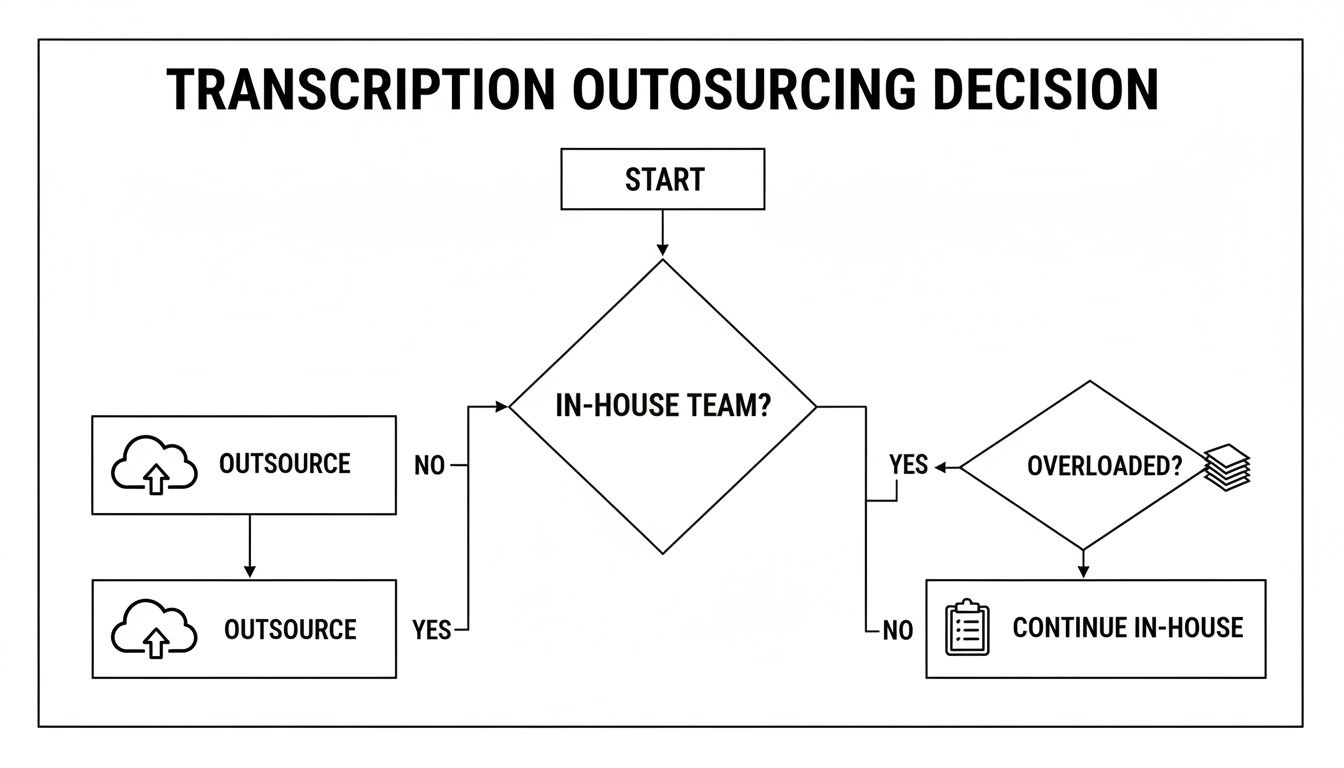
As you can see, outsourcing becomes the logical choice when you either don't have an in-house team or the one you have is buried in work.
Comparing Provider Models
To find the perfect fit, it helps to understand the different types of transcription services out there. Each one is built for a different set of priorities, from pure speed to absolute precision.
This table breaks down the most common models to help you see where your needs align.
| Provider Type | Best For | Typical Accuracy | Cost Structure | Security Level |
|---|---|---|---|---|
| Automated AI Services | Quick, low-stakes tasks with clear audio | 80-95% | Per-minute or subscription | Varies; often consumer-grade |
| Freelance Platforms | One-off projects; budget-sensitive tasks | 90-98% | Per-minute; bids | Depends heavily on the freelancer |
| Hybrid (AI + Human) | High accuracy on a budget; scalable projects | 98-99% | Per-minute; tiered pricing | High; often has compliance certs |
| Full-Service Agencies | Sensitive data; complex, high-volume work | 99%+ | Per-minute or project-based | Very High; enterprise-level |
Ultimately, choosing a provider is about balancing cost, speed, and security. A cheap, fast option might be great for meeting notes but a terrible idea for sensitive legal depositions.
Choosing the right partner isn't just about finding the lowest per-minute rate. It's about investing in a reliable extension of your own team that delivers consistent quality and protects your sensitive information.
If you want to see who's leading the pack, we've put together a detailed guide on the best audio transcription services available right now. Taking the time to evaluate these areas carefully will help you find a partner that truly supports your business goals.
Understanding Contracts and Service Level Agreements
Once you've done your due diligence on a vendor's expertise and security, the contract is where the rubber meets the road. This document, especially the Service Level Agreement (SLA) tucked inside, is your partnership’s rulebook. It’s what turns their sales pitch into concrete, measurable promises.
Don’t just glance over it. This is your chance to define exactly what success looks like on your terms.
A solid SLA should eliminate any guesswork. When you’re outsourcing transcription services, vague promises like "high quality" just won't cut it. Instead, your contract needs to pin down an exact accuracy guarantee—say, 99% or higher—and spell out precisely how that gets measured and verified.
Getting this granular from the start is the best way to prevent headaches and hold your partner accountable.
Defining Key Terms and Conditions
Beyond just accuracy, a comprehensive SLA needs to cover a few other critical areas to protect your interests and keep things running smoothly. Think of it as setting the ground rules before the game even starts.
Here are the key clauses I always tell people to look for:
- Turnaround Times: Be specific about deadlines. A one-hour, multi-speaker interview has a very different timeline than a quick 15-minute dictation, and your contract should reflect that.
- Data Handling Protocols: This part is non-negotiable. The contract must clearly state how your data is stored, who can access it, and the exact process for destroying it once the job is done.
- Pricing Structure: Is it per audio minute, per hour of labor, or a flat project fee? Get this in writing and be on the lookout for sneaky extra charges for things like poor audio quality or multiple speakers.
A well-defined contract is the bedrock of any good outsourcing relationship. It aligns everyone on quality, security, and delivery, stopping scope creep and arguments before they ever begin.
Remember, negotiating these points is a completely normal—and necessary—part of the process. If you want to dig deeper into building these kinds of strong relationships, take a look at our guide on effective vendor management strategies. A clear contract is the first step toward a transparent and successful partnership.
Building a Seamless Quality Assurance Workflow
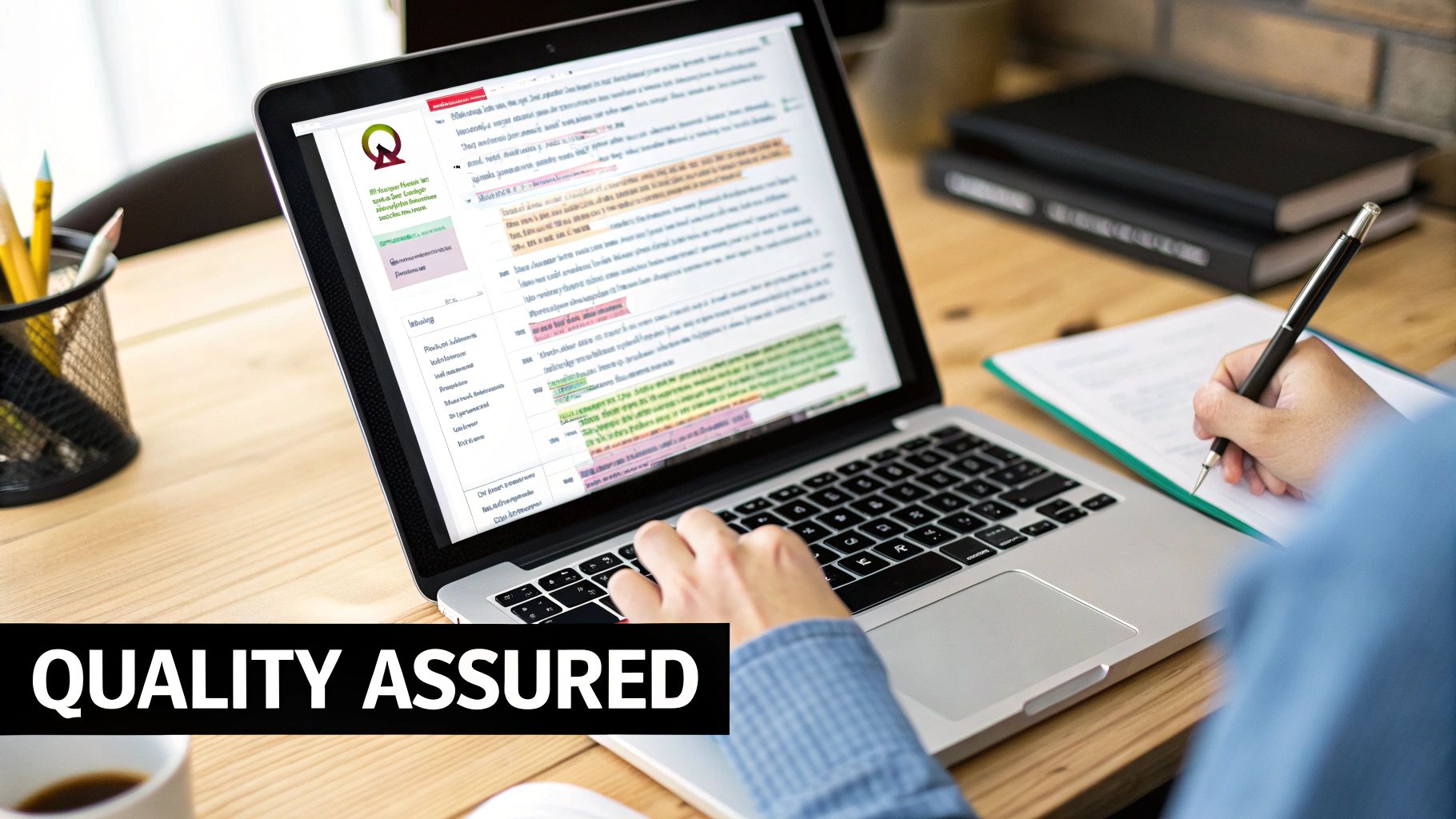
The whole reason you're outsourcing transcription services is to get high-quality transcripts without the in-house headache. But that quality doesn't just magically happen. It's the result of a solid, collaborative quality assurance (QA) workflow you build with your vendor.
This process is your safety net. It makes sure the final product is genuinely useful, whether you're submitting it as legal evidence or feeding it into a machine learning model. The cornerstone of this entire process? A rock-solid style guide.
Crafting a Comprehensive Style Guide
Think of a style guide as the single source of truth for your transcription projects. It’s not just a document you create once and forget about; it's a living guide that eliminates guesswork and sets crystal-clear expectations for your provider.
To head off inconsistencies before they start, your style guide needs to cover the nitty-gritty details.
- Formatting Rules: Get specific. How should timestamps look? What's the protocol for an inaudible section—
[inaudible 00:15:30]or something else? When should a new paragraph start? - Speaker Identification: Consistency is key for readability. Decide how speakers should be labeled. Is it by name (John Doe:), their role (Interviewer:), or a simple placeholder (Speaker 1:)?
- Terminology Glossary: This is non-negotiable for specialized fields. Create a go-to list of company acronyms, technical jargon, and product names that an outside transcriber wouldn't know.
A clear style guide is your first line of defense against errors. It empowers your vendor to deliver accurate transcripts from the start, minimizing the need for revisions and creating a more efficient partnership.
Nailing down this framework is fundamental. After all, quality is what drives cost efficiency. The best BPO providers can deliver up to 70% reductions in operational costs while maintaining over 99% accuracy rates. You can dig into more insights on the transcription industry from Reanin to see how the market is evolving.
Implementing Review and Feedback Loops
Your style guide lays down the law, but a good review process ensures those laws are being followed. The goal isn't to proofread every single transcript yourself—that would defeat the purpose of outsourcing. Instead, you need a system for spot-checking.
A practical approach is to review a random 5-10% sample of transcripts from each delivery. If you start noticing the same mistakes popping up, you can bump that percentage up temporarily until the issue is resolved.
For projects with zero margin for error, consider a two-tier system. This is where a second linguist at the vendor reviews the first transcriber's work, giving you an extra layer of confidence.
When you do find problems, your feedback needs to be specific and actionable. "This transcript is wrong" doesn't help anyone. Instead, point to the exact timestamp, explain the mistake, and tie it back to the style guide. This turns feedback into a coaching opportunity, helping your provider's team learn your preferences and get better with every project. Exploring different qualitative research transcription software options can also help streamline this review process.
Making Transcription Part of Your Everyday Workflow
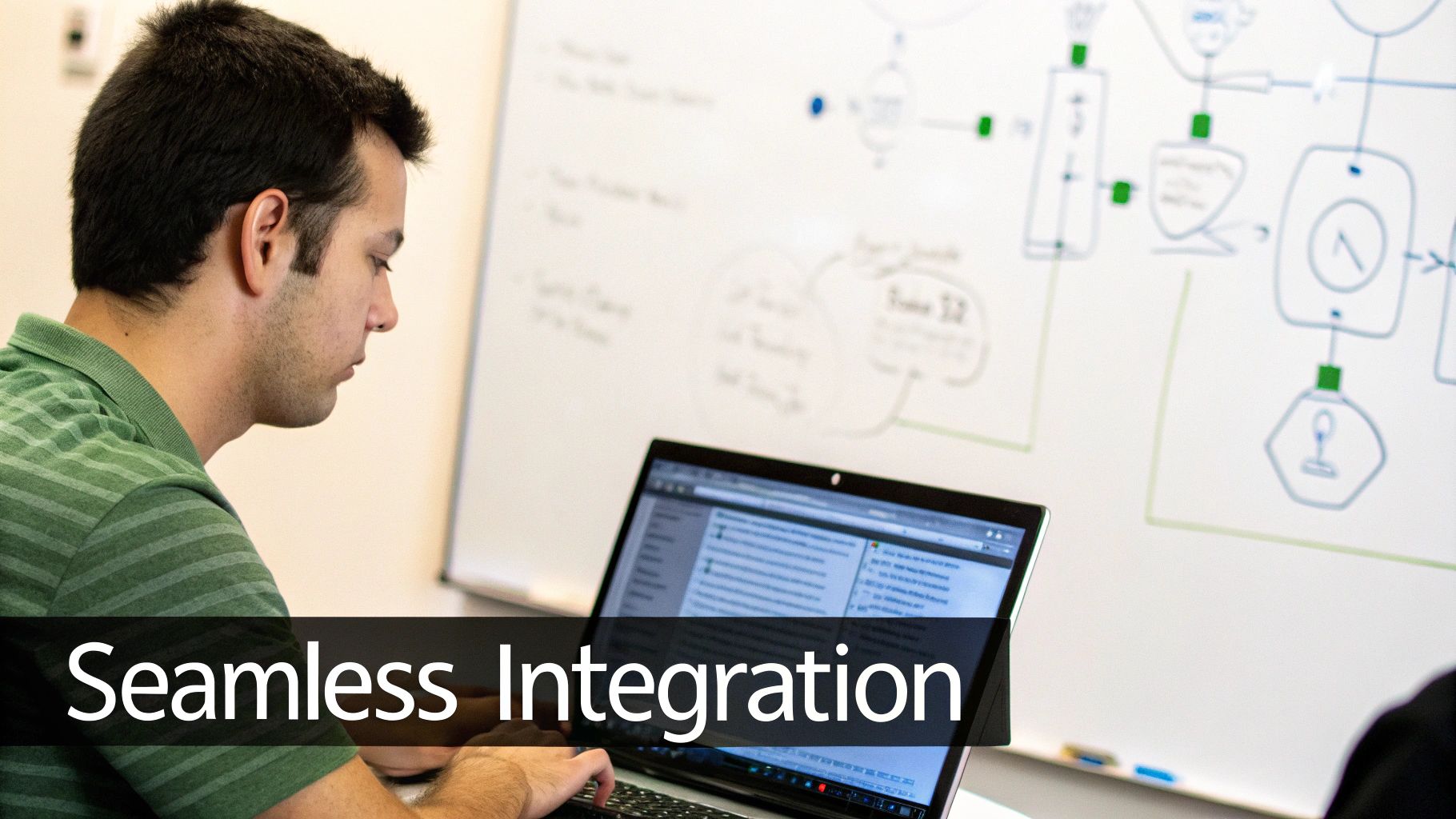
Alright, you've picked a great partner. Now, how do you make them feel like a true extension of your own team? This is where the real magic happens. Moving beyond a simple service-for-payment deal into a genuine partnership is what will truly boost your productivity. It’s all about creating a smooth, two-way street for both the technology and the people involved.
If you’re a tech company drowning in audio or video data, the technical side is non-negotiable. Look for a provider with a solid API (Application Programming Interface). This lets you build a secure, automated pipeline to send files directly from your systems, completely cutting out the tedious and risky process of manual uploads. Think of it as a dedicated highway for your sensitive research interviews or customer calls to travel safely and efficiently.
Set Up Clear Workflows and Communication Lines
Even the slickest tech is useless without good old-fashioned human communication. A successful partnership hinges on having crystal-clear communication channels and solid internal processes from day one.
The first thing I always recommend is to assign a single point of contact on your team. This person becomes the go-to for the vendor relationship—they'll manage file submissions, relay feedback, and handle any hiccups. It stops things from getting lost in the shuffle and ensures your transcription partner knows exactly who to call.
Next, you need to get your own team on board. A little bit of training on how to record good audio goes a long way. Here are a few simple rules of thumb:
- Kill the Background Noise: Make sure your team uses decent microphones and records in a quiet space whenever possible. A noisy café is a transcriber’s worst nightmare.
- Stop the Cross-Talk: Remind people to speak one at a time. When speakers overlap, it's nearly impossible to capture everything accurately.
- Give Them Some Context: A quick note with each file—mentioning the topic, industry jargon, or speaker names—can make a huge difference in the quality of the final transcript.
Think of integration like building a bridge. The stronger you make the technical and communication links between your team and your transcription provider, the faster and more reliably you'll get high-quality transcripts flowing back to support your real business goals.
Common Questions About Outsourcing Transcription
Even with a solid plan, a few questions always pop up when you're thinking about bringing on a transcription partner. Let's walk through the most common concerns I hear from businesses, so you can make your decision with total confidence. We'll get straight to the point on cost, security, and where AI fits into the picture.
How Much Can I Realistically Save?
The savings can be genuinely surprising—I've seen companies cut their transcription costs by up to 70% compared to keeping everything in-house. Think about it: an internal employee isn't just a salary. You're also paying for benefits, software licenses, equipment, and training.
Outsourcing completely changes that financial model. It takes a fixed overhead cost and turns it into a flexible, on-demand expense. You simply pay for the audio minutes you need transcribed, and that’s it. This is a game-changer for any business, but especially for those with project volumes that go up and down.
Is It Safe to Send Sensitive Audio Files?
Absolutely, as long as you do your homework and pick a partner who takes security seriously. Your number one job is to find a provider who is compliant with the regulations that matter to your industry, like HIPAA for healthcare or GDPR for general data privacy.
A vendor worth your trust will have a few non-negotiable security features in place:
- Encrypted File Transfers: Your data should be protected from the moment it leaves your system, usually via SFTP or a secure API.
- Strict Confidentiality Agreements: Everyone on their team who could possibly access your files must be under a rock-solid NDA.
- Transparent Security Credentials: They should be open and proud of their security measures, not cagey about them.
Will AI Replace Human Transcriptionists?
Not anytime soon, at least not for work that needs to be right. While AI is fantastic at creating a quick first draft, you still need a human expert to get you to that 99%+ accuracy mark.
AI can easily trip up on tricky audio—think heavy accents, people talking over each other, complex industry terms, or a recording with a lot of background noise.
The best services out there right now use a hybrid model. AI does the initial pass, and then a human professional comes in to review, edit, and perfect the transcript. They catch the nuance and context that machines miss.
This blended approach gives you the best of both worlds: the speed of automation and the precision that only a trained human ear can deliver. It’s the only way to ensure your final transcript is truly reliable.
At Zilo AI, we provide skilled professionals who deliver the high-quality, secure transcription your business needs to grow. Our experts are ready to handle your projects with the accuracy and confidentiality you demand. Learn how our manpower solutions can support your operations.