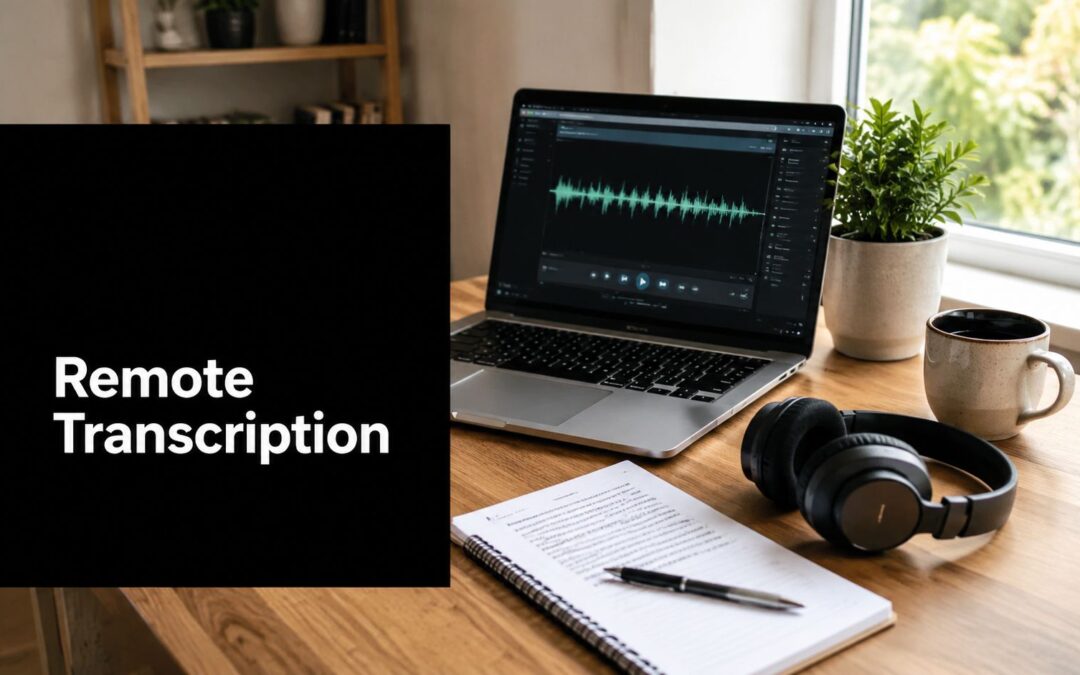
You're probably looking at remote transcription jobs for one of three reasons. You want flexible work, you need a legitimate work-from-home starting point, or you're trying to turn decent typing and listening skills into income without spending months chasing vague “online opportunities.” That's exactly where transcription fits. It's real work, but it's not easy money.
The people who last in this field usually get the basics right before they apply anywhere. Build typing speed to at least 65 WPM, but keep accuracy high. Clean grammar and punctuation matter just as much as speed because most platforms don't pay you for fixing preventable mistakes later. Your first gear purchases should be practical, not flashy: solid noise-canceling headphones and a quiet workspace where you can hear speaker changes, crosstalk, and muffled names without replaying the same clip ten times.
Remote transcription demand also isn't just generic typing anymore. Buyers often separate work by interviews, meetings, webinars, podcasts, captions, court proceedings, and healthcare documentation, and legal or medical queues usually require stronger domain knowledge and training, as noted by Remote.co's transcription hiring overview. If you also want a simple way to practice before applying, use a tool that can turn audio into text for free and compare the draft against your own cleanup work.
1. Rev

Rev Freelancers is one of the first names beginners find, and that's for good reason. The platform gives you a relatively clear on-ramp into transcription, captioning, legal work streams, and subtitle translation. It also helps that Rev has a recognizable brand, a guided application flow, and an in-browser editor that lowers the friction when you're still figuring out your workflow.
What makes Rev useful early on is file selection. If you're new, shorter clips are your friend because they let you learn speaker labeling, punctuation rhythm, and cleanup discipline without committing your whole afternoon to one rough recording.
Where Rev works best
Rev is strongest when you treat it as a training ground with real stakes. The style guides are usable, the interface is straightforward, and weekly PayPal payouts appeal to freelancers who don't want to wait around to validate whether the work is worth their time.
A practical upside is topic choice. Being able to gravitate toward cleaner interviews, meetings, or subject matter you already understand helps your accuracy and your sanity. If you plan to work with spoken research or client interviews long term, it also pairs well with learning how to transcribe interviews professionally.
Practical rule: On Rev, don't judge a file by its posted rate alone. Judge it by accent density, crosstalk, background noise, and how many names you'll have to verify.
The trade-off
The downside is the same one that catches almost every beginner. Pay is usually framed around audio length, not the actual time you'll spend untangling difficult audio. That means your effective hourly earnings can swing hard depending on file quality, your speed, and how much proofreading a file needs.
This isn't unique to Rev. It's common across transcription jobs remote, especially when platforms let workers self-select files. Good workers learn fast which jobs to leave alone.
2. TranscribeMe

TranscribeMe freelancer work is one of the better beginner platforms if you get overwhelmed by long files. Its micro-task model breaks work into smaller clips, which is much less punishing when you're still building confidence with accents, timestamps, and style consistency. For a lot of new transcribers, that format is the difference between quitting early and sticking with it long enough to improve.
The bigger draw is the upgrade path. TranscribeMe is known for tiered access, so general work can become a stepping stone into specialty teams if you qualify.
Why beginners often start here
Small chunks force repetition, and repetition sharpens your ears. You hear more speaker transitions, more false starts, more filler words, and more moments where you have to choose between verbatim and clean-read conventions. That's good training.
Published marketplace figures also show why expectations matter. TranscribeMe advertises standard work in the range of $15 to $22 per audio hour, with specialty teams rising to $60 to $70+ per audio hour, and average freelancer monthly earnings of $250. The important part isn't just the headline rate. It's the reminder that throughput decides whether a platform feels viable.
If you want to understand where buyers compare vendors and what separates commodity work from managed service work, it helps to review the range of audio transcription service options.
What doesn't work
TranscribeMe stops being attractive if you assume the base queue will carry your income on its own. For many freelancers, it won't. The platform makes more sense when you use it to build proof of competence, then test into better queues.
Don't confuse “easy to enter” with “easy to earn from.” Entry-level transcription often rewards consistency before it rewards speed.
3. GoTranscript

GoTranscript jobs stands out for freelancers who aren't limited to English-only work or U.S.-centric schedules. It has a long-standing reputation in multilingual transcription and translation, which makes it more relevant if you speak another language well enough to work professionally, not just conversationally.
That matters because remote transcription is shifting away from pure generic typing. Employers increasingly ask for multilingual ability, specialty knowledge, and live-format experience such as captioning, according to SpeakWrite's transcription jobs page. If you have bilingual ability, that's not a side note. It can become your main differentiator.
Best fit for multilingual freelancers
GoTranscript is a practical option when your advantage is language coverage rather than speed alone. Academic interviews, focus groups, business recordings, and multilingual media all create work that generic monolingual applicants can't touch. That opens a different lane than the usual race to claim the next clean English clip.
Its global contractor model also makes it friendlier for people working outside standard North American business hours. If you've struggled with platforms that seem built around one market, this one is worth testing.
- Good use case: Bilingual freelancers who can handle interviews, research recordings, or cross-border business content.
- Less ideal use case: Beginners who want fully transparent public pay information before investing time in the application.
The real trade-off
The missing piece is predictability. Public pay detail isn't as prominent as many applicants would like, so you may need to evaluate the platform by test experience, job flow, and how well available work matches your language pair or niche.
For agencies and clients, this is also a reminder that outsourcing multilingual work isn't the same as buying generic typing. Complex language projects usually need better reviewer matching, which is why many teams eventually outsource transcription services to providers that can staff by language and domain.
4. Allegis Transcription (a Veritext company)

Allegis Transcription application is where things start to feel more like a profession and less like an open gig marketplace. The company leans into insurance and legal workflows, and that changes the work in a good way for the right person. Expectations are stricter, but so are process standards.
That's usually a positive. New freelancers often underestimate how much easier transcription becomes when style rules are consistent and the client type is narrow enough that terminology starts repeating.
Why niche structure helps
Allegis is a solid fit if you want repeatable work instead of random subject matter every day. Insurance recordings, statements, and legal-adjacent material reward pattern recognition. After a while, you stop reinventing your process for every file.
Its onboarding is more structured than what you'll see on many open marketplaces. Paid quality-development files and community resources can make the early learning curve less chaotic, especially if you prefer guided improvement over trial by fire.
In legal and insurance transcription, the skill isn't just hearing words. It's formatting reliably under rules you don't get to improvise.
Where beginners get stuck
Eligibility is narrower. These roles are U.S.-focused, and equipment guidance can be more specific. Legal workflows may require a Windows PC, and some setups work better with a foot pedal than keyboard shortcuts alone.
That can feel restrictive, but in practice it filters for people who are serious enough to build a proper workstation. If your goal is higher-trust work, that's part of the game. General platforms let you start fast. Niche platforms expect you to show up ready.
5. Net Transcripts
Net Transcripts careers isn't a casual side-hustle platform. It serves law enforcement, public safety, and legal content, and that shows up immediately in the hiring requirements. If you want sensitive-domain work, this kind of operation is what the serious end of transcription looks like.
Some freelancers love that because the niche is clearer. Others bounce off the compliance burden.
Best for security-minded specialists
Net Transcripts makes sense for workers who are comfortable with screening, security protocols, and a slower onboarding process. The upside is that sensitive-domain work usually has a more defined purpose than broad marketplace queues. You know why the transcript matters, and clients tend to care about chain of custody, confidentiality, and procedural consistency.
That kind of environment suits detail-oriented people. If you're the type who likes documented process, secure systems, and fewer surprises, it can be a better fit than high-volume general transcription.
- Strong fit: U.S.-based applicants who can pass deep vetting and want specialized legal or public-safety work.
- Weak fit: Anyone who wants instant approval, international eligibility, or lightweight onboarding.
What to expect
The barrier is real. Background checks, identity verification, and compliance steps narrow the field fast. That doesn't make the platform better for everyone, but it does mean fewer casual applicants drifting in and out.
For remote transcription jobs, that's one of the clearest dividing lines in the market. Commodity work optimizes for access. Sensitive work optimizes for trust.
6. Speechpad

Speechpad worker portal sits in a useful middle ground. It's broad enough to offer general, legal, medical, and media transcription and captioning, but structured enough that you can see a path upward. That matters if you're trying to build a freelance system instead of chasing one-off gigs.
The platform's worker hub, foot-pedal support, and defined quality guidance make it friendlier to people who want to work efficiently. It also offers reviewer roles and access to higher-pay queues based on skill and performance, which is the right kind of incentive structure.
Why the advancement path matters
Speechpad is appealing if you're willing to earn trust before expecting better files. That's a normal progression in this field. Entry work proves you can follow rules. Better work arrives after you show consistency.
Published pay context from nearby remote transcription listings also helps frame expectations. Market examples include $19 to $38 per hour and $0.07 to $0.10 per line, while job pages often emphasize high accuracy standards and proofreading time that can shrink effective earnings. That's why reviewer access and cleaner queues matter so much. Better workflow often beats a better headline rate.
The catch
Speechpad isn't magic. Entry pay can feel modest, and the more attractive work is gated. If your ratings slip, your experience on the platform changes quickly.
The freelancers who do best on platforms like Speechpad protect their quality score first. Speed comes second.
7. Daily Transcription

Daily Transcription careers is a strong option for people who want a wider range of subject matter without jumping straight into a chaotic open marketplace. The company works across entertainment, corporate, academic, legal, and government material, and that variety can be useful if you're still discovering which audio types you handle best.
I like platforms like this for one reason. They expose you to enough real-world variation to teach you what kind of transcriber you are.
Where Daily Transcription helps most
Its onboarding materials are a practical advantage. Training videos, style guides, practice jobs, and defined contractor processes give newer workers a safer place to make early mistakes. That's valuable because beginners often fail from inconsistency, not lack of effort.
Daily Transcription also makes sense if you're curious about media files. Entertainment audio often trains your ear differently than corporate meetings do. It can sharpen your handling of overlapping speech, informal grammar, and speaker personality.
- Best for: Newer freelancers who want guidance and a mix of file types.
- Watch out for: Residency limitations for many English-language roles and project-based rate variability.
The limitation
This isn't the platform to choose if you only care about public rate transparency before applying. Some project details vary, and that can make it harder to predict fit upfront.
Still, for skill development, Daily Transcription has a lot going for it. A freelancer who learns corporate, academic, and media conventions becomes much more adaptable later, especially when moving into editing, QA, or annotation work.
Top 7 Remote Transcription Services Comparison
| Service | 🔄 Implementation complexity | ⚡ Resource requirements | ⭐️ Expected outcomes / 📊 Impact | Ideal use cases | 💡 Key advantages |
|---|---|---|---|---|---|
| Rev | Low, guided application and in-browser editor | Low, PC/browser, PayPal for payouts | ⭐⭐⭐, Variable hourly; high-volume when demand strong | General transcription, captioning, subtitle translation | Transparent per-minute rates; weekly PayPal; easy entry |
| TranscribeMe | Very low, micro-task queue, beginner-friendly | Low, any PC; asynchronous micro-clips | ⭐⭐, Modest average unless upgraded to specialties | Beginners, quick micro-tasks, path to specialty teams | Clear skill tiers and upgrade path to higher pay |
| GoTranscript | Moderate, multi-step QA and multilingual workflows | Medium, multilingual skills often beneficial | ⭐⭐⭐, Steady global demand across sectors 📊 | Bilinguals, research/media, non-US hour coverage | 140+ languages; human-only QA and 24/7 operations |
| Allegis Transcription (Veritext) | Moderate–High, structured legal/insurance processes | High, Windows recommended, foot pedal, US-based | ⭐⭐⭐, Niche repeatable work with firm style expectations | US legal and insurance transcription | Paid onboarding/coaching files; enterprise-grade workflows |
| Net Transcripts | High, stringent security, compliance, and vetting | High, national background checks, fingerprinting, E-Verify | ⭐⭐⭐, Predictable specialized contracts for vetted users | Law enforcement/public-safety and legal specialists (US) | Strong security posture and long-term enterprise relationships |
| Speechpad | Moderate, skill-gated queues and reviewer progression | Medium, worker hub, foot-pedal support, defined QA | ⭐⭐⭐, Steady general-market work; advancement to reviewer/rush | Career transcribers pursuing reviewer or rush roles | Transparent pay ranges; twice-weekly payouts; advancement paths |
| Daily Transcription | Low–Moderate, training plus project-based workflow | Medium, training materials, NDAs; residency limits for English roles | ⭐⭐⭐, Mix of steady corporate/academic and media jobs | Newer transcribers seeking training; media/corporate projects | Onboarding includes practice jobs, style guides, and training |
From Transcriber to Data Annotation Expert
Getting your first paid transcript done matters. It proves you can follow style rules, handle ambiguity, and deliver usable text from imperfect audio. But transcription becomes a much better career move when you stop treating it as the final destination.
The freelancers who earn more usually do one of two things. They specialize, or they move closer to data work. Specialization means legal, medical, multilingual, or live-captioning environments where terminology, confidentiality, and formatting carry more weight than raw typing speed. That shift is already visible in the market, where employers increasingly look for niche capabilities instead of generic keyboard speed alone.
There's also a practical income lesson beginners need early. Marketplace pricing for remote transcription can look decent at first glance, but it's a low-to-mid wage, high-volume labor market with a lot of variation by source and specialty. For example, ZipRecruiter reports an average hourly pay of $24.76 for remote transcription in New York City, while other platforms and postings frame pay by audio hour or specialty queue instead. That's why experienced freelancers watch effective earnings, not just posted rates.
The next step after transcription is often annotation. If you can identify speakers, clean noisy text, follow labeling rules, and work carefully with language data, you already have part of the foundation for voice annotation and related data-labeling work. AI teams need people who can do more than type. They need people who can interpret messy audio, flag ambiguity, normalize text, and maintain consistency across datasets.
That's where a transcription background becomes more valuable than many beginners realize. It teaches listening discipline, formatting precision, terminology research, and review habits that transfer well to AI workflows. If you want a broader remote-work path, a data entry job success guide also helps you think in terms of productivity systems, not just task completion.
Zilo AI is well positioned in that transition. The company supports businesses with text annotation, image annotation, voice annotation, translation, and transcription, which makes it a practical next stop for freelancers who want to move from entry-level audio work into higher-value language and AI-ready data projects. That shift won't happen overnight, but it's one of the clearest ways to future-proof the skills you build through transcription jobs remote.
If you're building a team that needs reliable transcription, multilingual support, or AI-ready annotation talent, Zilo AI is worth a serious look. Zilo AI helps companies scale with skilled professionals across transcription, translation, text annotation, image annotation, and voice annotation, making it a strong partner for startups, enterprise AI teams, research groups, and global operations that need dependable language-data workflows.