
Business services outsourcing is all about strategically handing off specific business operations to a specialized third-party provider. Think of it as hiring an expert crew to manage essential but non-core functions, freeing up your internal team to focus on what actually drives growth. It's a move that goes way beyond simple cost-cutting; it's a powerful tool for gaining agility and expertise.
What Is Business Services Outsourcing, Really?

Imagine your company is a championship sports team. Your star players—your core employees—are laser-focused on winning the game by developing products, closing sales, and delighting customers. Business services outsourcing is like bringing in the best specialized crew to manage the stadium, sell the tickets, and run the broadcast.
These external partners are pros in their specific fields, whether it's managing payroll, handling customer support calls, or annotating data for an AI model. When you entrust these tasks to them, you let your main players concentrate solely on their performance and strategy.
This model is more crucial now than ever before. Companies today face immense pressure to adapt quickly, innovate constantly, and operate with maximum efficiency. Trying to build every single capability in-house isn't just slow and expensive; it can be a major competitive disadvantage.
A Modern Strategy for Growth and Agility
The conversation around outsourcing has completely changed. It’s no longer viewed as just a cost-reduction tactic but as a strategic lever for agility and resilience. Modern challenges, from talent scarcity to the need to scale operations at a moment's notice, have made it a go-to solution for smart, forward-thinking companies.
The global business process outsourcing (BPO) market is proof of this trend, projected to hit around $348 billion in 2025. Fueling this boom, 63% of organizations increased their outsourcing budgets last year, with a major focus on gaining access to top talent. With a staggering 74% of employers struggling to find skilled workers, outsourcing provides a direct line to the expertise needed to thrive. You can explore the latest outsourcing statistics to see how smart delegation is fueling business growth.
By delegating non-core functions, you can:
- Innovate Faster: Your internal teams can pour their energy into research, development, and improving your core offerings without getting bogged down by administrative or repetitive tasks.
- Scale On Demand: Need to double your customer support capacity for the holiday rush? An outsourcing partner can provide trained agents almost overnight—a feat that would take months to pull off internally.
- Access Specialized Skills: Gaining access to experts in niche fields like AI data annotation or complex financial compliance becomes immediate, skipping the long and costly recruitment process.
The core idea of business services outsourcing is simple but powerful: focus your resources on what you do best and partner with experts for the rest. This isn't about giving up control; it's about gaining strategic capability.
Ultimately, outsourcing allows a business to operate with the muscle of a large corporation while keeping the agility of a startup. It’s about building a more flexible, resilient, and competitive organization from the ground up.
The Real Payoff of Strategic Outsourcing

When you hear "outsourcing," the first thing that probably comes to mind is cutting costs. And while that's certainly part of the picture, the true benefits run much, much deeper. Thinking of outsourcing as just a way to save a few bucks is like buying a smartphone only to use it as a calculator. You're missing out on the real power.
Smart outsourcing is about building a more resilient, efficient, and competitive company. It’s a strategic move that delivers value in a few key areas that all work together. Let’s break down what those advantages actually look like in the real world.
Unlocking Significant Cost Efficiencies
Let's start with the most obvious win: the impact on your bottom line. Bringing someone on board in-house means more than just their salary. You have to factor in recruitment fees, training time, benefits, equipment, office space, and all the other overhead that comes with an employee. It adds up fast.
An outsourcing partner has already shouldered these costs. They've got the trained people, the right technology, and the proven processes ready to go. This fundamentally changes your cost structure. Instead of a huge, fixed capital expense, you get a predictable, variable operating cost. You only pay for what you need, when you need it.
That kind of financial predictability is a game-changer. It makes budgeting more accurate and, more importantly, frees up capital that would otherwise be locked into payroll and overhead. You can then pour that money back into what really drives growth—like product development, marketing campaigns, or expanding your sales team.
Gaining Access to a Global Talent Pool
Let's be honest: the absolute best person for a specific job probably doesn't live within a 20-mile radius of your office. For specialized skills—think AI data annotation, complex software development, or multilingual customer support—finding local talent can be a slow, expensive, and often frustrating search.
Business services outsourcing tears down those geographic walls. Instantly, you have access to a global network of professionals who are already masters of their craft.
The modern approach to outsourcing isn't just about finding cheaper labor anymore. It's about finding the best labor for the job, wherever they happen to be. This shift from a cost-first to a talent-first mindset is what separates a decent outsourcing arrangement from a truly great strategic partnership.
Think about a tech startup building a machine learning model. They need thousands of images annotated accurately. Instead of spending months and a small fortune hiring and training a local team, they can partner with a firm like Zilo. Within days, they can have an expert team working on their project, which drastically speeds up their time to market and improves the final product.
Achieving Unprecedented Operational Flexibility
Markets change. Customer demand spikes. A new project pops up that requires a totally different skill set. These shifts can put an enormous strain on a fixed, in-house team. Traditional hiring and firing is just too slow and rigid to keep up with the pace of modern business.
This is where outsourcing provides the agility you need to thrive. It gives your operations a kind of elasticity, allowing you to scale your team up or down almost immediately without the headache of recruitment or layoffs. That flexibility is a powerful competitive advantage.
- Handle Seasonal Peaks: A retailer can easily double its customer support team for the holiday rush and then scale right back down in January.
- Support New Launches: A software company can bring on a dedicated team of QA testers for a three-month product launch without taking on permanent staff.
- Adapt to Market Shifts: If your business focus pivots, you can quickly adjust your outsourced services to align with the new priorities.
The choice between building an in-house team and engaging an outsourced partner often comes down to a trade-off between control and flexibility. This table highlights the key operational and financial differences.
In-House Operations vs. Outsourced Services: A Strategic Comparison
| Factor | In-House Team | Outsourced Partner |
|---|---|---|
| Hiring Time | Weeks or Months | Days |
| Cost Structure | High Fixed Costs | Predictable Variable Costs |
| Scalability | Rigid and Slow | Flexible and On-Demand |
| Expertise | Limited to Local Talent | Access to Global Specialists |
| Management | Direct Overhead | Partner Manages Team |
As you can see, the outsourced model is built for speed and adaptability, transforming fixed overhead into a flexible resource that you can dial up or down as your business needs dictate.
Common Business Services You Can Outsource

So, you’ve decided that business services outsourcing makes sense. That’s a huge step. But the next question is usually the most practical one: where do you even begin? The sheer number of options can feel a bit overwhelming, but the truth is, most outsourced work falls into a few key categories.
Think of it like walking into a massive library. You don't just start wandering aimlessly; you head to a specific section—fiction, history, science. We can do the same thing with outsourcing to pinpoint the best opportunities for your company.
Information Technology Services
When people think of outsourcing, IT is often the first thing that comes to mind, and for good reason. It’s a complex, technical field that changes constantly, and having real expertise isn't just a nice-to-have, it's a necessity. For a lot of businesses, building and maintaining a full-blown, in-house IT department just isn't realistic or cost-effective.
IT outsourcing can be as broad as managing your entire digital backbone or as specific as handling a single project.
- Managed IT Services: This is where you hand over the day-to-day grind of managing your network, servers, and cybersecurity to a dedicated expert team.
- Software Development: Need a custom mobile app or enterprise-grade software? You can tap into world-class development teams without hiring them directly.
- Help Desk Support: This provides your employees with a go-to resource for everything from password resets to software glitches.
The impact here is massive. A staggering 76% of businesses already outsource at least some of their IT functions. The global IT outsourcing market is on track to hit $290.30 billion by 2029, largely fueled by the demand for cloud computing and AI. This is part of a larger trend, with the entire outsourcing market projected to grow from $302.62 billion in 2024 to $525.23 billion by 2030. Why? Because companies are prioritizing access to talent (42%) and the need to meet customer demands (35%). You can dig into more of the numbers with these outsourcing statistics and trends.
Finance and Accounting
Financial tasks are all about precision and following the rules—making them perfect for outsourcing. When you hand these functions over to specialists, you not only ensure accuracy and compliance but also free up your own leadership to focus on big-picture financial strategy instead of getting bogged down in the daily numbers.
Some of the most commonly outsourced financial jobs include:
- Bookkeeping and Payroll: This covers managing daily transactions, processing salaries, and making sure all tax obligations are met.
- Accounts Payable/Receivable: A partner can handle paying your vendors and, just as importantly, chasing down payments from your clients.
- Financial Reporting: Getting clear, professional monthly or quarterly statements that show you exactly how the business is performing.
Human Resources and Customer Support
Functions that are all about people—like HR and customer support—are the lifeblood of your business, but they can eat up an incredible amount of resources. Outsourcing these areas lets you deliver top-notch service without pulling focus from what your business actually does.
For HR, this usually means offloading administrative work like benefits management, payroll (a common overlap with finance), and the initial screening of job candidates. This frees up your internal HR team to concentrate on the stuff that really matters, like building a great company culture and developing your people.
Customer support is another perfect candidate for outsourcing. A specialized partner can provide:
- 24/7 Call Center Support: This ensures your customers can get help whenever they need it, not just during your business hours.
- Email and Chat Support: An efficient way to manage all the digital conversations with your customers.
- Technical Support: Having experts on hand to help customers with tricky, product-specific problems.
By outsourcing customer support, you gain the ability to scale your team instantly to handle seasonal peaks or product launches, ensuring a consistently high level of service without the long-term overhead.
Specialized Data Services for AI and Machine Learning
A whole new world of outsourcing has opened up around data services, especially for companies diving into AI and machine learning. High-quality, well-organized data is the fuel that makes these advanced systems work, and preparing that data is a huge undertaking.
These are incredibly precise, large-scale tasks that are tough to manage in-house.
- Text Annotation: This involves labeling text to train natural language processing (NLP) models, which power things like sentiment analysis tools and chatbots.
- Image Classification and Annotation: This is how you teach a computer to "see." It involves tagging objects in images or videos so AI models can learn to identify them correctly.
- Audio Transcription: Converting speech from audio files into text. This is the first step in training voice assistants and other speech-recognition software.
These specialized data services are fundamental to modern innovation. For companies in this space, partnering with a provider like Zilo gives them access to skilled professionals for a variety of business outsourcing services and can dramatically speed up the development of powerful AI tools.
How to Choose the Right Outsourcing Partner
Picking the right partner is the single most important decision you'll make when outsourcing business services. It's the difference between finding a seamless extension of your team and getting stuck in a frustrating, costly mess. Forget the generic advice—let's walk through a real-world process for vetting potential partners to find one that truly gets your goals.
A great partnership isn’t just about a contract. It’s about building trust and making sure you’re on the same page, creating a relationship that helps both of you succeed. That means you have to look past the price tag and really dig into what makes a provider reliable, secure, and ready to grow with you.
Vet for Deep Technical Expertise
First thing's first: you have to confirm that a potential partner has genuine, proven expertise in the specific area you need help with. Don't settle for a jack-of-all-trades; you need a specialist. If you're outsourcing data annotation for a new AI model, for instance, they better have a deep understanding of your industry's specific data requirements and quality standards.
Ask them for detailed case studies. Better yet, ask for references from companies with needs just like yours. A top-tier provider will be proud to show off their successes and connect you with happy clients. This isn't just about checking a box; it's about verifying their claims and making sure their past performance is a good predictor of future results.
Prioritize Robust Data Security Protocols
When you outsource, you're handing over sensitive company and customer data to a third party. A data breach from a vendor can be absolutely catastrophic for your reputation and your bottom line. Because of this, security can't be an afterthought—it has to be a non-negotiable from day one.
Get specific and ask about their security certifications and compliance standards.
- Key Certifications: Look for recognized credentials like ISO 27001 or SOC 2 compliance. These prove a commitment to serious security controls.
- Data Handling Policies: Ask how they manage data access, encryption, and employee training on security best practices.
- Incident Response Plan: Any mature partner will have a clearly documented plan for exactly how they would handle a security breach.
This visual breaks down the key evaluation steps, starting with expertise and security.
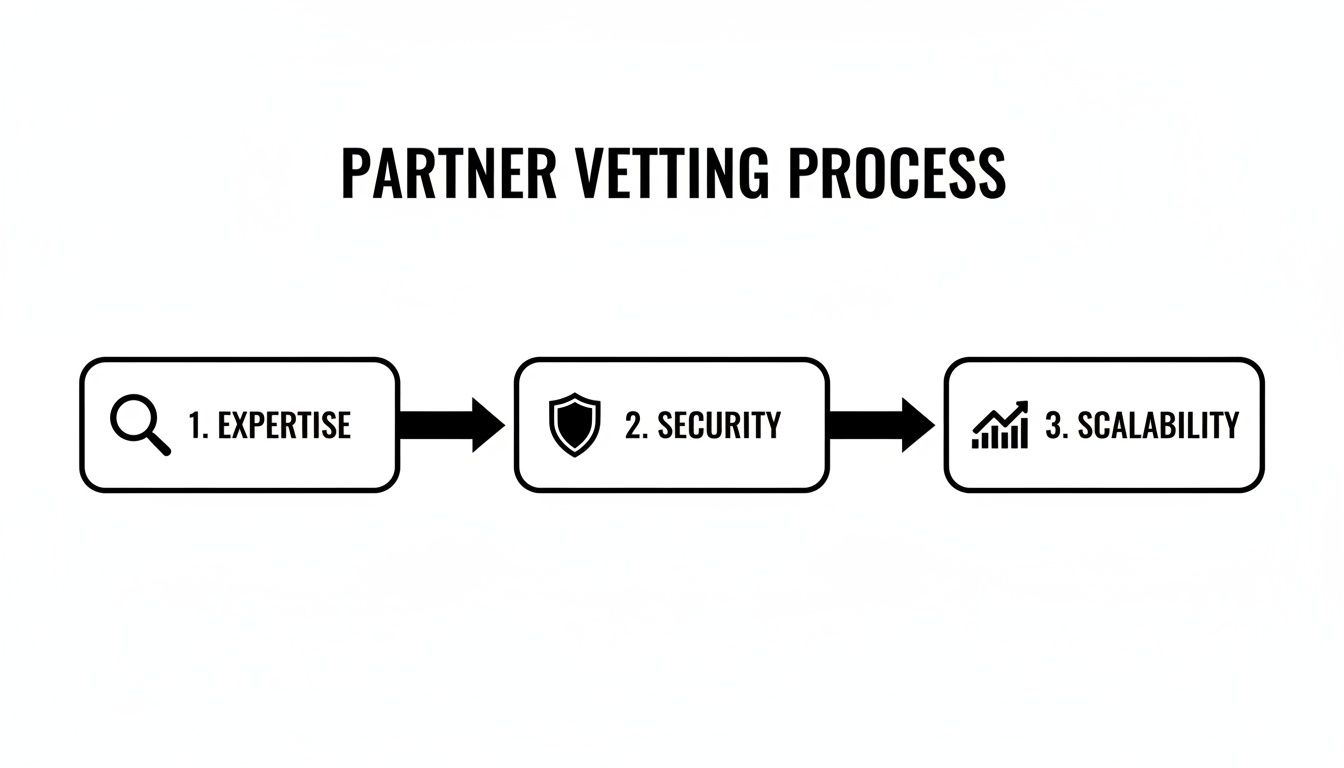
As the flowchart shows, after you've confirmed their expertise and security chops, the next crucial step is ensuring they can scale with your future needs.
Ensure Proven Scalability and Flexibility
Your business isn't static, and your needs will change. A partner that seems perfect today could become a bottleneck tomorrow if they can't scale alongside you. The ideal provider gives you the flexibility to ramp services up or down based on your demand, project timelines, and what's happening in the market. This kind of agility is one of the biggest perks of outsourcing.
Talk to them about their process for scaling teams. How quickly can they add trained people to your account? What does their internal training and onboarding look like? This is especially critical for functions like customer support or recruitment process outsourcing, where demand can swing wildly. You can dive deeper into the specifics in our guide to recruitment process outsourcing.
The move toward outsourcing is only getting bigger, making this decision more important than ever. The sales and marketing BPO market is on track to hit $57.46 billion by 2030, and finding the right partner is your ticket to tapping into that global talent. North America currently leads the pack with 42% of global spending, but the Asia-Pacific region is catching up fast with a 9% CAGR. This trend shows just how much outsourcing helps companies stay nimble—in fact, 33% of firms use a global delivery model for better performance.
Finally, insist on a transparent and straightforward pricing model. Hidden fees and complicated contracts just create friction and mistrust. Look for a partner who offers clear, predictable pricing that matches the value they deliver. This ensures you can budget effectively and avoid any nasty surprises down the road.
Your Step-by-Step Implementation Roadmap
Jumping into a business services outsourcing project without a solid plan is a lot like setting sail without a map. You might eventually hit land, but it probably won’t be where you intended to go. A well-thought-out, structured process isn't just a nice-to-have; it's essential for success.
This five-step roadmap will guide you from the initial idea to building a thriving, long-term partnership. It’s about more than just signing a contract. It's a strategic sequence designed to perfectly align your business needs with a partner’s capabilities. By following these steps, you sidestep common risks, set crystal-clear expectations, and build a foundation for a relationship that delivers real value from day one.
Let’s break down each phase of the journey.
Step 1: Define Your Scope and Objectives
Before you even start Googling potential partners, you need to look inward. What, exactly, are you trying to accomplish? Vague goals like "improve efficiency" or "cut costs" are just starting points. You need to get specific and define the Key Performance Indicators (KPIs) that will tell you what success actually looks like.
Are you aiming to slash customer support ticket resolution time by 25%? Or maybe your goal is to boost the accuracy of your annotated data to 99.5%? These clearly defined objectives become your North Star, guiding every decision and giving you a concrete way to measure the final outcome.
A well-defined scope is your best defense against "scope creep"—that quiet, sneaky expansion of a project that can obliterate budgets and timelines. Be ruthless about clarity: what tasks are being outsourced, and what stays in-house?
It’s also smart to start small. Instead of trying to offload an entire department at once, begin with a manageable pilot project. This gives you a low-risk way to test the partnership, iron out any communication wrinkles, and prove the value of outsourcing to your internal team before going all-in.
Step 2: Research and Shortlist Potential Partners
With your objectives locked in, it’s time to find the right partner. This research phase is critical, so don't rush it. Cast a wide net at first. Dig into industry reviews, case studies, and client testimonials to build a long list of candidates who specialize in the services you need.
Once you have that list, you can start to narrow it down. Vet each company against the criteria you’ve already established—their technical chops, security protocols, and ability to scale with you. Request proposals and schedule initial calls to get a real feel for their company culture and how they communicate. This is your chance to ask the tough questions and see how they handle the pressure.
Step 3: Create a Robust Service Level Agreement (SLA)
The Service Level Agreement, or SLA, is the single most important document in your outsourcing relationship. It's the contract that turns your goals into legally binding commitments. A vague SLA is a recipe for disaster, but a strong one creates clarity and accountability for everyone involved.
Your SLA needs to be incredibly specific. It should clearly outline:
- Specific Services Provided: A detailed breakdown of every single task and deliverable the partner is responsible for.
- Performance Metrics (KPIs): The exact numbers that will measure success, like response times, quality scores, or uptime percentages.
- Reporting and Communication: How often you'll get performance reports, what format they'll be in, and the agreed-upon channels for day-to-day communication.
- Consequences and Remedies: Clear terms for what happens if performance standards aren't met, including any remedies or penalties.
Step 4: Manage a Seamless Transition and Onboarding
With a strong SLA signed, the focus shifts to making it all happen. The transition phase is where the plan meets reality. A smooth handover requires tight collaboration between your team and your new partner. Map out a detailed transition plan that covers every step, from transferring knowledge to granting system access.
Great onboarding is what gets your outsourced team productive, fast. Make sure they get thorough training on your brand voice, internal processes, and any specific software they'll be using. Communication is everything during this stage. You need to catch small issues before they snowball. To make these relationships even stronger, you can explore different vendor management strategies that build a spirit of collaboration and mutual success.
Step 5: Monitor Performance and Foster Partnership
Outsourcing is never a "set it and forget it" deal. This final step is really a continuous loop: monitor, give feedback, and work together to improve. Use the KPIs from your SLA to track performance objectively. Hold regular review meetings to have honest conversations about what’s working and what could be better.
The real magic happens when you stop thinking of your provider as just a vendor and start treating them like a strategic partner. When they win, you win. Foster an open and transparent relationship, share your bigger company goals, and treat them as a true extension of your own team. This is how you transform a simple transaction into a powerful partnership that drives real, sustained growth.
What's Next for Business Services Outsourcing?
The days of outsourcing being just about cutting costs or offloading simple tasks are long gone. We're now seeing a major shift in what it means to bring in an outside partner. The future isn’t about finding cheaper labor; it’s about plugging into a global ecosystem of advanced technology and specialized talent to make your own team stronger.
Leading this evolution are Artificial Intelligence (AI) and automation. These aren't just buzzwords; they're fundamentally changing which tasks get outsourced and how that work is performed. Think about all the repetitive, by-the-book processes in your business—AI is taking those over, freeing up human minds for work that requires real strategy, creativity, and nuance.
For example, an AI-powered chatbot can handle hundreds of basic customer questions at once, 24/7. This doesn't replace your support team. Instead, it lets your human experts focus their energy on solving the tricky, high-stakes problems that actually build customer loyalty.
A New Focus on Expert Knowledge
With automation handling the grunt work, the real value in outsourcing is now in accessing highly specialized, knowledge-based skills. Businesses are moving past simply outsourcing payroll and are now looking for partners to tackle incredibly complex challenges that demand deep expertise.
This new wave of outsourcing looks a lot different. We're talking about:
- Advanced Data Analytics: Bringing in a team of data scientists to uncover market trends that your in-house team might miss.
- AI Development: Partnering with specialists who can train and validate the complex machine learning models that power modern business.
- Niche Compliance: Hiring experts who live and breathe the dense regulatory landscapes of industries like healthcare or finance.
The future of outsourcing is less about offloading work and more about onloading expertise. It’s a strategic decision to tap into world-class talent that would be too difficult or expensive to develop internally.
The Rise of Integrated Hybrid Teams
Finally, get rid of the old image of an outsourcing provider as a separate, siloed entity. That model is quickly becoming a relic. The most successful partnerships today look more like truly integrated hybrid teams, where your people and the external team work as one cohesive unit.
Using shared tools like Slack or Asana, these blended teams collaborate in real-time on shared goals. This approach gives you the best of both worlds: the deep institutional knowledge of your internal staff combined with the fresh perspectives and specialized skills of your outsourcing partner.
Companies that get this integrated approach to business services outsourcing right will find themselves way ahead of the competition. They'll be more agile, more innovative, and ready to tackle whatever challenges come their way.
Got Questions? We've Got Answers
Even with the best plan in hand, you're bound to have a few questions about business services outsourcing. It’s a big step. Let's tackle some of the most common ones that come up.
"Isn't Outsourcing Just for Big Corporations?"
That’s a common misconception, but the answer is a firm no. While giant companies have been outsourcing for decades, it’s now one of the most powerful tools for startups and small to medium-sized businesses (SMBs).
Think of it this way: outsourcing gives you access to the kind of talent, technology, and expertise that used to be reserved for the big players, all without the staggering upfront cost. It’s a fantastic way to level the playing field and scale your operations quickly and affordably, letting you punch well above your weight.
"How Do I Keep Quality from Slipping?"
Quality control isn't something you bolt on at the end; it has to be baked into the process from the very beginning. It all starts with choosing the right partner and then cementing that relationship with a rock-solid Service Level Agreement (SLA).
Your SLA is more than just a document—it's your quality guarantee. It needs to spell out your Key Performance Indicators (KPIs), define what "good" looks like with clear benchmarks, and establish a non-negotiable reporting schedule. Open, honest, and regular communication is what keeps everyone pulling in the same direction.
"What Are the Real Risks Involved?"
It's smart to be cautious. The biggest worries usually revolve around data security, poor communication leading to misunderstandings, and a feeling that you're losing control over a part of your business. The good news is, you can get ahead of these issues with some smart planning.
Here’s a simple framework to protect your business:
- Make Security a Deal-Breaker: Only work with partners who can prove their security chops with certifications like ISO 27001 or SOC 2.
- Set Communication Rules Early: From day one, establish a clear rhythm for check-ins, updates, and feedback. This prevents small issues from becoming big problems.
- Test the Waters with a Pilot: Don't jump into the deep end. Start with a smaller, non-critical project to see how you work together. It’s the perfect way to test the relationship before you commit to outsourcing core functions.
Taking these steps doesn't just reduce risk; it builds the trust and understanding needed for a great long-term partnership.
Ready to unlock your business's full potential with expert support? Zilo AI connects you with highly skilled professionals and provides the AI-ready data services you need to grow. Discover how our manpower and data annotation solutions can drive your success.