LiDAR annotation isn't interchangeable across providers. A vendor that handles simple 3D cuboids may struggle with synchronized camera, radar, and LiDAR streams, while a strong editor may still leave your team without the workforce, review layers, or delivery controls needed for production. The decision depends on point-cloud density, sensor fusion, ontology complexity, frame continuity, QA design, security requirements, and deployment constraints.
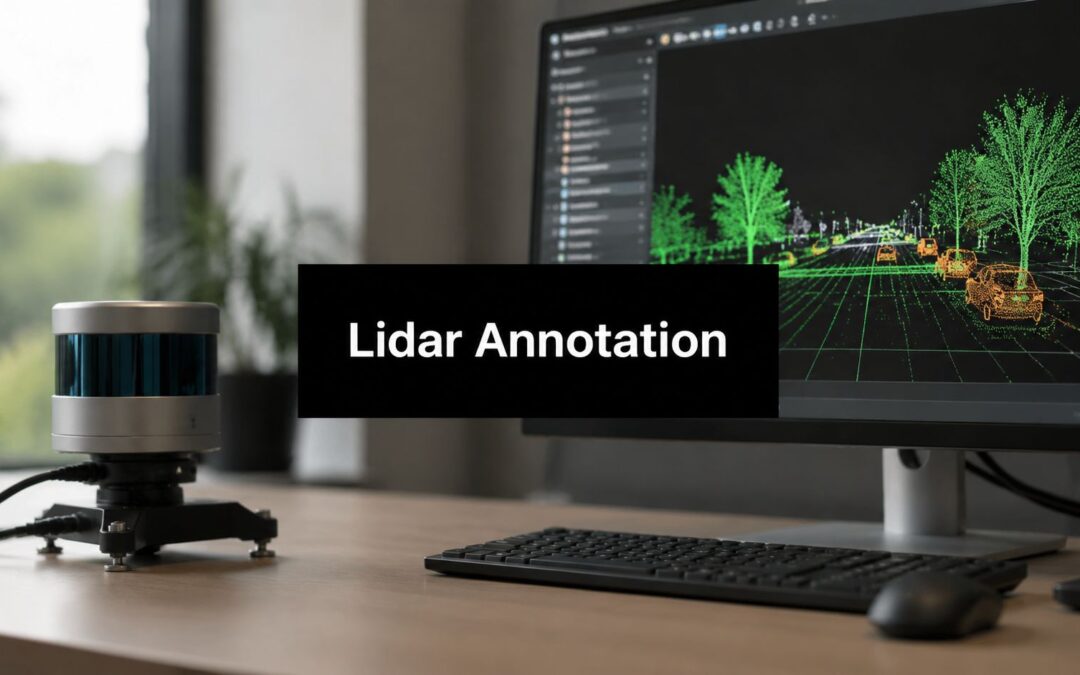
In practical terms, LiDAR annotation services convert raw spatial sensor data into structured labels that machine-learning systems can use. Those labels may include 3D bounding boxes, semantic or instance segmentation, lane markings, attributes, object identities across frames, and links between camera imagery and point clouds. The work supports autonomous driving, ADAS, robotics, mapping, drones, infrastructure inspection, and other 3D perception programs.
The list below separates platform capability from managed-service capacity. It compares whether each provider supplies software, labor, or both, then examines sensor-fusion support, tool ownership, quality controls, workforce scalability, secure delivery, and commercial transparency. Buyers should also validate fundamentals such as coordinate handling, occlusion rules, interpolation, export formats, and review procedures before treating a demonstration as evidence of production readiness. For practical guidance on preparing point-cloud workflows, see these point-cloud annotation tips.
1. Deepen AI
Deepen AI is a strong candidate for teams that treat LiDAR labeling as part of a broader safety-critical perception pipeline, rather than as an isolated annotation task. Its offering combines 3D point-cloud annotation, multi-sensor fusion, sensor calibration, quality assurance, and dataset or version management. That combination matters when the labels must remain consistent across different sensors, frames, and model iterations.
The platform is purpose-built for 3D workflows instead of adapting a conventional 2D interface to point clouds. Teams can use its production-oriented LiDAR and fusion editor, while calibration services address the alignment problems that can undermine otherwise accurate labels. Role-based QA and dataset management also give engineering and program leads a way to separate production work from review and release decisions.
Where the operating model fits
Deepen AI offers both tool access and a managed-service route. Buyers can therefore retain more ownership of annotation operations, outsource execution, or combine internal reviewers with an external workforce. Availability through the AWS Marketplace may also simplify an existing cloud procurement path, although marketplace availability alone doesn't answer questions about data residency, support, or contractual accountability.
The provider's focus on ADAS, autonomous systems, and robotics is an advantage for mobility teams with demanding sensor and safety requirements. It may be less convenient for organizations seeking a general-purpose annotation service for unrelated computer-vision tasks. Buyers evaluating 3D LiDAR point-cloud workflows should ask how calibration outputs, ontology changes, and annotation versions move through the release process.
Practical rule: Don't evaluate the editor separately from calibration and QA. A technically capable labeling interface can't compensate for misaligned sensor streams or unclear review ownership.
Pricing is custom, with no public rate card identified in the brief. Request a pilot that includes sparse points, occlusion, multi-sensor alignment, and temporal continuity, then require the proposal to distinguish software fees, managed labor, calibration, QA, and rework.

2. Sama
Sama fits enterprises that need a managed annotation program with governance around it, not just access to a labeling canvas. Its services cover 3D LiDAR, video fusion, tracking, and object attributes, while its human-in-the-loop model connects production labeling with review and analytics. That closed-loop structure is useful when teams need to identify recurring errors and refine instructions rather than accept a one-time delivery.
The provider also offers Sama Go for lighter workloads, giving smaller projects a self-service route alongside its larger managed programs. That creates an important procurement distinction. A buyer can test an ontology or run a limited internal workflow without immediately committing every task to a fully managed engagement, although the commercial fit still needs to be confirmed for the actual workload.
Governance is part of the product
Sama's enterprise orientation is reflected in its documented processes, security posture, and experience across autonomous vehicles, robotics, and regulated industries. Those strengths matter when procurement requires evidence of access controls, workforce governance, auditability, and escalation procedures. They don't automatically prove that a specific LiDAR project will meet its acceptance criteria, so buyers should request sample QA reports and a description of how disagreements are resolved.
The service is likely to suit mid-sized and large programs better than occasional labeling work. Pricing is custom, and a buyer should ask whether the quote assumes a particular volume, review depth, or minimum engagement. The vendor's prior public controversy concerning annotator wages may also become relevant during ESG or responsible-sourcing review. That isn't an annotation defect, but it can affect vendor approval.
Sama is most compelling when a company values process maturity and workforce management as much as editor features. It may be less attractive to a small team that wants a transparent, self-directed workflow with minimal procurement overhead.

3. iMerit
iMerit is built around a large managed workforce and subject-matter expertise across autonomous vehicles, geospatial projects, and industrial robotics. Its 3D offering includes cuboids, segmentation, 2D and 3D linking, and multi-frame tracking. That breadth makes it relevant when a program needs more than object detection labels, particularly when camera, LiDAR, and radar data must follow documented cross-sensor rules.
The provider uses the Ango Hub point-cloud editor and describes secure delivery options for regulated data. The important distinction is that iMerit combines a proprietary tool with a service operation. Customers seeking only an independent annotation platform may find the model less flexible than a tool-first vendor, while customers needing execution, supervision, and specialist review may value the integration.
Scale needs operating discipline
iMerit's plan notes identify a workforce of 5,500+ full-time employees, a quantitative claim supplied in the brief and linked to the iMerit website. Workforce size can support continuity and capacity, but it isn't a substitute for project-specific evidence. Ask how many people will work on your ontology, who owns instruction updates, how senior reviewers are assigned, and how the vendor prevents label drift when teams expand.
The provider's process documentation and integration options are useful for enterprises that need to connect annotation with existing data pipelines. Its coverage beyond automotive can also help organizations running several 3D programs under one supplier relationship. On the other hand, pricing is available by request, minimums may apply, and tool access is primarily connected to service contracts.
For procurement, iMerit should be tested on handoff quality. Provide a representative sequence, require the vendor to preserve object IDs across frames, and ask for an export that your training or evaluation pipeline can validate without manual reconstruction.

4. Scale AI
Scale AI is a logical option for teams that put API integration, workflow automation, and throughput ahead of white-glove consulting. Its managed labeling operation supports 3D sensor-fusion tasks such as LiDAR cuboids, tracking, and attributes. Policy and ontology controls help formalize what annotators should label, while analytics and human review connect production work to quality monitoring.
The strongest fit is a data-engineering organization that wants annotation embedded in an existing pipeline. API-driven workflows can reduce manual transfers between storage, task creation, review, and delivery. That advantage becomes more meaningful when the buyer has internal engineers who can own integrations and build validation around the exported labels.
Automation doesn't remove specification work
Scale AI's experience with large computer-vision programs supports high-volume operations, but buyers shouldn't treat scale as proof that a vendor understands every domain-specific edge case. A driving dataset with rare objects, unusual sensor placement, or strict tracking rules still needs a precise ontology and clear adjudication process. The customer must define what counts as a defect, not ask for “high quality.”
The platform's enterprise orientation means pricing isn't publicly listed and is likely to require a formal commercial discussion. Compared with boutique firms, the service may offer less hands-on domain consulting. That can be acceptable for a mature autonomy team, but it creates more internal work for organizations that haven't stabilized their annotation policy.
Teams considering data annotation service providers should compare the operational boundary carefully. Does Scale AI provide only the workforce and infrastructure, or will it help interpret ambiguous labels, revise the ontology, and investigate systematic errors?
The fastest workflow is still expensive if it produces labels your engineers must repeatedly repair.
5. TELUS International AI Data Solutions
TELUS International AI Data Solutions, including the Playment heritage, offers a broad combination of 3D annotation, platform capabilities, consulting, data collection, and evaluation. Its LiDAR workflows cover point-cloud labeling, 2D to 3D linking, tracking, bird's-eye-view work, and segmentation. That range suits enterprises that want one supplier to support multiple stages of a data program rather than contract separately for collection, labeling, and evaluation.
The platform's documentation and API or format guidance can help technical teams plan ingestion and export. Enterprise security, global delivery, and secure engagement options address procurement concerns that are often absent from product demonstrations. Buyers should still confirm the exact hosting model, workforce location, access controls, retention policy, and incident process for their dataset.
Broad coverage creates a buying question
TELUS can be attractive to a large program that needs enterprise SLAs and adjacent services. The trade-off is that the product naming can be confusing because references may distinguish TELUS Digital, TELUS International, and Playment-era capabilities. Procurement should identify the exact contracting entity, platform, service team, and support obligations before approval.
Pricing is handled through an RFP or quote and may favor larger programs. Request a line-item proposal that separates data collection, annotation, QA, evaluation, consulting, platform access, and any integration work. Otherwise, a broad end-to-end quote can make it difficult to compare TELUS with a focused workforce provider.
The provider is a better fit when scope breadth reduces vendor management. If the project only needs a controlled LiDAR editor and a small internal team, its broader service structure may introduce more commercial and operational complexity than necessary.

6. CloudFactory
CloudFactory is primarily a managed workforce and program-management choice. It provides teams experienced in 3D LiDAR scene labeling and tracking, and it can operate inside a client's existing tools or selected partner platforms. That flexibility changes the buying decision. Instead of replacing the customer's annotation environment, CloudFactory can supply the people, supervision, and operational routines needed to run it.
This model works well for organizations that already have a preferred 3D editor, storage architecture, and export process. It also avoids forcing engineers to migrate projects just to gain workforce capacity. The cost is that the customer remains responsible for the underlying tool's limitations, licensing, uptime, and feature roadmap.
Workforce-first versus platform-first
CloudFactory's strengths are program management, workforce stability, and iterative instruction refinement. Those qualities matter when early deliveries reveal ambiguous rules and the team needs to revise guidance without losing operational continuity. They also help when internal staff want to retain technical ownership while outsourcing repetitive production work.
The provider doesn't present a native best-in-class 3D editor as its central differentiator. Buyers therefore need to test the complete combination of client tool plus CloudFactory workforce, not CloudFactory in isolation. A pilot should measure how quickly annotators learn the interface, how supervisors record disagreements, and whether the chosen platform supports the required fusion and tracking operations.
Pricing is proposal-based and may require commitments that support team stability. That can be sensible for a continuing program, but it may be less suitable for an unpredictable research workload. Ask how paused volumes, changed priorities, and urgent batches affect staffing and commercial terms.
7. Appen
Appen brings a long-standing managed labeling operation, a global talent pool, and platform tooling to 3D LiDAR and sensor-fusion projects. Its stated workflows include semantic segmentation, 3D cuboids, co-annotation across LiDAR, camera, and radar, and tracking. That makes it relevant for programs that need several annotation modalities under one operational structure.
The provider's extensive guidance and workflow documentation can reduce the burden of translating an internal perception policy into production instructions. Its broad workforce coverage may also help with multilingual or geographically distributed programs. However, workforce breadth doesn't eliminate the need for a carefully controlled specialist group. LiDAR quality depends on spatial reasoning, sensor context, and consistent interpretation of ambiguous scenes.
Expect a program, not an instant task
Appen's program complexity can create a longer onboarding process than a narrowly scoped tool or small specialist team. That isn't negative. A complex program often needs data intake, taxonomy design, training, qualification, production, review, and reporting. The procurement question is whether the onboarding effort produces reusable operating knowledge or just delays the first useful delivery.
Pricing is quote-based, and the cost can vary with QA depth. Ask the vendor to price multiple review configurations rather than presenting one blended figure. A low apparent rate may reflect lighter review, while a higher rate may include adjudication, specialist checks, or more detailed reporting.
Appen is a reasonable contender when an enterprise values global delivery and broad process coverage. It deserves closer scrutiny when the project is small, technically unusual, or dependent on rapid changes to a narrow ontology. In those cases, insist on a named escalation path and a change-control procedure before production begins.

8. SuperAnnotate Managed Services
SuperAnnotate offers a full-stack model that combines a native point-cloud and LiDAR editor with pipelines, automations, and an optional managed-services team. It suits organizations that want to keep internal annotators involved while using an external team for overflow, specialized tasks, or complete project execution.
The unified model can reduce vendor sprawl. A customer doesn't necessarily need one company for software and another for labor, and internal reviewers can work in the same environment as the managed team. The platform also presents on-premises and secure data-handling options, which should be verified against the buyer's actual deployment and compliance requirements rather than assumed from a product page.
Shared ownership needs clear boundaries
Co-labeling is valuable only when responsibility is explicit. Define who owns ontology edits, who approves new edge-case rules, who can reopen completed tasks, and which party maintains the final export. Without those boundaries, a unified platform can conceal rather than solve process ambiguity.
SuperAnnotate's service capacity may fluctuate with demand for its platform, according to the supplied evaluation notes. Pricing also varies by seat count and service scope. Buyers should request a capacity plan that identifies the dedicated team, expected availability, backup coverage, and treatment of urgent work.
For teams researching computer-vision annotation tools, SuperAnnotate deserves consideration when tool ownership and managed labor must coexist. It may be less suitable for a buyer that wants a completely independent workforce operating in an established third-party editor.
9. understand.ai
understand.ai, a dSPACE company, is aimed primarily at automotive perception teams that need ground-truth production with strict technical specifications. Its services cover 3D point clouds, tracking, and sensor fusion, including complex multi-LiDAR configurations. ML-assisted workflows can help generate starting labels, while human review, data-quality assessments, and process consulting address consistency and specification control.
The provider's automotive specialization is its central differentiator. OEMs and Tier-1 suppliers often need labels that follow detailed definitions for attributes, object states, sensor relationships, and temporal continuity. A vendor that understands those requirements can contribute more than labor, particularly when a dataset needs an audit before model evaluation or release.
Best for demanding mobility programs
understand.ai emphasizes consistency and quality assessment rather than general-purpose annotation breadth. That makes it less natural for unrelated computer-vision projects, but potentially valuable for programs where a small semantic error can invalidate an evaluation set. Buyers should ask how ML-assisted suggestions are reviewed, how difficult fusion cases are escalated, and whether quality audits produce actionable defect categories.
Its European base may add procurement steps for organizations restricted to US-only vendors or specific data-residency arrangements. That issue should be resolved early, alongside questions about subcontractors, hosting, retention, and access from outside the approved region.
The provider's commercial model is not publicly priced in the brief. A useful evaluation should include multi-LiDAR alignment, long-tail objects, partial occlusion, and sequence-level tracking. A polished sample of isolated cuboids won't demonstrate the automotive-grade consistency that this type of engagement requires.

10. Shaip
Shaip offers an end-to-end data-services model covering LiDAR and 3D point-cloud annotation, sensor fusion, data collection, licensing, and quality assurance. That breadth can help robotics, autonomous-vehicle, and embodied or physical-AI teams that don't yet have all the source data they need. Instead of coordinating separate contracts for collection and labeling, a buyer can explore whether one provider can manage the full supply chain.
Its global collector and annotator network supports a range of data programs, while secure workflows are relevant for sensitive operational environments. The important question is whether the provider's capabilities match the project's technical specification. “End to end” can mean different things across vendors, so the RFP should identify the exact sensor types, collection conditions, label primitives, formats, and review outputs.
Useful for emerging data programs
Shaip is particularly relevant when the challenge begins before annotation. A team may need new scenes, licensed datasets, or targeted collection for rare environments, then require those assets to be labeled and evaluated. Combining those steps can simplify accountability, but it can also make price comparisons harder if collection, licensing, annotation, and QA appear as one bundled service.
Public pricing isn't listed, and quotes depend on scope. The provider also publishes less technical documentation than tool-first competitors, so buyers should compensate with a detailed pilot and written acceptance criteria. Require examples of annotation schemas, escalation records, secure delivery procedures, and change-order treatment.
Shaip is a sensible candidate when data acquisition and labeling belong in the same procurement package. A mature team with its own sensor archive and established tooling may prefer a narrower annotation partner with more transparent technical documentation.

Top 10 LiDAR Annotation Services Comparison
| Provider | Core capabilities | Quality & Reliability (★/🏆) | Unique selling points (✨) | Target audience (👥) | Pricing / Value (💰) |
|---|---|---|---|---|---|
| Deepen AI | Production-proven 3D LiDAR & multi-sensor fusion; calibration, dataset/version management | ★★★★★ 🏆 | ✨ Purpose-built 3D editor + integrated sensor calibration | 👥 OEMs, ADAS, robotics, safety-critical programs | 💰 Custom pricing; enterprise-focused |
| Sama | 3D LiDAR + video fusion, tracking, closed-loop QA; Sama Go self-service | ★★★★ 🏆 | ✨ Lifecycle QA + self-service option for lighter workloads | 👥 Enterprise AV, regulated industries, large programs | 💰 Custom; favors mid→large volumes |
| iMerit | 2D/3D linking, segmentation, multi-frame tracking; Ango Hub tooling | ★★★★ 🏆 | ✨ Large managed SME workforce & secure delivery options | 👥 AV, geospatial, industrial robotics | 💰 Quote-based; minimums may apply |
| Scale AI | 3D sensor-fusion labeling, API-driven pipelines, automation & analytics | ★★★★★ 🏆 | ✨ Strong developer tooling + automation at scale | 👥 High-throughput ML teams, platform-first orgs | 💰 Enterprise-oriented; quote |
| TELUS Intl (Playment) | 3D point-cloud, 2D–3D linking, BEV/segmentation, consulting & global delivery | ★★★★ 🏆 | ✨ Playment heritage + enterprise SLAs & consulting | 👥 Global enterprises, regulated programs | 💰 RFP/quote; favors larger engagements |
| CloudFactory | Managed annotation workforce, PM, iterative instruction refinement; plugs into client tools | ★★★★ | ✨ Flexible engagement (use-your-tools or theirs) | 👥 Teams needing program mgmt & stable workforce | 💰 Proposal-based; team stability commitments |
| Appen | LiDAR semantic segmentation, 3D cuboids, co-annotation across sensors | ★★★★ | ✨ Very large multilingual talent pool & broad coverage | 👥 Global ML programs needing scale & languages | 💰 Quote-based; varies with QA depth |
| SuperAnnotate (Managed) | Native point-cloud/LiDAR editor + pipelines, automations + managed services | ★★★★ | ✨ Unified tool + optional managed team; co-labeling support | 👥 Teams wanting all-in-one tool + outsourced ops | 💰 Tiered (seats + services); variable |
| understand.ai (dSPACE) | Automotive-grade 2D/3D fusion, ML-assisted workflows, data-quality audits | ★★★★★ 🏆 | ✨ ML-assisted fusion + strict data-quality audits | 👥 OEMs, Tier‑1 suppliers, automotive perception teams | 💰 Quote-based; EU procurement norms |
| Shaip | LiDAR/3D annotation + data collection, licensing & multi-tier QA | ★★★★ | ✨ End-to-end data supply + labeling under one contract | 👥 Embodied-AI, startups & teams needing bundled data | 💰 Scope-dependent quotes |
Turn Vendor Quotes Into a Controlled Data Program
A vendor comparison should end with a controlled pilot, not a winner chosen from a feature list. Start by defining the ontology, annotation modality, coordinate conventions, and output format before requesting quotes. State whether the project needs 3D cuboids, semantic segmentation, instance segmentation, lane markings, drivable areas, keypoints, tracking, or links between camera, radar, and LiDAR. A provider can't price or staff the work accurately when “LiDAR annotation” describes only a sensor rather than a label specification.
Prepare representative samples that include the conditions most likely to expose workflow weaknesses. Include sparse and dense point clouds, occlusion, rare classes, difficult lighting, sensor movement, and sequences where object identity must persist across frames. If calibration matters, provide the relevant sensor relationships and ask the vendor to demonstrate alignment, coordinate transformation, and the handling of calibration changes. Public benchmarks illustrate why this matters. nuScenes contains 1,000 scenes with 6 cameras, 5 radars, and 1 lidar, with 3D boxes for 23 classes and 8 attributes, while SemanticKITTI contains over 43,000 complete LiDAR sweeps with point-wise semantic and instance labels, as documented in this nuScenes dataset overview. These datasets are useful reminders that production annotation involves synchronization, taxonomy detail, and temporal or point-wise consistency, not just box placement.
Ask every provider to separate tool ownership from workforce ownership. A platform-first quote should identify licenses, seats, storage, APIs, automation, support, deployment, and export obligations. A workforce-first quote should identify the editor being used, who maintains it, how annotators are trained, and what happens if that tool changes. An end-to-end quote should itemize collection, licensing, calibration, annotation, QA, evaluation, and delivery rather than hiding them inside one blended rate.
Build the SLA around defects and release decisions
Your SLA should define what “accepted” means. Specify the required output schema, file formats, coordinate system, object-ID rules, occlusion treatment, attribute vocabulary, version identifiers, and metadata. Define review layers, sampling or inspection procedures, adjudication ownership, and the evidence delivered with each batch. Avoid unsupported promises such as “high accuracy.” Write measurable acceptance tests that your team can run against the export.
The commercial comparison should include more than throughput. Ask vendors to state their assumptions about rework, rejected tasks, difficult scenes, instruction updates, and QA depth. Confirm turnaround expectations for normal and urgent batches, the process for pausing work, and whether unused capacity or minimum commitments remain payable. Pricing for these providers is commonly custom or quote-based, so a line-item response is essential for a meaningful comparison.
Security and compliance belong in the initial procurement package. The supplied market guidance identifies ISO 27001, TISAX, SOC 2 Type 2, GDPR, and CCPA as certifications or frameworks enterprise buyers increasingly evaluate, as described in this LiDAR platform comparison. Treat that list as a starting point, not an automatic approval. Ask where data is stored, who can access it, whether subcontractors participate, how credentials are managed, how incidents are reported, and whether on-premises or hybrid deployment is available.
Choose the provider model deliberately
A tool-first provider fits a team with internal annotators, engineering ownership, and a need to retain control over workflows. It can offer flexibility and repeatability, but the buyer must supply labor, supervision, QA design, and operational support.
A workforce-first provider fits a company that already has a suitable editor or platform but lacks reliable production capacity. This model can accelerate execution without forcing a tool migration, although tool limitations and integration responsibilities remain with the buyer.
An end-to-end provider fits a program that needs several services, such as data collection, calibration, annotation, evaluation, and secure delivery. It can simplify vendor management, but bundled scope can obscure cost drivers and make technical accountability harder to assign.
Zilo AI is another relevant option for enterprises that may need LiDAR-related 3D labeling alongside broader image, text, voice, translation, or transcription annotation support. Its stated image annotation coverage includes 2D and 3D bounding boxes, polygons, polylines, landmarks, and semantic segmentation for use cases including LiDAR and geospatial imagery. Evaluate it with the same sample-based SLA process, especially if a multimodal program could benefit from one broader manpower and annotation partner.
Select the provider only after the pilot proves that labels are consistent, exports are usable, review defects are traceable, and security terms match the deployment environment. Then make the SLA enforce those conditions across every batch, ontology revision, and delivery.
Zilo AI provides image annotation with 2D and 3D labels, plus text, voice, translation, and transcription services for broader AI data programs. If your LiDAR workflow also needs multimodal annotation capacity, visit Zilo AI to discuss a defined pilot and delivery requirements.